



Mesoscale Convective Characteristics of Developing and Non-developing Tropical Disturbances over the Western North Pacific
-
摘要: 本文利用多源卫星遥感观测数据,对西北太平洋区域发展为热带气旋(TC)的热带扰动的对流特征进行统计分析,并对比了其与未能发展扰动之间的差异。基于ERA5再分析资料,采用涡度质心定义扰动系统的中心位置,进行热带扰动的示踪,识别出充足的发展型扰动(Developing Disturbance, Dev)和非发展型扰动(Nondeveloping Disturbance, NonDev)轨迹样本。首先对比了两类扰动的大尺度环境特征,发现它们在初期阶段(-48 h之前)的动力环境特征比较相似,主要在相对湿度等热力因子特征上存在差异。本文侧重对比分析了两类扰动在初期阶段的对流特征。结果表明,相比于NonDev,Dev中的对流不但发生频率更高且分布更广泛。在相对于环境垂直风切变方向的空间分布上,Dev在顺切变区域中具有更高的冷云发生频率,在逆切变区域中具有更高的暖云发生频率;同时,Dev内部逆切变区域中的强对流面积覆盖率比NonDev更高。基于星载降水雷达数据分析显示,Dev在顺切变区域上的层状性降水面积占比更高;从-72~-24 h时段,内部逆切变区域的中等至深对流的24 h平均潜热加热率强度的增幅比内部顺切变区域更大。这些结果进一步揭示了可能与TC形成有关的对流特征。Abstract: This study investigates the convective characteristics associated with tropical cyclogenesis in the Western North Pacific (WNP) using multi-source satellite datasets. The differences between developing (Dev) and non-developing (NonDev) tropical disturbances are analyzed. Based on the ECMWF ERA5 reanalysis data, disturbance centers were identified via the vorticity centroid and the positions of those tropical disturbance traced for the June to November period spanning 2000-2018, yielding sufficient samples for both Dev and NonDev groups. Analysis of the characteristics of large-scale environment reveals that while dynamic parameters are similar between the two groups in the early stage (prior to-48 h), evident disparities exist in thermodynamic variables, in particular relative humidity. Focusing on disturbances under comparable dynamic conditions, their convective characteristics were compared. The results indicate that Dev disturbances exhibit more widespread spatial distributions and higher temporal frequencies of convective activity than NonDev disturbances. Spatially, relative to the environmental vertical wind shear vector, Dev cases show a higher frequency of cold cloud coverage in the downshear quadrant and warm cloud coverage in the upshear quadrant. Furthermore, the Dev disturbances possess a larger fractional coverage of strong convection in the inner upshear region. Spaceborne precipitation radar observations show a higher proportion of stratiform precipitation area in Dev disturbances. Diagnostically, from-72 h to-48 h, the 24-hour average latent heating rate from moderate to deep convection increases more significantly in the inner upshear region than that in inner downshear region. Subsequently (from-48 h to-24 h), and the differential in average latent heating rate from-48 h to-24 h between inner and outer regions is more pronounced in the upshear region than that in downshear region. These findings further reveal the distinct convective characteristics and heating profiles that facilitate TC genesis.
-

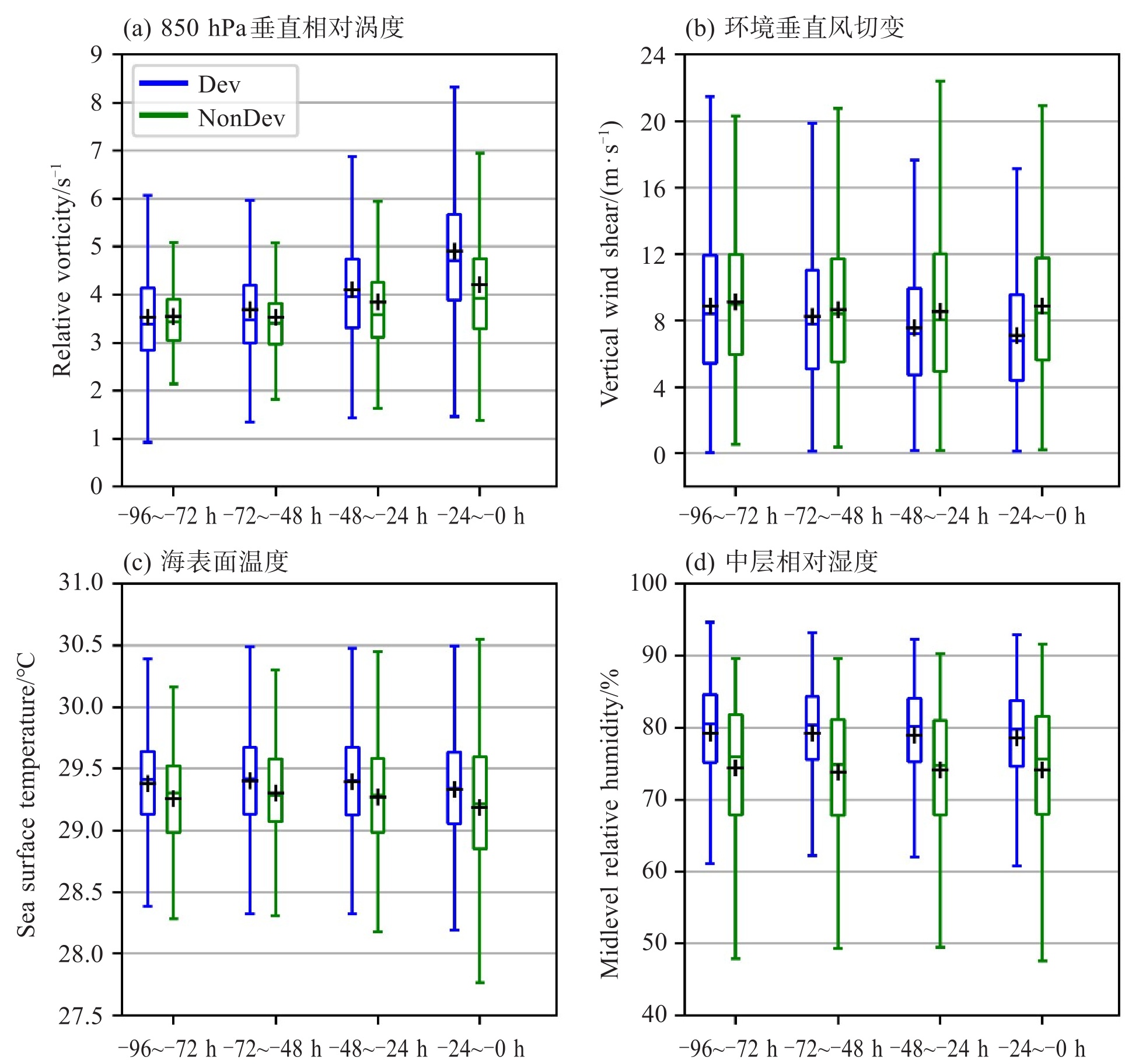
图 2 Dev(蓝色)与NonDev(绿色)在850 hPa平均相对涡度(a),200~800 km内200 hPa与850 hPa之间的环境垂直风切变(b),海表面温度(c)和700~500 hPa平均相对湿度(d)大小的分布

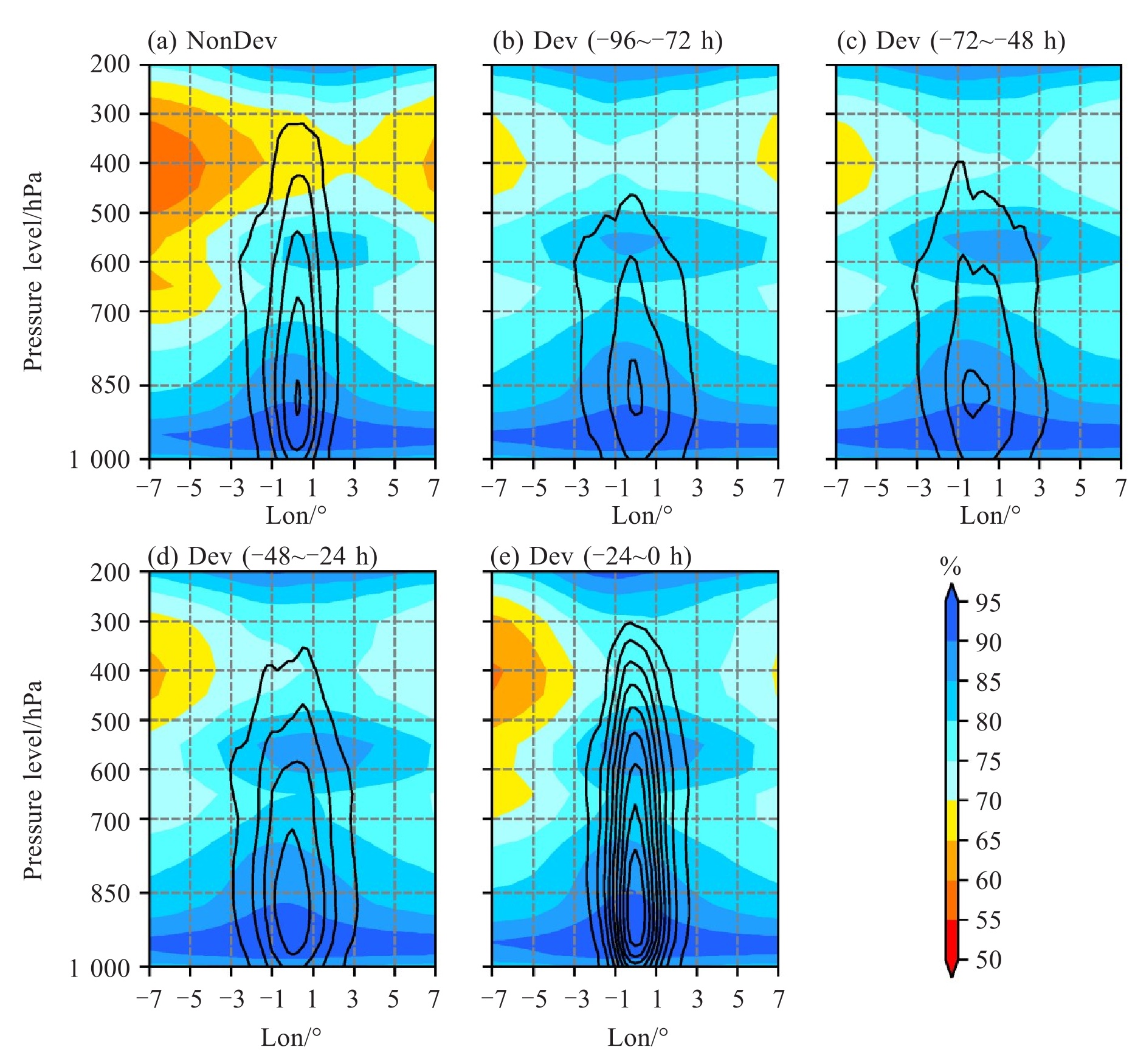
图 3 NonDev(a)以及Dev在-96~-72 h(b)、-72~-48 h(c)、-48~-24 h(d)、-24~0 h(e)合成的OW参数值(等值线,从0开始,逐1 × 10⁻⁹ s-2增加)以及相对湿度大小(填色;单位:%)的垂直经向剖面合成图(纬向上2 °范围内的平均结果)

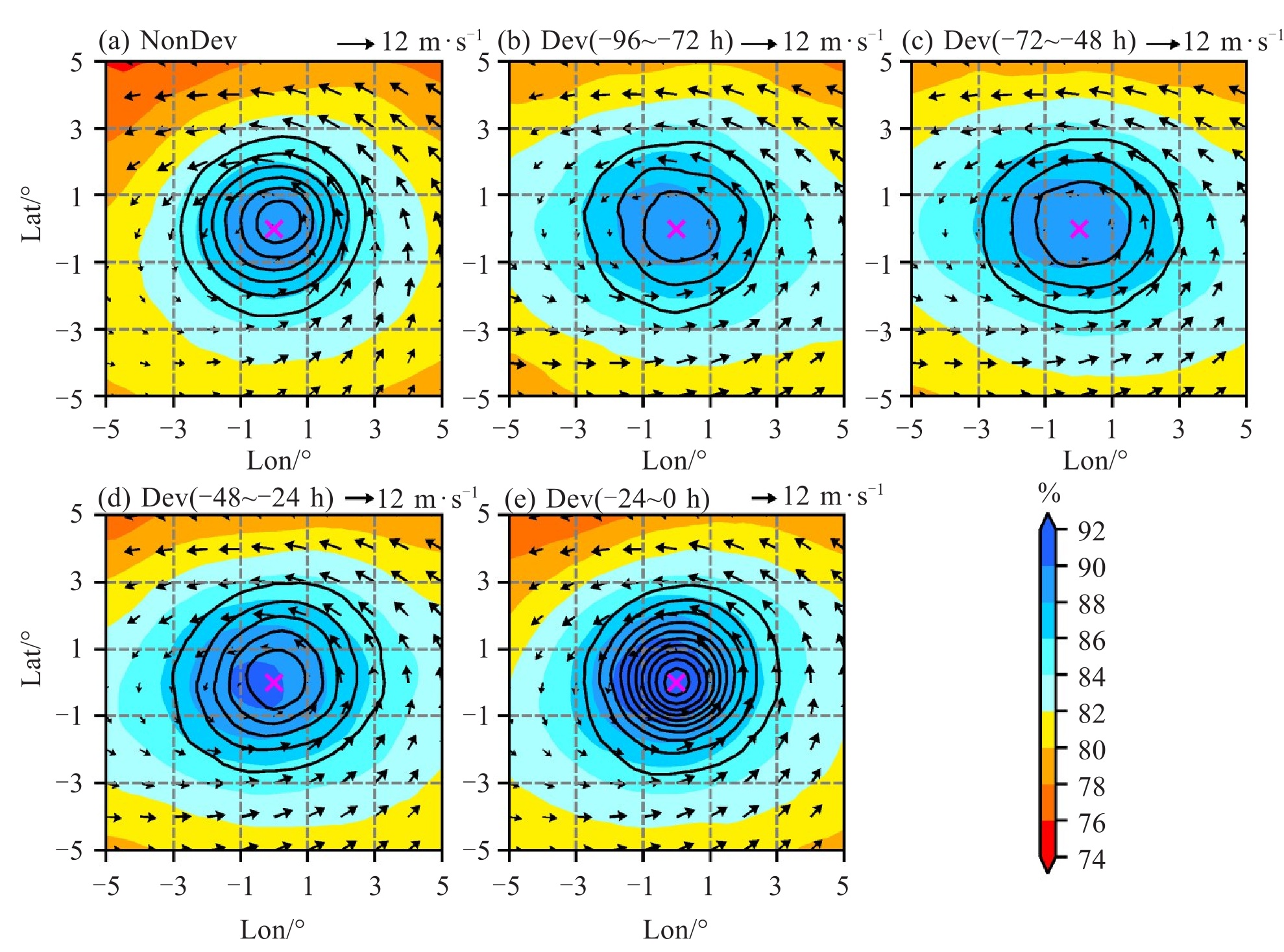
图 4 NonDev(a)以及Dev在-96~-72 h(b)、-72~-48 h(c)、-48~-24 h(d)、-24~0 h(e)合成的850~700 hPa平均OWZ参数值(等值线,从2 × 10⁻⁵ s-1开始,逐1 × 10⁻⁵ s-1增加)、850 hPa水平风场(箭头;单位:m·s-1)以及800 hPa相对湿度(填色;单位:%)的合成水平分布

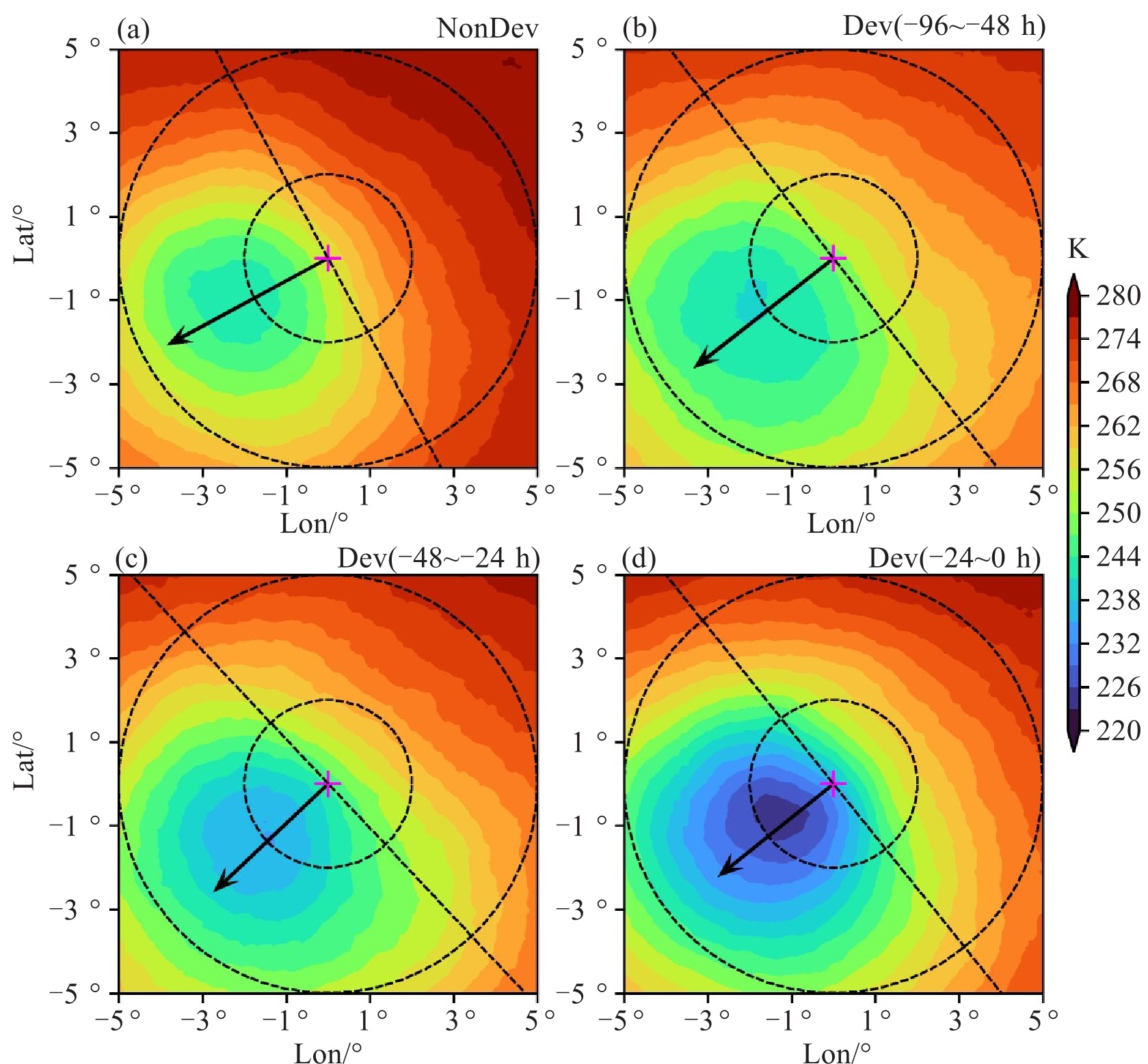
图 5 NonDev(a)以及Dev在-96~-48 h(b)、-48~-24 h(c)、-24~0 h(d)相对于环境垂直风切变的合成平均红外亮温大小(填色;单位:K)水平分布
黑色箭头为对应时段内的平均环境垂直风切变,其长度与其大小成正比,内部虚线圆半径大小均为2 °,外部虚线圆半径大小为5 °,虚直线与环境垂直风切变方向垂直。

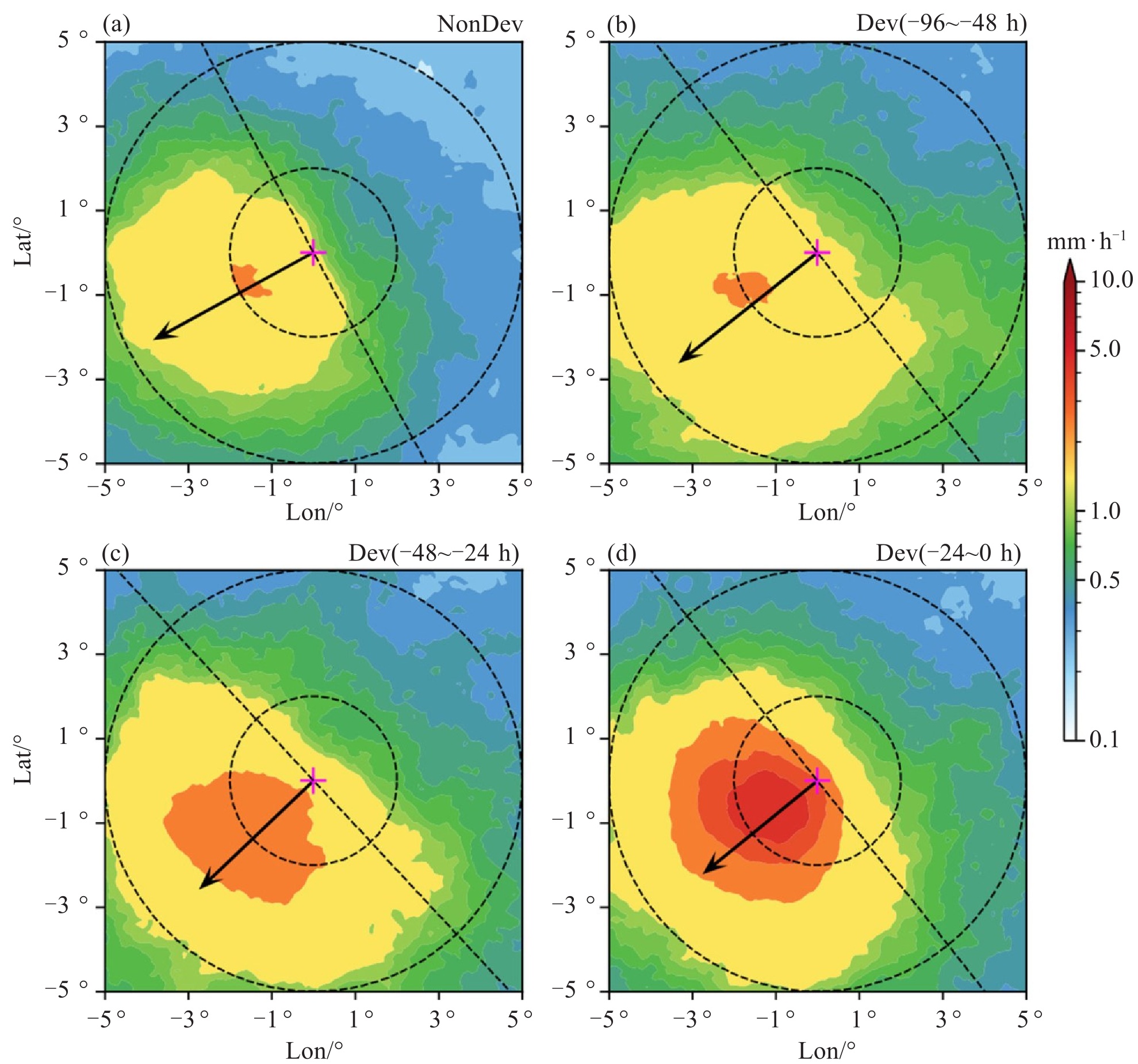
图 6 NonDev(a)以及Dev在-96~-48 h(b)、-48~-24 h(c)、-24~0 h(d)相对于环境垂直风切变的合成平均小时降水强度(填色;单位:mm·h-1),其它同图 5

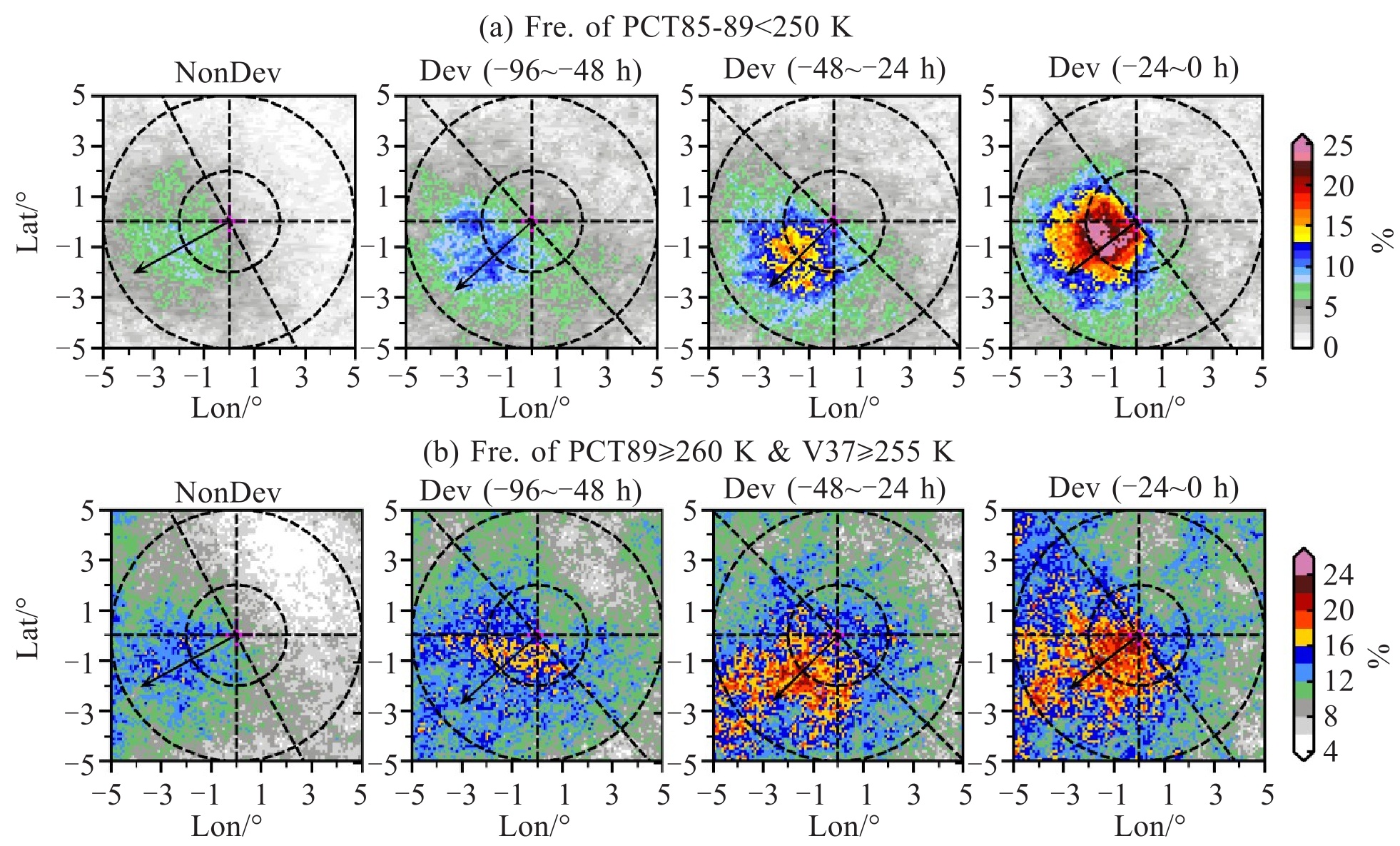
图 8 NonDev以及Dev在不同时段中的PCT85-89GHz小于250 K(a)、PCT85-89GHz大于260 K且V37GHz大于255 K(b)的发生频率大小分布,其它同图 5

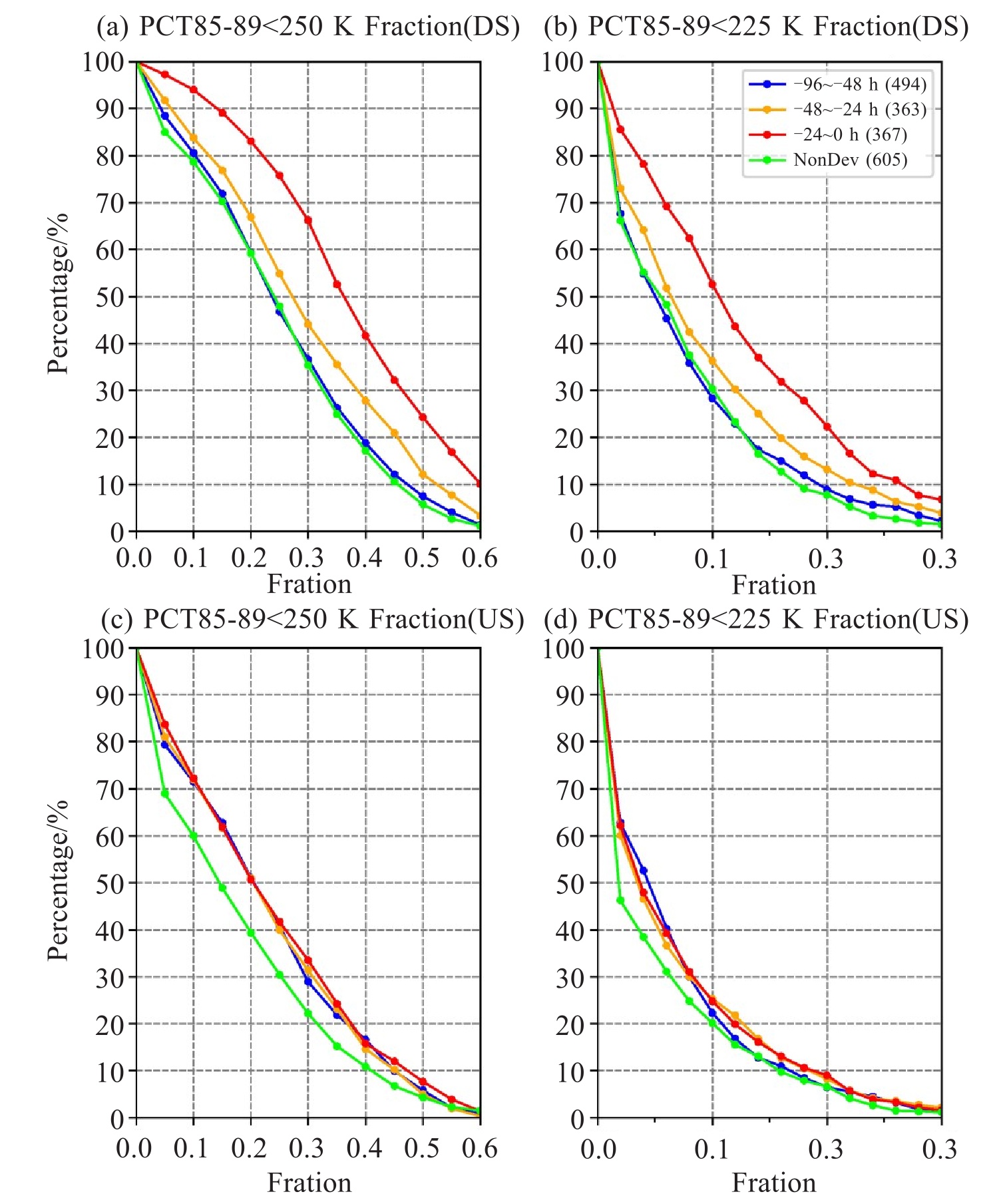
图 9 扰动系统在200 km范围内的PCT85-89GHz在顺切变方位上小于250 K (a)、顺切变方位上小于225 K(b)、在逆切变方位上小于250 K(c)、在逆切变方位上小于225 K(d)占PCT85-89GHz小于275 K的面积比例的累积频率分布
图例括号内数字为样本数。

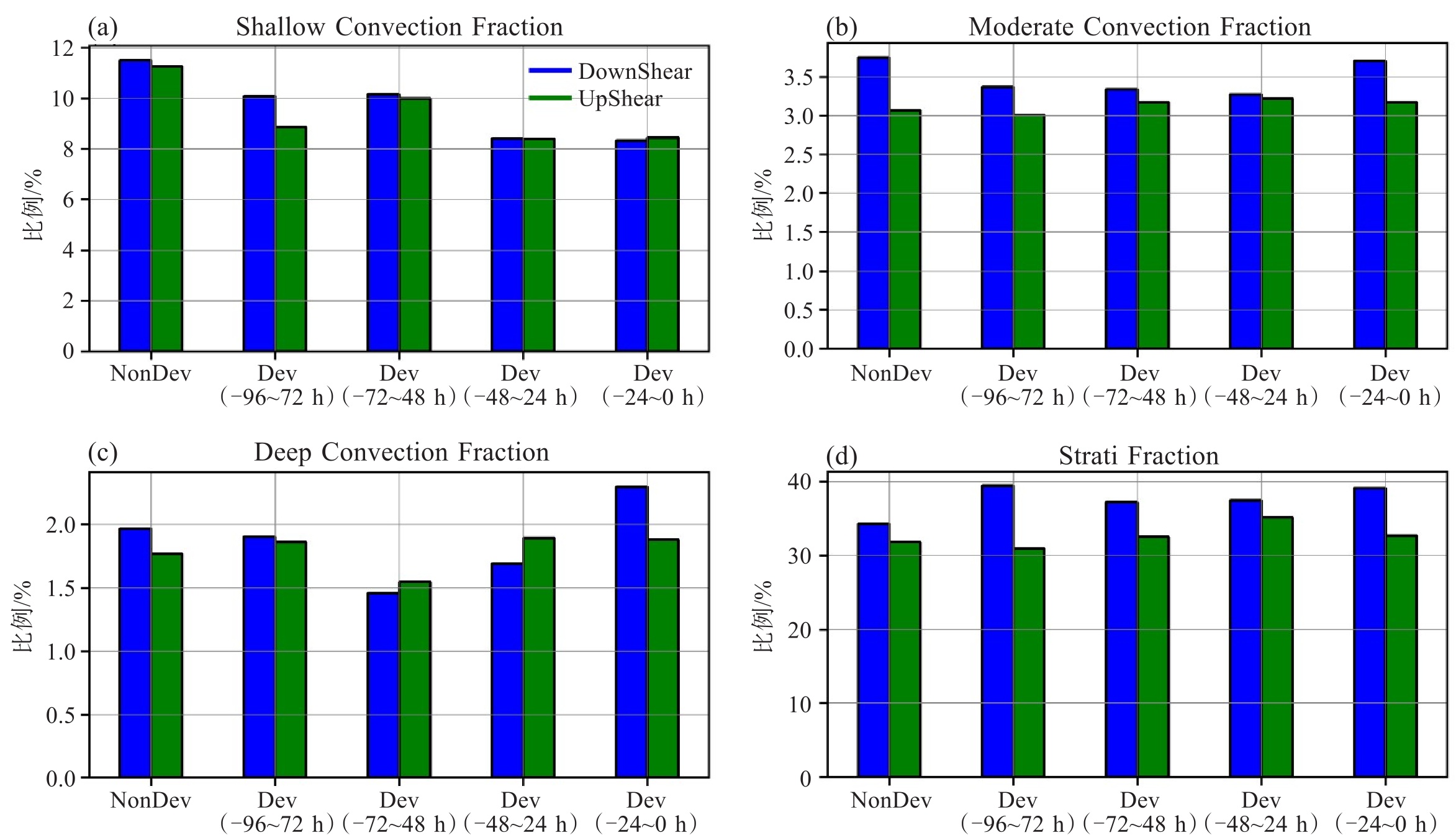
图 10 基于TRMM PR探测的不同类型的对流在200 km范围内的顺切变(蓝色)和逆切变(绿色)方位上的浅对流(a)、中等强度对流(b)、深对流(c)、层状性降水(d)的面积占200 km范围内的总降水面积的比例

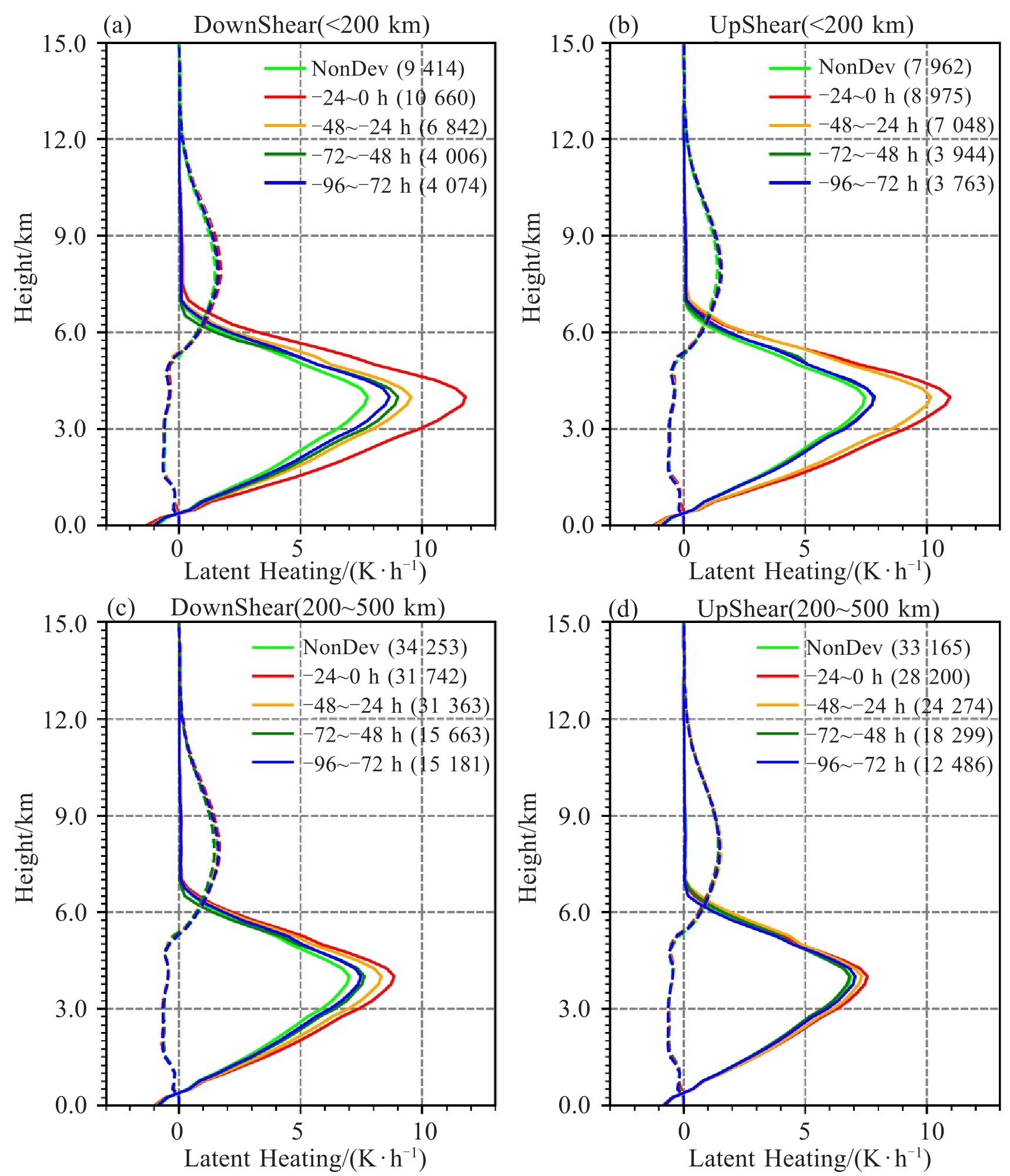
图 11 基于TRMM PR的层状性降水(虚线)以及中等深度至深对流(实线)在内部区域的顺切变方位(a)和逆切变方位(b)上的潜热加热率的中位数水平;在外部区域的顺切变方位(c)和逆切变方位(d)上的潜热加热率的中位数水平
图例括号内数字为对流性降水有关的样本数。
表 1 追踪得到的热带扰动轨迹样本数以及相关的低轨道卫星扫描轨道数量
时段 -96~-72 h -72~-48 h -48~-24 h -24~0 h 发展型扰动 1 512 2 092 2 540 2 728 非发展型扰动 877 1 652 3 224 5 418 筛选过后非发展型扰动 256(29%) 512(31%) 1 020(32%) 1 657(31%) 被动微波轨道样本数 278/57 310/93 429/193 426/356 TRMM PR轨道样本数 264/37 359/65 600/133 833/227 注:0 h是TC中心附近最大持续性风速首次超过22 kt的时刻。扰动系统轨迹样本数以3 h为分辨率计数。在低轨道卫星的轨道样本数前面为发展型扰动,后面为非发展型扰动。  下载: 导出CSV
-
[1] Chan J C L, Kepert J D. Global perspectives on tropical cyclones: from science to mitigation[M]. Singapore: World Scientific Publishing, 2010: 55-86. [2] 张文龙, 崔晓鹏. 热带气旋生成问题研究综述[J]. 热带气象学报, 2013, 29(2): 337-346. [3] 张庆红, 郭春蕊. 热带气旋生成机制的研究进展[J]. 海洋学报(中文版), 2008, 30(4): 1-11. [4] 李勋. 南海及毗邻海域热带气旋生成研究进展概述[J]. 气象科技进展, 2020, 10(4): 83-92. [5] Gray W M. The formation of tropical cyclones[J]. Meteorology and Atmospheric Physics, 1998, 67(1): 37-69. [6] Tang B H, Fang J, Bentley A, et al. Recent advances in research on tropical cyclogenesis[J]. Tropical Cyclone Research and Review, 2020, 9(2): 87-105. [7] Rajasree V P M, Cao X, Ramsay H, et al. Tropical cyclogenesis: controlling factors and physical mechanisms[J]. Tropical Cyclone Research and Review, 2023, 12(3): 165-181. [8] McBride J L, Zehr R. Observational analysis of tropical cyclone formation. Part II: comparison of non-developing versus developing systems[J]. Journal of the Atmospheric Sciences, 1981, 38(6): 1132-1151. [9] Kerns B W, Chen S S. Cloud clusters and tropical cyclogenesis: developing and nondeveloping systems and their large-scale environment [J]. Monthly Weather Review, 2013, 141(1): 192-210. [10] Fu B, Li T, Peng M S, et al. Analysis of tropical cyclogenesis in the western north Pacific for 2000 and 2001[J]. Weather and Forecasting, 2007, 22(4): 763-780. [11] Teng H F, Lee C S, Hsu H H, et al. Tropical cloud cluster environments and their importance for tropical cyclone formation[J]. Journal of Climate, 2019, 32(13): 4096-4088. [12] Wang Z. Role of cumulus congestus in tropical cyclone formation in a high-resolution numerical model simulation[J]. Journal of the Atmospheric Sciences, 2014, 71(5): 1681-1700. [13] 王科, 陈光华, 吕欣宇, 等. 1521号台风"杜鹃"生成阶段中尺度对流系统和降水演变特征[J]. 大气科学, 2021, 45(1): 73-87. [14] Narenpitak P, Bretherton C S, Khairoutdinov M F. The role of multiscale interaction in tropical cyclogenesis and its predictability in near-global aquaplanet cloud-resolving simulations[J]. Journal of the Atmospheric Sciences, 2020, 77(8): 2847-2863. [15] Bister M, Emanuel K A. The genesis of hurricane guillermo: TEXMEX analyses and a modeling study[J]. Monthly Weather Review, 1997, 125(10): 2662-2682. [16] Hendricks E A, Montgomery M T, Davis C A. The role of"vortical"hot towers in the formation of tropical cyclone Diana (1984)[J]. Journal of the Atmospheric Sciences, 2004, 61(11): 1209-1232. [17] Montgomery M T, Nicholls M E, Cram T A, et al. A vortical hot tower route to tropical cyclogenesis[J]. Journal of the Atmospheric Sciences, 2006, 63(1): 355-386. [18] Ooyama K V. Conceptual evolution of the theory and modeling of the tropical cyclone[J]. Journal of the Meteorological Society of Japan Ser II, 1982, 60(1): 369-380. [19] Charney J G, Eliassen A. On the growth of the hurricane depression[J]. Journal of the Atmospheric Sciences, 1964, 21(1): 68-75. [20] Houze R A Jr, Lee W C, Bell M M. Convective contribution to the genesis of hurricane Ophelia (2005)[J]. Monthly Weather Review, 2009, 137(9): 2778-2800. [21] Bell M M, Montgomery M T. Mesoscale processes during the genesis of hurricane karl (2010) [J]. Journal of the Atmospheric Sciences, 2019, 76(8): 2235-2255. [22] Zawislak J, Zipser E J. Analysis of the thermodynamic properties of developing and nondeveloping tropical disturbances using a comprehensive dropsonde dataset[J]. Monthly Weather Review, 2014, 142(3): 1250-1264. [23] Raymond D J, Sessions S L. Evolution of convection during tropical cyclogenesis[J]. Geophysical Research Letters, 2007, 34(6): L06811. [24] 端义宏, 方娟, 程正泉, 等. 热带气旋研究和业务预报进展—第九届世界气象组织热带气旋国际研讨会(IWTC-9)综述[J]. 气象学报, 2020, 78(3): 537-550. [25] Zehr R M, Branch R, Collins F. TROPICAL CYCLOGENESIS IN THE WESTERN NORTH PACIFIC[R]. America: NOAA technical report NESDIS, 1992. [26] Lee C S, Cheung K K W, Hui J S N, et al. Mesoscale features associated with tropical cyclone formations in the western north Pacific[J]. Monthly Weather Review, 2008, 136(6): 1250-1264. [27] Chang M, Ho C H, Park M S, et al. Multiday evolution of convective bursts during western North Pacific tropical cyclone development and nondevelopment using geostationary satellite measurements[J]. Journal of Geophysical Research: Atmospheres, 2017, 122(3): 1635-1649. [28] Zhang X P, Fang J, Yu Z F. Characteristics of the quasi-periodic outbreaks of deep convection during tropical cyclone genesis[J]. Journal of Geophysical Research: Atmospheres, 2022, 127(12): e2021JD035312. [29] Leppert K D II, Cecil D J, Petersen W A. Relation between tropical easterly waves, convection, and tropical cyclogenesis: a Lagrangian perspective[J]. Monthly Weather Review, 2013, 141(8): 2649-2668. [30] Zawislak J, Zipser E J. A multisatellite investigation of the convective properties of developing and nondeveloping tropical disturbances[J]. Monthly Weather Review, 2014, 142(12): 4624-4645. [31] Zawislak J. Global survey of precipitation properties observed during tropical cyclogenesis and their differences compared to nondeveloping disturbances[J]. Monthly Weather Review, 2020, 148(4): 1585-1606. [32] Fritz C, Wang Z, Nesbitt S W, et al. Vertical structure and contribution of different types of precipitation during Atlantic tropical cyclone formation as revealed by TRMM PR[J]. Geophysical Research Letters, 2016, 43(2): 894-901. [33] Wang K, Chen G H, Bi X X, et al. Comparison of convective and stratiform precipitation properties in developing and nondeveloping tropical disturbances observed by the global precipitation measurement over the western north Pacific[J]. Journal of the Meteorological Society of Japan Ser II, 2020, 98(5): 1051-1067. [34] Raymond D J, Sessions S L, López Carrillo C. Thermodynamics of tropical cyclogenesis in the northwest Pacific[J]. Journal of Geophysical Research, 2011, 116(D18): D18101. [35] Knapp K R, Kruk M C, Levinson D H, et al. The international best track archive for climate stewardship (IBTrACS): Unifying tropical cyclone data[J]. Bulletin of the American Meteorological Society, 2010, 91(3): 363-376. [36] Hersbach H, Bell B, Berrisford P, et al. The ERA5 global reanalysis[J]. Quarterly Journal of the Royal Meteorological Society, 2020, 146(730): 1999-2049. [37] Chen S S, Knaff J A, Marks F D Jr. Effects of vertical wind shear and storm motion on tropical cyclone rainfall asymmetries deduced from TRMM[J]. Monthly Weather Review, 2006, 134(11): 3190-3208. [38] Hence D A, Houze R A Jr. Vertical structure of hurricane eyewalls as seen by the TRMM precipitation radar[J]. Journal of the Atmospheric Sciences, 2011, 68(8): 1637-1652. [39] Knapp K R, Ansari S, Bain C L, et al. Globally gridded satellite observations for climate studies[J]. Bulletin of the American Meteorological Society, 2011, 92(7): 893-907. [40] Huffman G J, Bolvin D T, Braithwaite D, et al. Integrated multi-satellite retrievals for the global precipitation measurement (GPM) mission (IMERG)[M]//Satellite precipitation measurement: volume 1. Cham: Springer, 2020: 343-353. [41] Cecil D J, Zipser E J. Relationships between tropical cyclone intensity and satellite-based indicators of inner core convection: 85-GHz ice-scattering signature and lightning[J]. Monthly Weather Review, 1999, 127(1): 103-123. [42] Harnos D S, Nesbitt S W. Passive microwave quantification of tropical cyclone inner-core cloud populations relative to subsequent intensity change[J]. Monthly Weather Review, 2016, 144(11): 4461-4482. [43] Jiang H Y, Zagrodnik J P, Tao C, et al. Classifying precipitation types in tropical cyclones using the NRL 37 GHz color product[J]. Journal of Geophysical Research: Atmospheres, 2018, 123(10): 5509-5524. [44] Spencer R W, Goodman H M, Hood R E. Precipitation retrieval over land and ocean with the SSM/I: identification and characteristics of the scattering signal[J]. American Meteorological Society, 6(2): 254-273. [45] Cecil D J, Chronis T. Polarization-corrected temperatures for 10-, 19-, 37-, and 89-GHz passive microwave frequencies[J]. Journal of Applied Meteorology and Climatology, 2018, 57(10): 2249-2265. [46] Alvey G R, Zawislak J, Zipser E. Precipitation properties observed during tropical cyclone intensity change[J]. Monthly Weather Review, 2015, 143(11): 4476-4492. [47] Kummerow C, Barnes W, Kozu T, et al. The tropical rainfall measuring mission (TRMM) sensor package[J]. Journal of Atmospheric and Oceanic Technology, 1998, 15(3): 809-817. [48] Shige S, Takayabu Y N, Tao W K, et al. Spectral retrieval of latent heating profiles from TRMM PR data. part II: algorithm improvement and heating estimates over tropical ocean regions[J]. Journal of Applied Meteorology and Climatology, 2007, 46(7): 1098-1124. [49] Holland G J. Scale interaction in the western Pacific monsoon[J]. Meteorology and Atmospheric Physics, 1995, 56(1): 57-79. [50] Zong H J, Wu L G. Re-examination of tropical cyclone formation in monsoon troughs over the western North Pacific[J]. Advances in Atmospheric Sciences, 2015, 32(7): 924-934. [51] Hodges K I. A general method for tracking analysis and its application to meteorological data[J]. Monthly Weather Review, 1994, 122(11): 2573-2586. [52] Wu S L, Fang J. The initial mesoscale vortexes leading to the formation of tropical cyclones in the western north Pacific[J]. Advances in Atmospheric Sciences, 2023, 40(5): 804-823. [53] Rozoff C M, Schubert W H, McNoldy B D, et al. Rapid filamentation zones in intense tropical cyclones[J]. Journal of the Atmospheric Sciences, 2006, 63(1): 325-340. [54] Dunkerton T J, Montgomery M T, Wang Z. Tropical cyclogenesis in a tropical wave critical layer: easterly waves[J]. Atmospheric Chemistry and Physics, 2009, 9(15): 5587-5646. [55] Tory K J, Dare R A, Davidson N E, et al. The importance of low-deformation vorticity in tropical cyclone formation[J]. Atmospheric Chemistry and Physics, 2013, 13(4): 2115-2132. [56] Rutherford B, Boothe M A, Dunkerton T J, et al. Dynamical properties of developing tropical cyclones using Lagrangian flow topology[J]. Quarterly Journal of the Royal Meteorological Society, 2018, 144(710): 218-230. [57] Chen W Z, Ho C H, Yang S, et al. Modulations of madden-Julian oscillation and quasi-biweekly oscillation on early summer tropical cyclone genesis over the bay of Bengal and South China Sea[J]. Journal of Climate, 2024, 37(6): 1951-1964. [58] Wang Z Q, Chen G H. Comparison between developing and nondeveloping disturbances for tropical cyclogenesis in different large-scale flow patterns over the western north Pacific[J]. Journal of Climate, 2024, 37(2): 655-672. [59] Wang Z. What is the key feature of convection leading up to tropical cyclone formation [J]. Journal of the Atmospheric Sciences, 2018, 75(5): 1609-1629. [60] Gao S, Jia S B, Wan Y Y, et al. The role of latent heat flux in tropical cyclogenesis over the western north Pacific: comparison of developing versus non-developing disturbances[J]. Journal of Marine Science and Engineering, 2019, 7(2): 28. -

 点击查看大图
计量
- 文章访问数: 3
- HTML全文浏览量: 1
- PDF下载量: 0
- 被引次数: 0
 粤公网安备 4401069904700003号