



Impacts of ENSO Spatial Patterns on Pre-flood Season Precipitation Anomalies in Fujian Province
-
摘要: 基于1961—2024年福建省66个常规气象观测站的降水资料、美国国家海洋和大气管理局(NOAA)海表温度和向外长波辐射、美国国家环境预报中心/国家大气研究中心(NCEP/NCAR)再分析数据等资料,系统探讨了不同ENSO空间型对福建省前汛期降水异常的影响机制。结果表明:福建省前汛期降水量占全年总降水量41.1%,呈显著年际和年代际波动,空间上表现为由东南沿海向西北内陆递增分布态势。前冬东部型厄尔尼诺次年前汛期,全省降水普遍偏多,其中西北部(南平市、三明市)增强尤为显著,主要原因是西太平洋型(WP型)负位相环流增强西南水汽输送,配合对流活跃(OLR负异常)导致;东部型拉尼娜次年降水整体偏少,环流呈典型WP型分布,水汽输送受阻。中部型厄尔尼诺次年降水呈“北多南少”格局,副高偏南且印缅槽偏弱,水汽输送局限于内陆;中部型拉尼娜次年中南部降水偏多,与早台风活动增多相关,但水汽辐散抑制整体强度。东部型厄尔尼诺事件通过激发欧亚“西高东低”遥相关波列,增强副高边缘暖湿气流与冷空气对峙;而中部型事件则因副高位置异常及热带对流响应差异,导致水汽输送路径异常。研究揭示ENSO空间型通过调制大尺度环流与水汽输送,影响福建省前汛期降水时空分布异常,可为季节预测及防灾减灾提供依据。Abstract: Based on precipitation data from 66 meteorological stations in Fujian Province from 1961 to 2024, alongside NOAA sea surface temperature (SST) and outgoing long wavelength radiation (OLR)datasets, and NCEP/NCAR reanalysis data, this study investigates the physical mechanisms linking diverse El Niño-Southern Oscillation (ENSO) spatial patterns to precipitation anomalies during the pre-flood season (April-June).The results indicate that pre-flood season precipitation accounts for 41.1% of the annual total and exhibits prominent interannual and decadal variations, showing a spatial gradient that increases from the southeastern coast to the northwestern inland. During the decaying pre-flood season following an Eastern-Pacific (EP) El Niño, precipitation across the province is generally above normal, with significant enhancement in the northwestern region (Nanping and Sanming). This is primarily driven by an anomalous western North Pacific anticyclone (WNPAC), resembling a negative phase of the Western Pacific (anti-WP) pattern, which substantially intensifies southwesterly moisture flux into Fujian in cooperation with enhanced localized convection (negative OLR anomalies). Conversely, following an EP La Niña, precipitation is profoundly suppressed statewide as the large-scale circulation exhibits a typical positive WP pattern that severely obstructs moisture supply. Following a Central-Pacific (CP) El Niño, precipitation displays a distinct "north-rich and south-poor" spatial pattern; the Western Pacific subtropical high (WPSH) shifts westward and southward while the India-Burma trough weakens, confining significant moisture convergence to northern inland areas. Following a CP La Niña, precipitation increases primarily along the central and southern coasts-a trend closely linked to a higher frequency of early-season typhoons-although the seasonal mean intensity is constrained by widespread background moisture divergence. Mechanistically, EP El Niño events trigger a prominent "west-high and east-low" teleconnection wave train across mid-high latitude Eurasia at 500 hPa, which accelerates cold air outbreaks to confront the warm-moist airflow along the northern periphery of the WPSH. In contrast, CP events modify moisture transport pathways primarily through localized shifts of the WPSH and asymmetric tropical convective responses. This study highlights how ENSO spatial patterns modulate regional climate anomalies by reshaping large-scale circulations and moisture flux pathways, thereby providing crucial scientific insights for seasonal climate prediction and disaster mitigation over Southeast China.
-

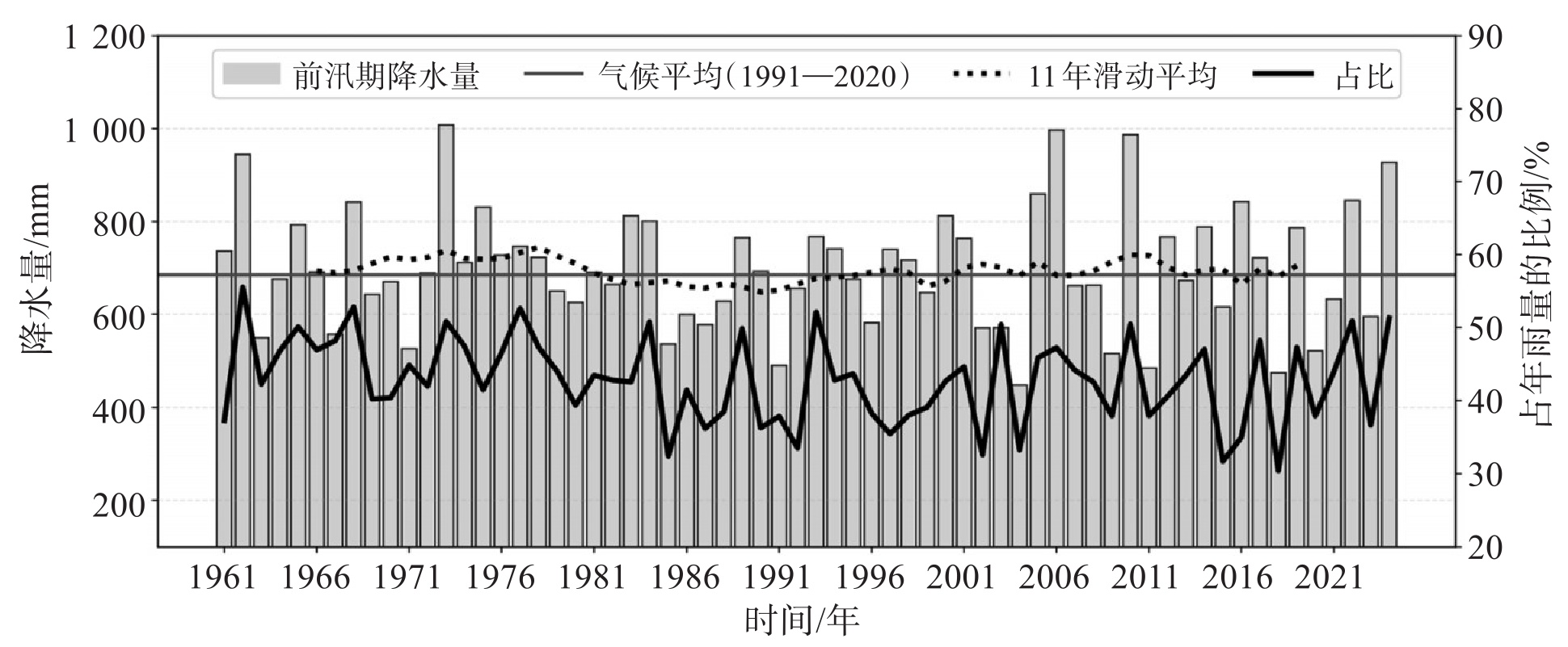
图 1 1961—2024年福建省前汛期降水量(柱状,单位:mm)和占全年总降水量比例(黑色实线,单位:%)变化
灰色水平实线为1991—2020年平均,黑色点线为11年滑动平均。

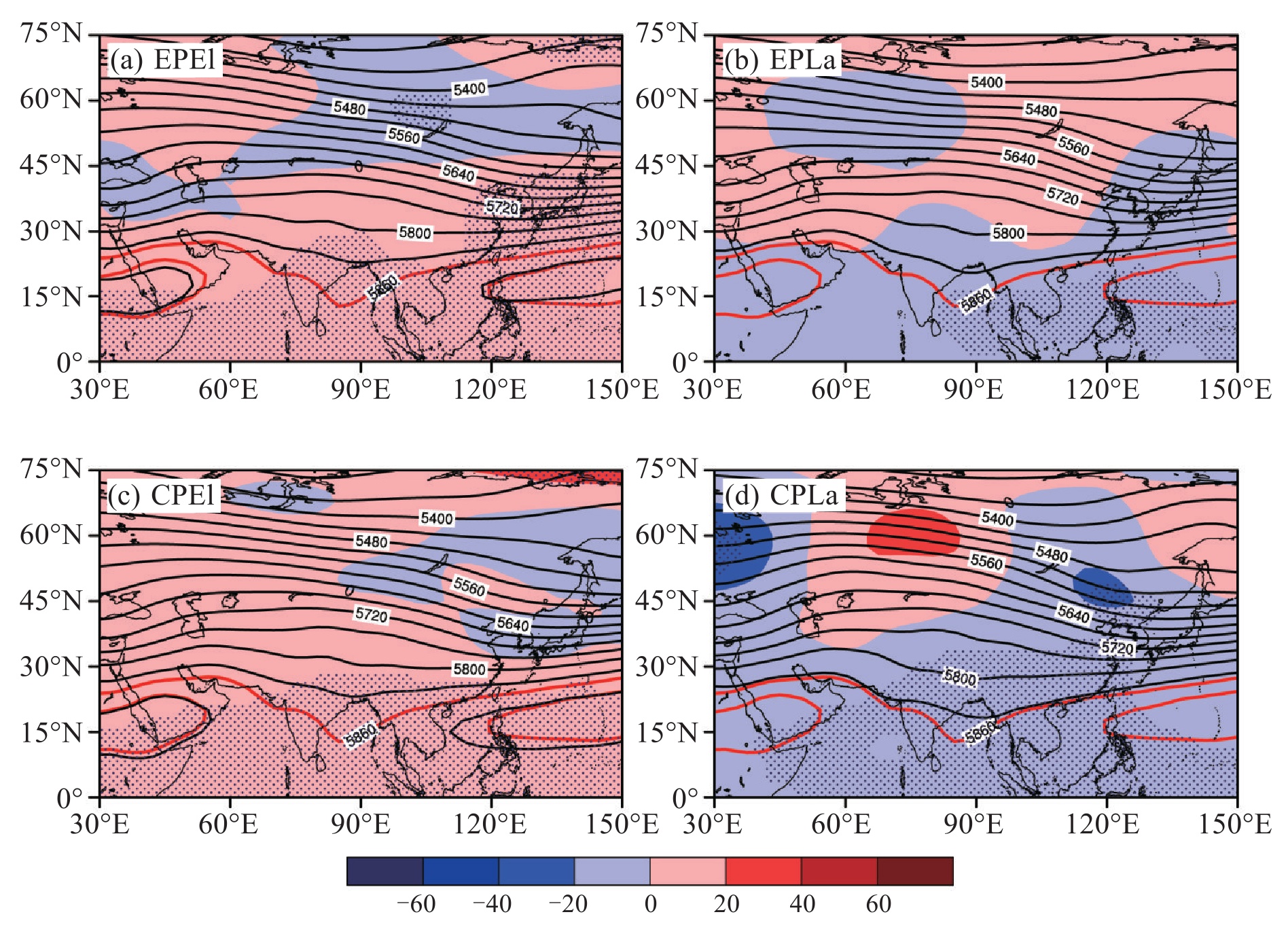
图 6 不同ENSO分布型500 hPa位势高度场(黑实线,单位:gpm)及距平分布(阴影,单位:gpm)
红色粗线为气候态的5 860 gpm和5 880 gpm特征线。打点区域表示通过90%置信度水平检验。

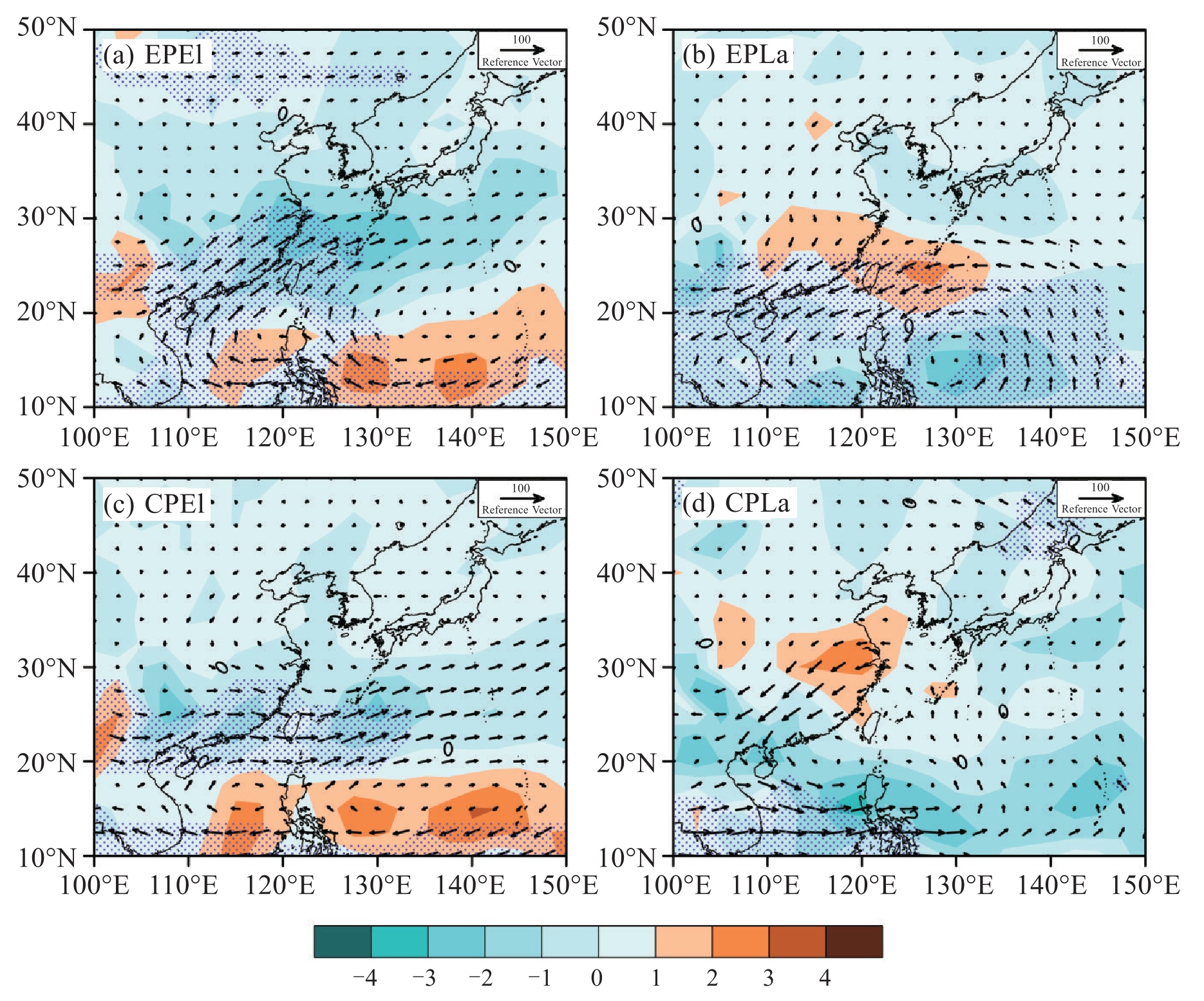
图 8 不同ENSO分布型对应的垂直积分水汽输送距平(矢量,单位:kg·s-1·m-1)及散度(阴影,单位:10-5 kg·s-1·m-2)
打点区域表示通过95%置信度水平检验。

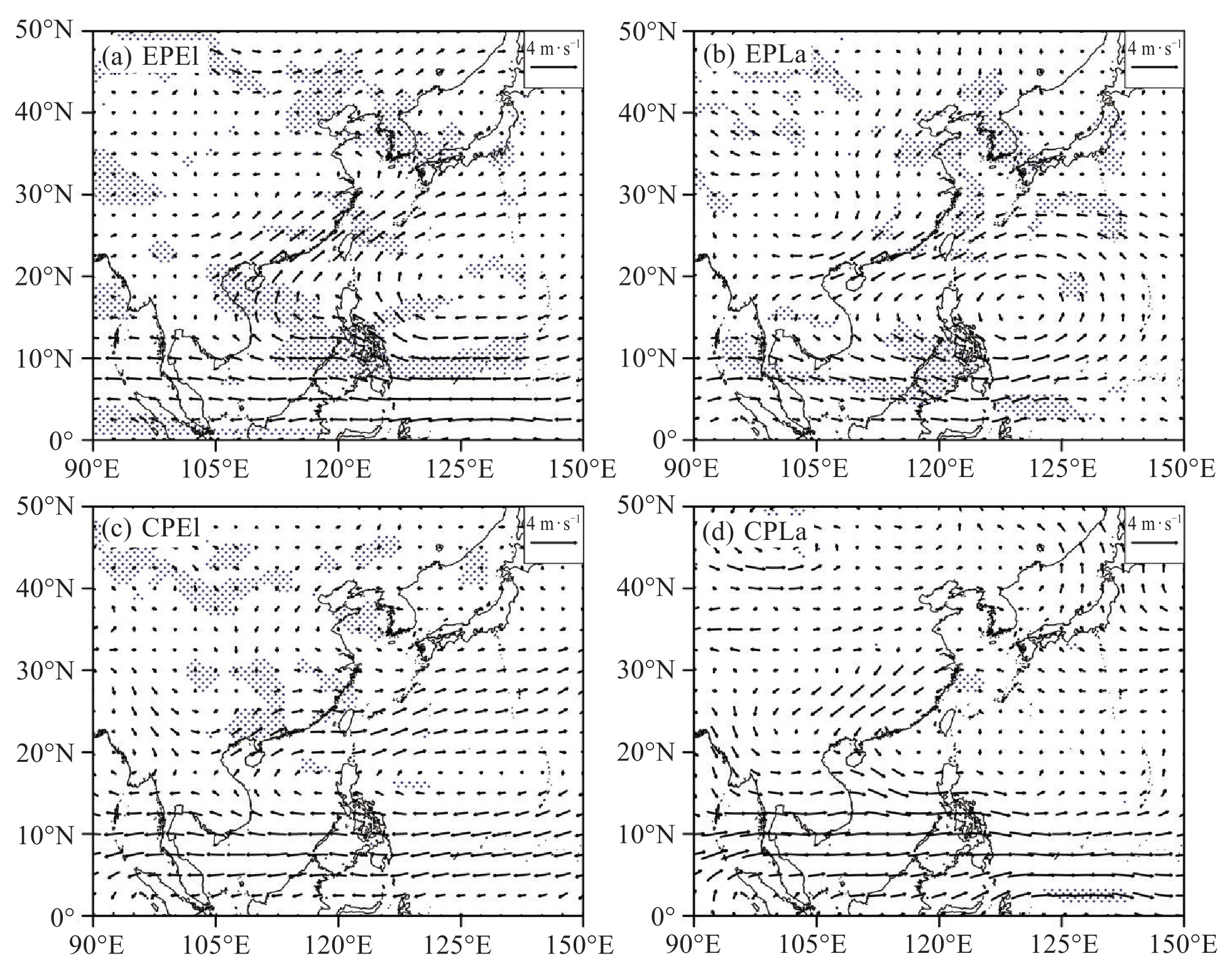
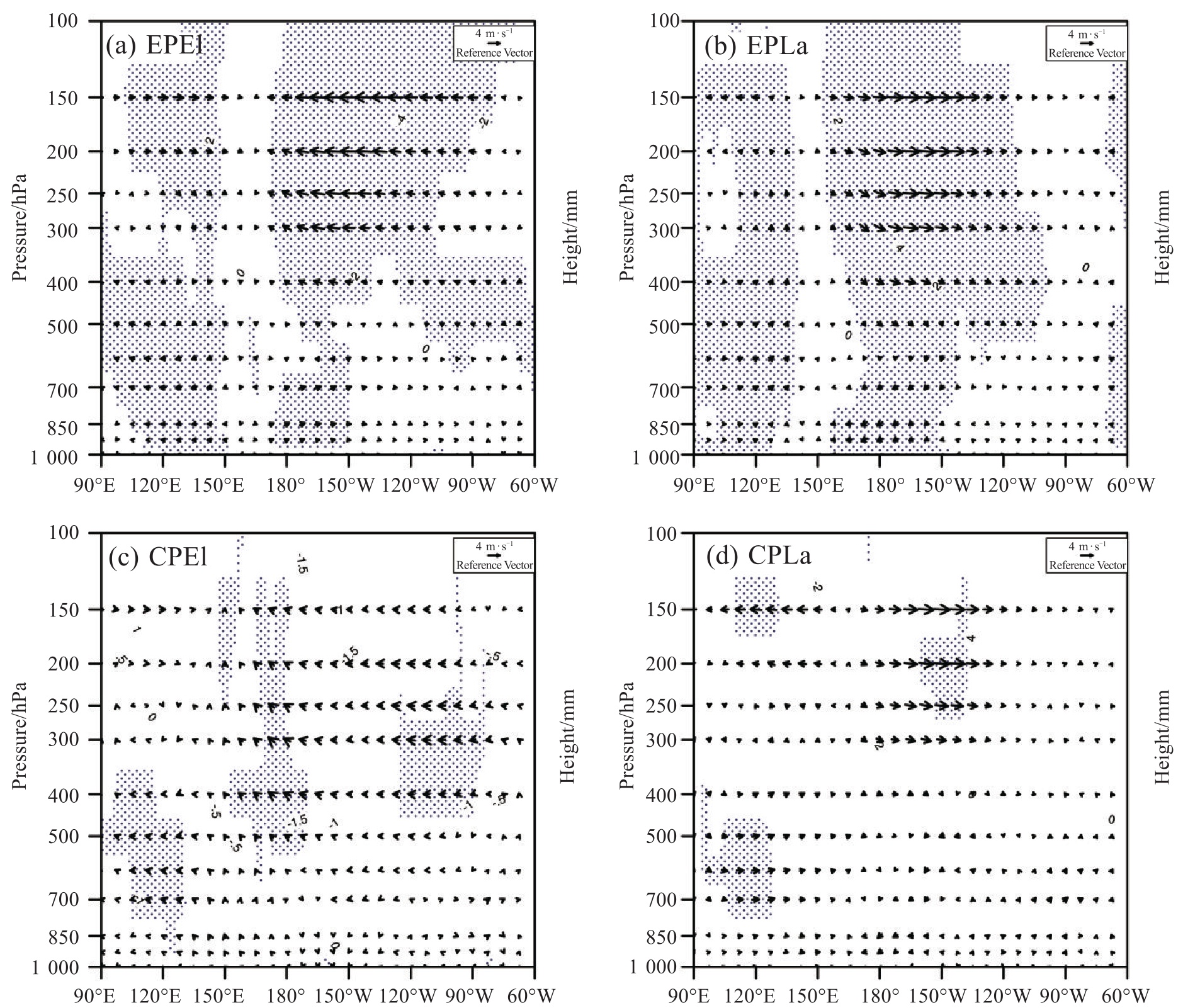
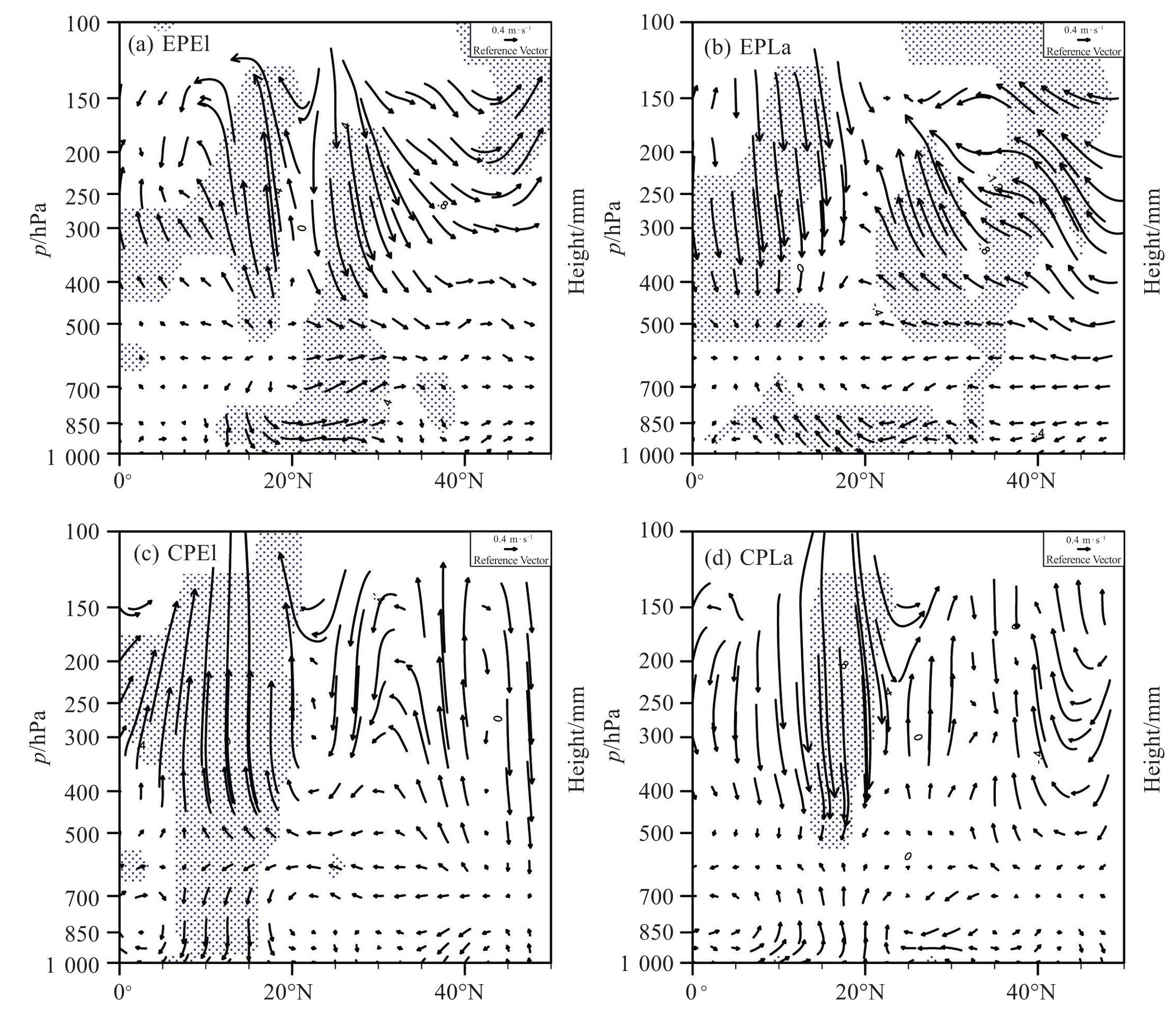
图 9 不同ENSO分布型对应的5 °S~5 °N平均Walker环流距平(矢量,单位:m·s-1)
垂直速度为扩大100倍后的结果。打点区域表示通过90%置信度水平检验。
表 1 不同ENSO空间分布型及相应年例
类型 年份 东部型El Niño 1963/1964、1965/1966、1972/1973、1976/1977、1979/1980、1982/1983、1986/1987、1991/1992、1997/1998、2006/2007、2014/2016、2023/2024 东部型La Niña 1964/1965、1970/1972、1984/1985、1988/1989、1995/1996、1998/2000、2007/2008、2010/2011、2017/2018、2020/2021、2021/2023 中部型El Niño 1968/1970、1977/1978、1994/1995、2002/2003、2004/2005、2009/2010、2018/2019、2019/2020 中部型La Niña 1973/1974、1975/1976、2000/2001、2011/2012  下载: 导出CSV
-
[1] Intergovernmental Panel on Climate Change. Climate change 2021-the physical science basis: Working group I contribution to the sixth assessment report of the intergovernmental panel on climate change[M]. Cambridge, UK: Cambridge University Press, 2023. [2] 冯强, 王昂生, 李吉顺. 我国降水的时空变化与暴雨洪涝灾害[J]. 自然灾害学报, 1998, 7(1): 87-93. [3] 鹿世瑾, 王岩. 福建气候[M]. 北京: 气象出版社, 2012. [4] Chen Y, Zhai P. Persistent extreme precipitation events in China during 1951-2010[J]. Climate Research, 2013, 57(2): 143-155. [5] 黄丽娜, 高建芸, 陈彩珠, 等. 福建前汛期持续性强降水的大气低频特征分析[J]. 气象, 2014, 40(6): 723-732. [6] 温克刚, 宋德众, 蔡诗树, 等. 中国气象灾害大典-福建卷[M]. 北京: 气象出版社, 2007. [7] 陈香, 王静爱, 陈静. 福建暴雨洪灾时空变化与区域划分的初步研究[J]. 自然灾害学报, 2007, 16(6): 1-7. [8] 喻婷婷, 万金红, 高路. 福建省暴雨时空演变规律与洪涝灾害脆弱性曲线研究[J]. 水利水电技术(中英文), 2023, 54(12): 64-74. [9] 杨善恭, 邱晓光, 赵水芝, 等. "98.6"闽北罕见持续性暴雨的环流特征和预报[J]. 气象, 1999, 25(2): 40-43. [10] 高建芸, 陈彩珠, 周信禹, 等. 2010年福建前汛期典型持续性暴雨过程的低频特征分析[J]. 气象科技进展, 2013, 3(1): 39-45. [11] 吴滨, 李玲. 福建省降水量的趋势变化对旱涝灾害的影响综述[J]. 热带气象学报, 2009, 25(1): 103-109. [12] 何芬, 赖绍钧, 池艳珍, 等. 福建省2018年3—6月干旱环流的变化特征[J]. 干旱气象, 2022, 40(1): 22-29. [13] 陈旭哲, 范伶俐, 徐建军, 等. 华南汛期旱涝急转特征及其与海温异常的关系[J]. 广东海洋大学学报, 2023, 43(1): 68-77. [14] 梁金树, 王岩. 福建沿海近百年雨季总降水量的变化特征[J]. 台湾海峡, 1997, 16(4): 415-419. [15] 许金镜, 温珍治, 肖再勉, 等. 福建雨季降水异常的特征分析[J]. 海洋预报, 2002, 19(4): 52-59. [16] 蔡晓禾, 廖廓, 池艳珍, 等. 福建雨季降水时空非均匀分布特征分析[J]. 福建农业学报, 2014, 29(4): 378-384. [17] 刘静, 管兆勇, 龚振彬, 等. 近30a福建省前汛期极端降水事件特征及其成因[J]. 气象科学, 2016, 36(1): 28-35. [18] 李霖, 黄永玉, 江彩英. 福建北部持续性暴雨个例分析[J]. 气象科技, 2008, 36(2): 197-201, 259. [19] 赵玉春, 李泽椿, 王叶红, 等. 2006年6月5~8日梅雨锋上中尺度对流系统引发福建北部暴雨的诊断分析[J]. 大气科学, 2008, 32(3): 598-614. [20] 刘爱鸣, 潘宁, 邹燕, 等. 福建前汛期区域暴雨客观预报模型研究[J]. 应用气象学报, 2003, 14(4): 419-429. [21] 吴滨, 蔡学湛. 用典型相关分析预测福建前汛期降水[J]. 气象科技, 2005, 33(1): 32-36. [22] 张容焱, 李永尧, 徐宗焕, 等. 福建旱涝短期气候预测统计方法试验研究[J]. 热带气象学报, 2007, 23(6): 636-642. [23] 蔡学湛, 吴滨, 温珍治. 青藏高原雪盖异常对福建雨季旱涝影响的环流诊断[J]. 南京气象学院学报, 2002(6): 800-806. [24] 邹燕, 黄凯安, 江晓南. 福建省前汛期旱涝年前冬季500hPa高度场特征及其与东亚冬季风的关系[J]. 台湾海峡, 2006, 25(1): 110-116. [25] 邹燕, 何金海, 邱章如, 等. 副高及其南侧偏东气流输送在福建前汛期降水中的作用[J]. 热带气象学报, 2006, 22(5): 515-520. [26] 陈齐川. ECMWF集合预报产品对福建前汛期暴雨的预报性能评估[J]. 海峡科学, 2019(11): 3-8, 17. [27] 池艳珍, 梁潇云, 何芬, 等. BCC_CSM1.1m模式对福建前汛期降水预测的误差订正[J]. 气候变化研究进展, 2020, 16(6): 714-724. [28] 陈彩珠, 高建芸, 黄丽娜, 等. 大气低频变化对福建前汛期典型持续性暴雨影响[J]. 应用气象学报, 2016, 27(1): 75-84. [29] 曹蓉, 杨开甲, 何芬. 福建前汛期持续性极端降水事件的多尺度扰动特征分析[J]. 海峡科学, 2024(5): 20-28. [30] Dai A G, Fung I Y, Del Genio A D. Surface observed global land precipitation variations during 1900-88[J]. Journal of Climate, 1997, 10(11): 2943-2962. [31] Huang R H, Wu Y F. The influence of ENSO on the summer climate change in China and its mechanism[J]. Advances in Atmospheric Sciences, 1989, 6(1): 21-32. [32] Dai A G, Wigley T M L. Global patterns of ENSO-induced precipitation[J]. Geophysical Research Letters, 2000, 27(9): 1283-1286. [33] Kug J S, Jin F F, An S I. Two types of El Niño events: cold tongue El Niño and warm pool El Niño[J]. Journal of Climate, 2009, 22(6): 1499-1515. [34] Zhang W J, Jin F F, Li J P, et al. Contrasting impacts of two-type El Niño over the western north Pacific during boreal autumn[J]. Journal of the Meteorological Society of Japan Ser II, 2011, 89(5): 563-569. [35] Feng J, Li J P. Influence of El Niño Modoki on spring rainfall over South China[J]. Journal of Geophysical Research, 2011, 116(D13): D13102. [36] Yuan Y, Yang S. Impacts of different types of El Niño on the East Asian climate: focus on ENSO cycles[J]. Journal of Climate, 2012, 25(21): 7702-7722. [37] 毕成祥, 任保华, 郑建秋. ENSO对次年夏季西北太平洋降水的非对称影响[J]. 热带气象学报, 2023, 39(1): 89-101. [38] Feng J, Li J P, Zheng F, et al. Contrasting impacts of developing phases of two types of El Niño on Southern China rainfall[J]. Journal of the Meteorological Society of Japan Ser II, 2016, 94(4): 359-370. [39] 李海燕, 孙家仁, 谌志刚, 等. 两类El NiÑo事件对华南前汛期降水异常的影响[J]. 热带气象学报, 2019, 35(4): 491-503. [40] 蔡学湛, 温珍治, 吴滨. 西太平洋副高与ENSO的关系及其对福建雨季降水分布的影响[J]. 热带气象学报, 2003, 19(1): 36-42. [41] Huang B Y, Thome P W, Banzon V F, et al. NOAA extended reconstructed sea surface temperature (ERSSTv5), upgrades, validations, and intercomparisons[J]. Journal of Climate, 2017, 30(20): 8179-8205. [42] Liebmann B, Smith C A. Description of a complete (interpolated) outgoing longwave radiation dataset[J]. Bulletin of the American Meteorological Society, 1996, 77: 1275-1277. [43] Kalnay E, Kanamitsu M, Kistper R, et al. The NCEP/NCAR 40-year reanalysis project[J]. Bulletin of the American Meteorological Society, 1996, 77(3): 437-471. [44] 任宏利, 孙丞虎, 任福民, 等. 厄尔尼诺/拉尼娜事件判别方法(GB/T 33666-2017)[S]. 北京: 中国标准出版社, 2017. [45] 魏凤英. 现代气候统计诊断与预测技术(2版)[M]. 北京: 气象出版社, 2007. [46] 赵永晶, 钱永甫. 全球海温异常对中国降水异常的影响[J]. 热带气象学报, 2009, 25(5): 561-570. [47] 唐卫亚, 管兆勇, 钱代丽. 北半球冬季南北半球环流同时变化的主要模态及其与ENSO的联系[J]. 热带气象学报, 2015, 31(5): 588-598. -

 点击查看大图
图(11) / 表(1)
计量
- 文章访问数: 3
- HTML全文浏览量: 1
- PDF下载量: 1
- 被引次数: 0
 粤公网安备 4401069904700003号