



Regional Disparities and Disaster Mechanisms of Typhoon Impacts in China from 2014 to 2023
-
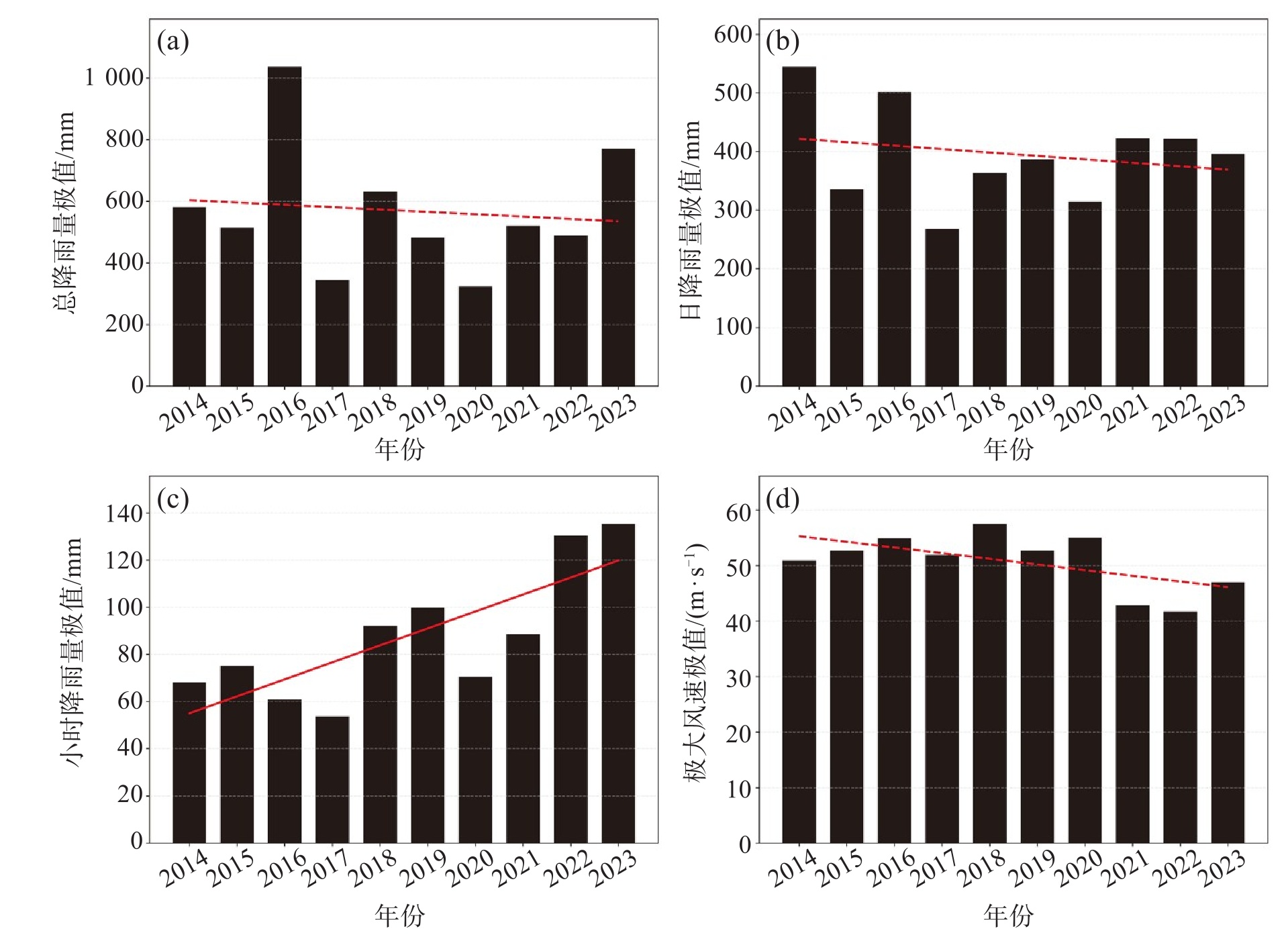
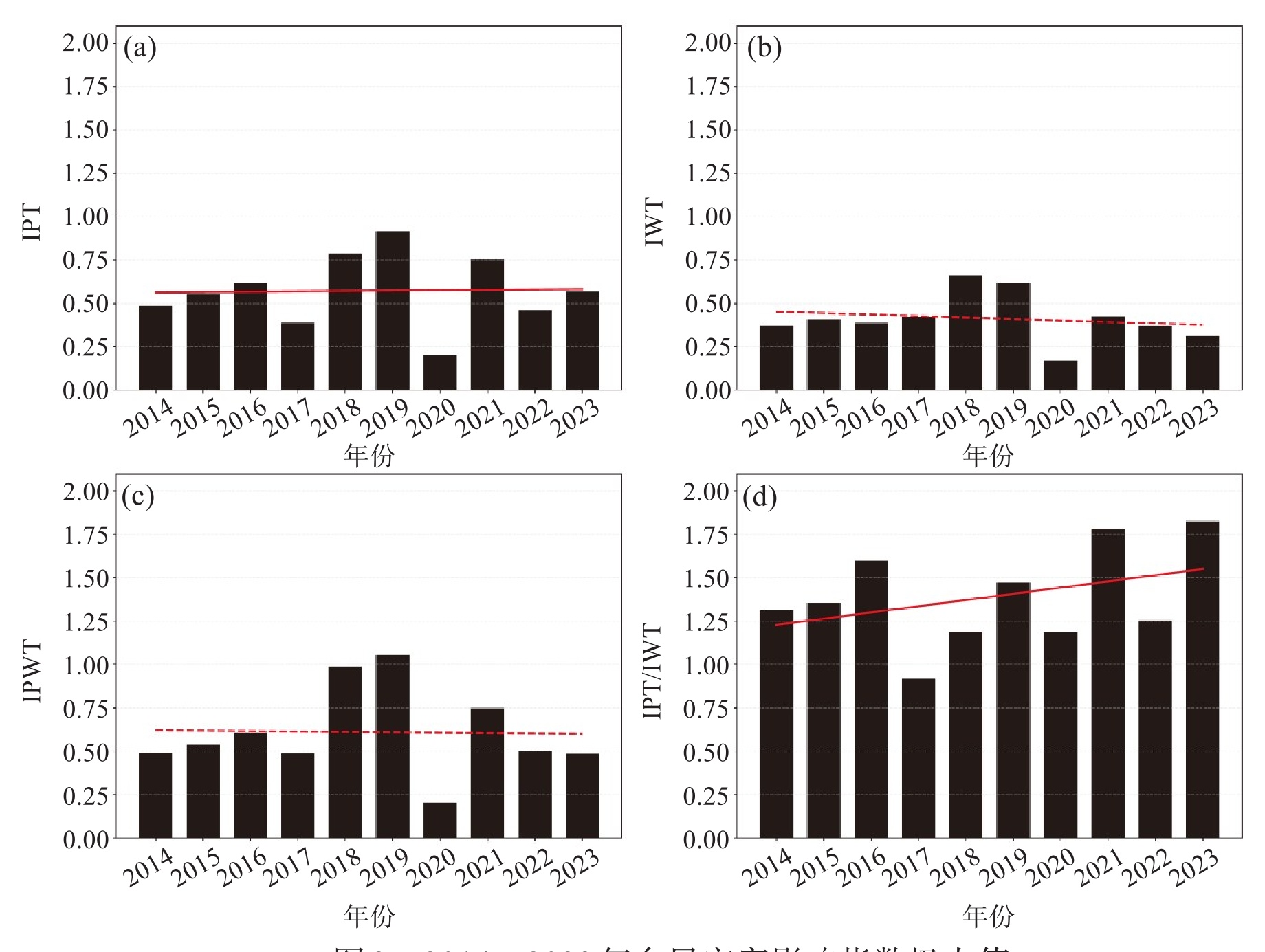
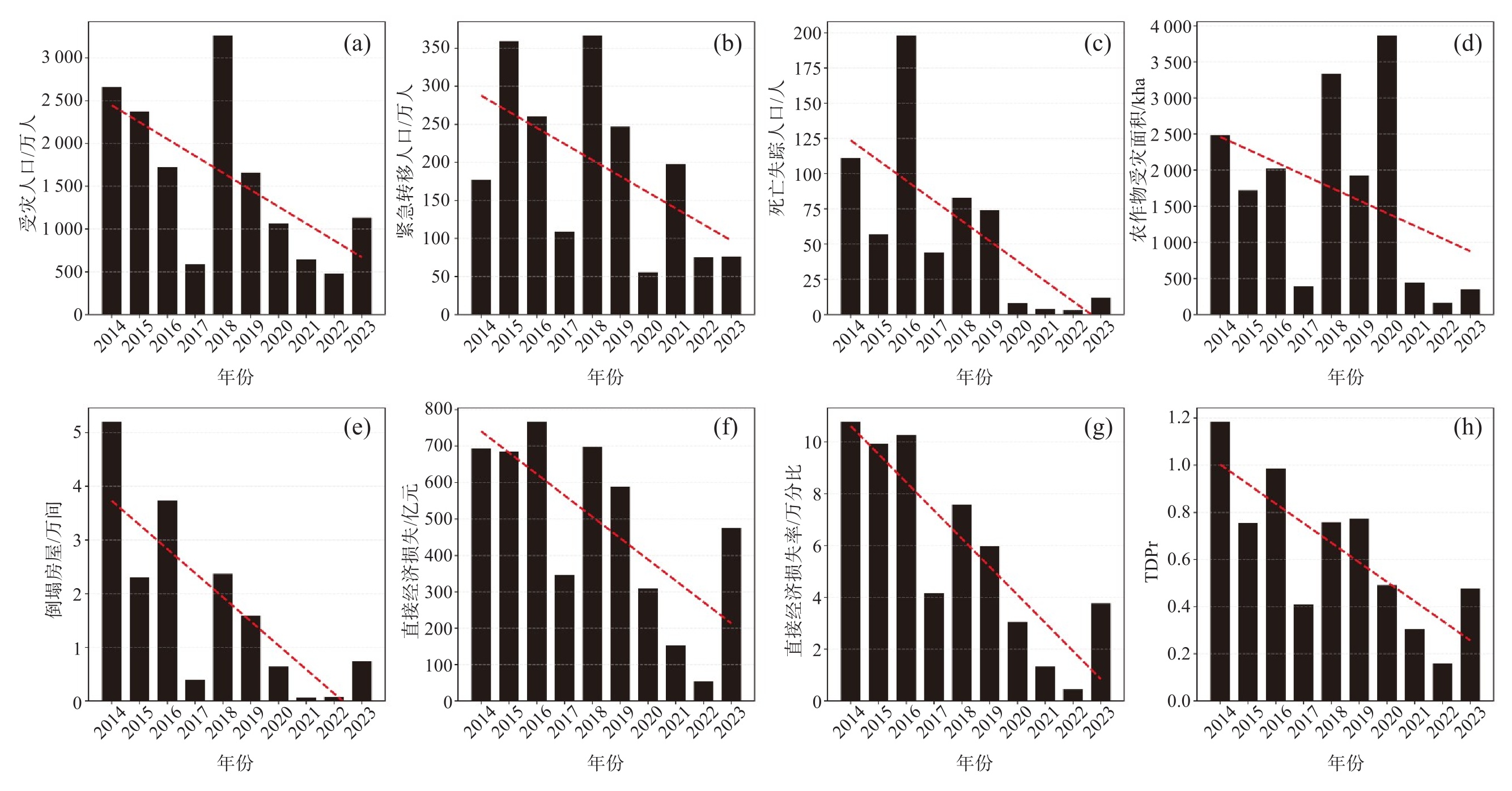
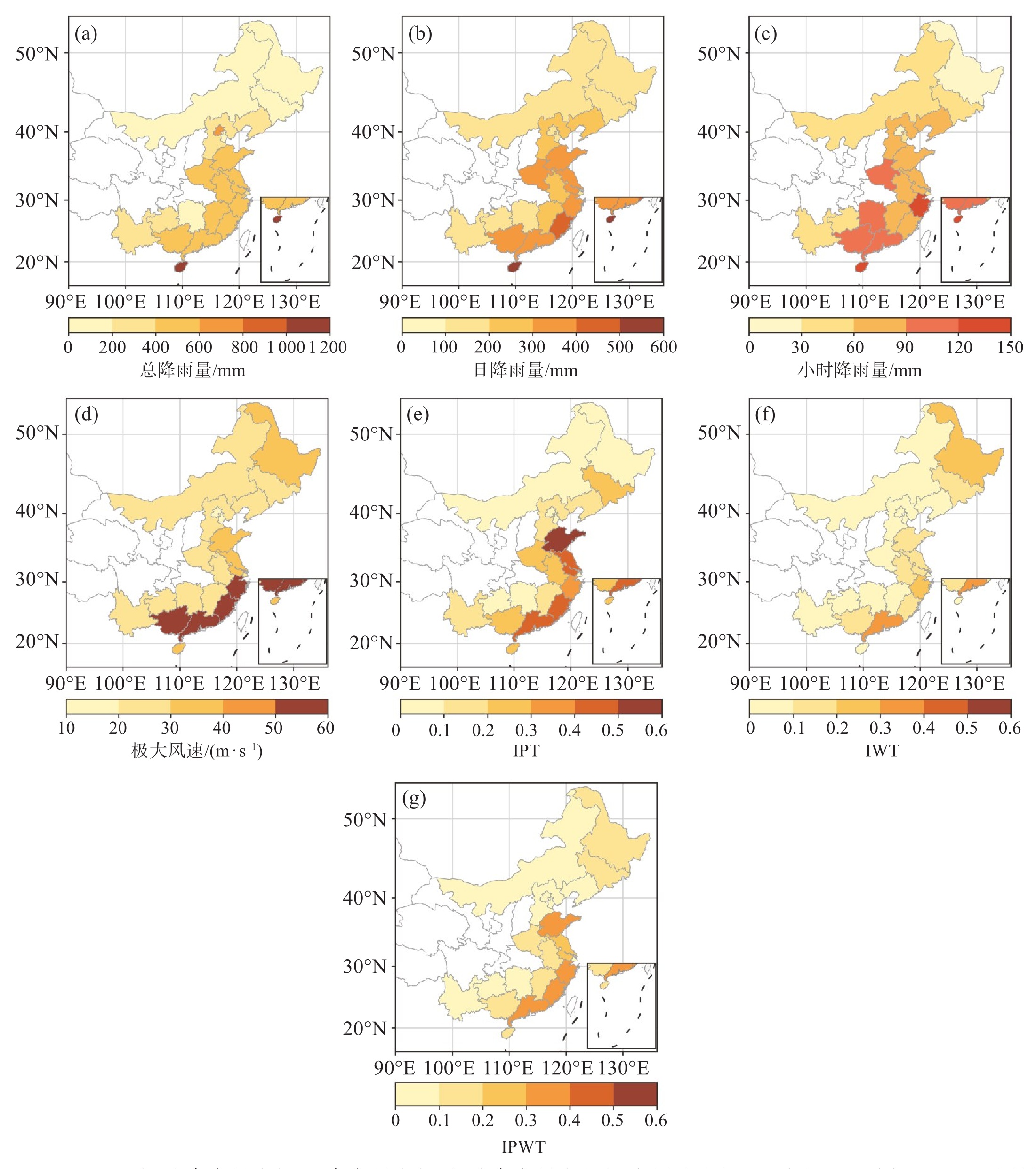
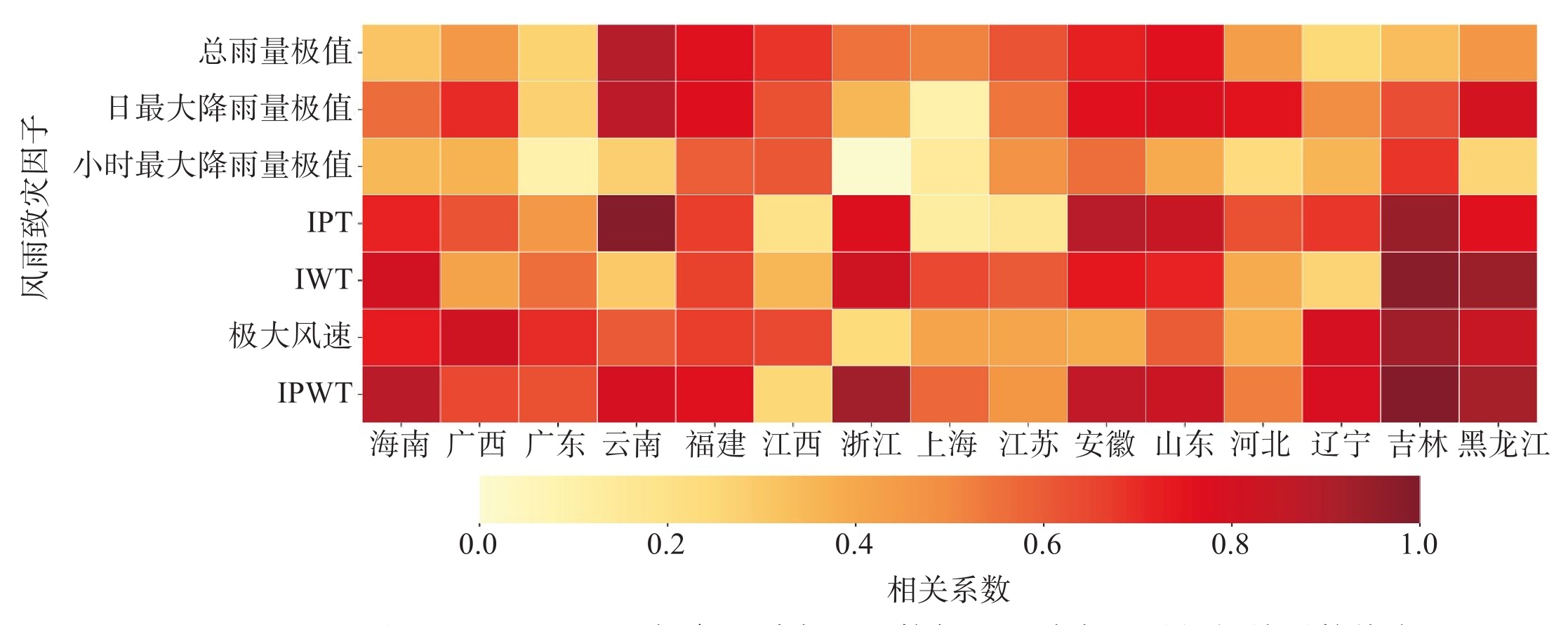
摘要: 基于2014—2023年中国台风灾情与气象数据, 本研究系统揭示了台风灾害的时空分异及致灾机制, 并评估防灾减灾成效。结果表明:台风生成量(年均24.8个)和登陆量(年均6.7个)呈微弱下降趋势, 但致灾台风数量逆势波动(年均8.0个, 极值差7.0个)。短历时暴雨风险显著加剧(小时降水极值增速$ 7.2 \mathrm{~mm} \cdot \mathrm{a}^{-1} $, 2023年达135.3 mm), 降水致灾贡献持续增强(IPT/IWT由2014年的1.31增至2023年的1.83)。灾害呈现"沿海高频高损、内陆低频高损"分异格局, 风雨综合影响指数(IPWT)为灾损核心驱动因子, 但致灾路径区域异质性显著:华南以风雨协同效应主导, 西南依赖持续性暴雨, 东北受强风直接破坏。尽管全国灾损指标显著改善(死亡失踪人口年均降速10.7人, 台风灾损综合评价指数(TDPr)降幅60.0%), 北方新兴风险区加速形成(河南、黑龙江IPWT增速 > 6% $ \mathrm{a}^{-1} $)且单个致灾峰值逼近沿海水平。研究提出分区治理策略, 为应对台风极端化与北扩化提供科学依据。Abstract: Based on typhoon disaster records and meteorological observations across China from 2014 to 2023, this study systematically analyzes the spatiotemporal evolution of typhoon activity, regional differentiation in disaster mechanisms, and the effectiveness of disaster prevention and mitigation measures. The annual average typhoon generation and landfall numbers show a slight decline (24.8 and 6.7 per year, respectively). Disaster-inducing typhoons exhibit counter-trend fluctuations (annual average: 8.0; extreme difference: 7.0). Short-duration rainstorm risks have intensified markedly, with hourly rainfall extremes rising at $ 7.2 \mathrm{~mm} \cdot \mathrm{a}^{-1} $, peaking at 135.3 mm in 2023. The ratio of rainfall-induced to wind-induced typhoon disasters (IPT/IWT) increased from 1.31 in 2014 to 1.83 in 2023, indicating a growing contribution of precipitation-driven impacts. Typhoon disasters display a distinct regional differentiation pattern of high-frequency and high-loss in coastal areas versus low-frequency but high-loss in inland areas. The Integrated Precipitation and Wind Threat (IPWT) index emerges as the core driver of cross-regional losses, yet underlying regional disaster mechanisms diverge substantially: wind-rain synergistic effects dominate in South China, persistent rainfall governs Southwest China, and direct wind damage prevails in Northeast China. Most national-scale disaster indicators declined significantly over the decade (annual reduction rate of deaths/missing persons: 10.7; Comprehensive Typhoon Disaster Impact Index (TDPr) decrease: 60.0%). However, emerging risk zones in northern China (e.g., Henan and Heilongjiang, with IPWT growth $ >6 \% \;\mathrm{a}^{-1} $) have experienced single-event disaster peaks approaching coastal levels. The study proposes region-specific governance strategies to address the intensification and northward expansion of typhoon impacts.
-

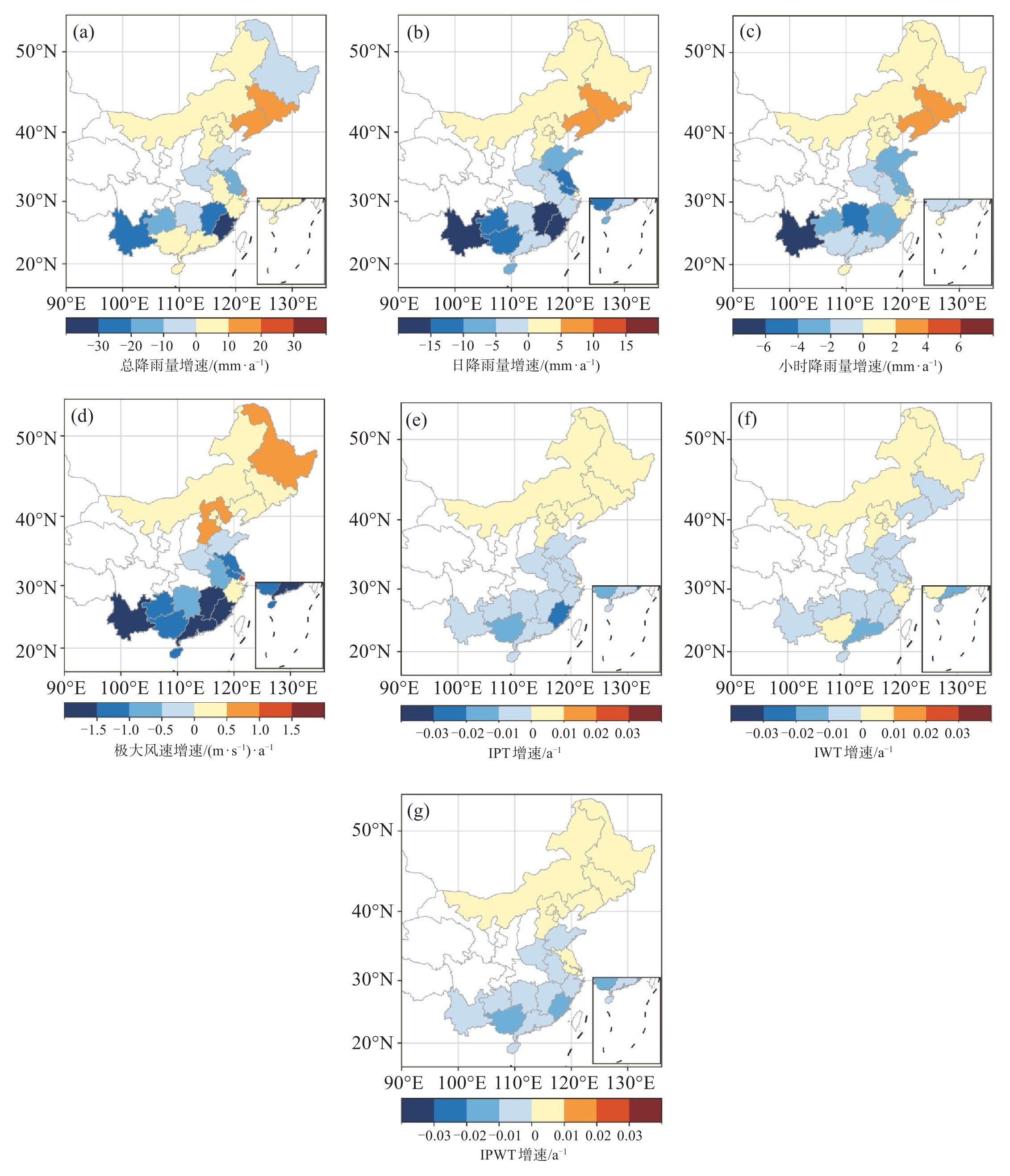
图 3 2014-2023年台风灾害影响指数极大值
a.降水影响指数(IPT);b.大风影响指数(IWT);c.风雨综合影响指数(IPWT);d.降水与大风影响指数比值(IPT/IWT)。

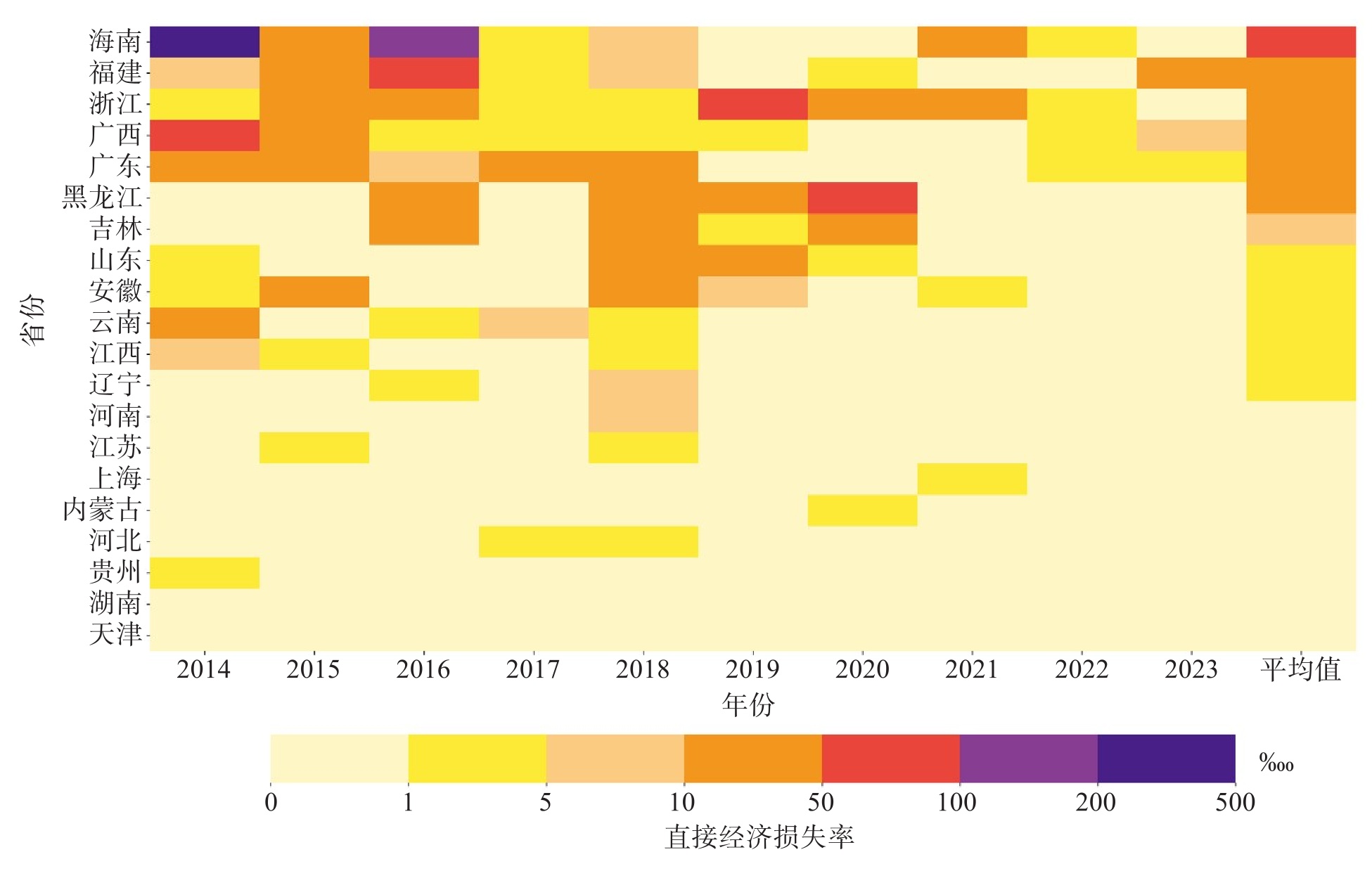
图 4 2014—2023年台风灾害致各省受灾人口数(a)、紧急转移人口(b)、死亡失踪人口(c)、农作物受灾面积(d)、倒塌房屋(e)、直接经济损失(f)、直接经济损失相对国内生产总值占比(g)和TDPr(h)指数情况
图中对应的线性变化趋势虚线为下降, 实线为上升。

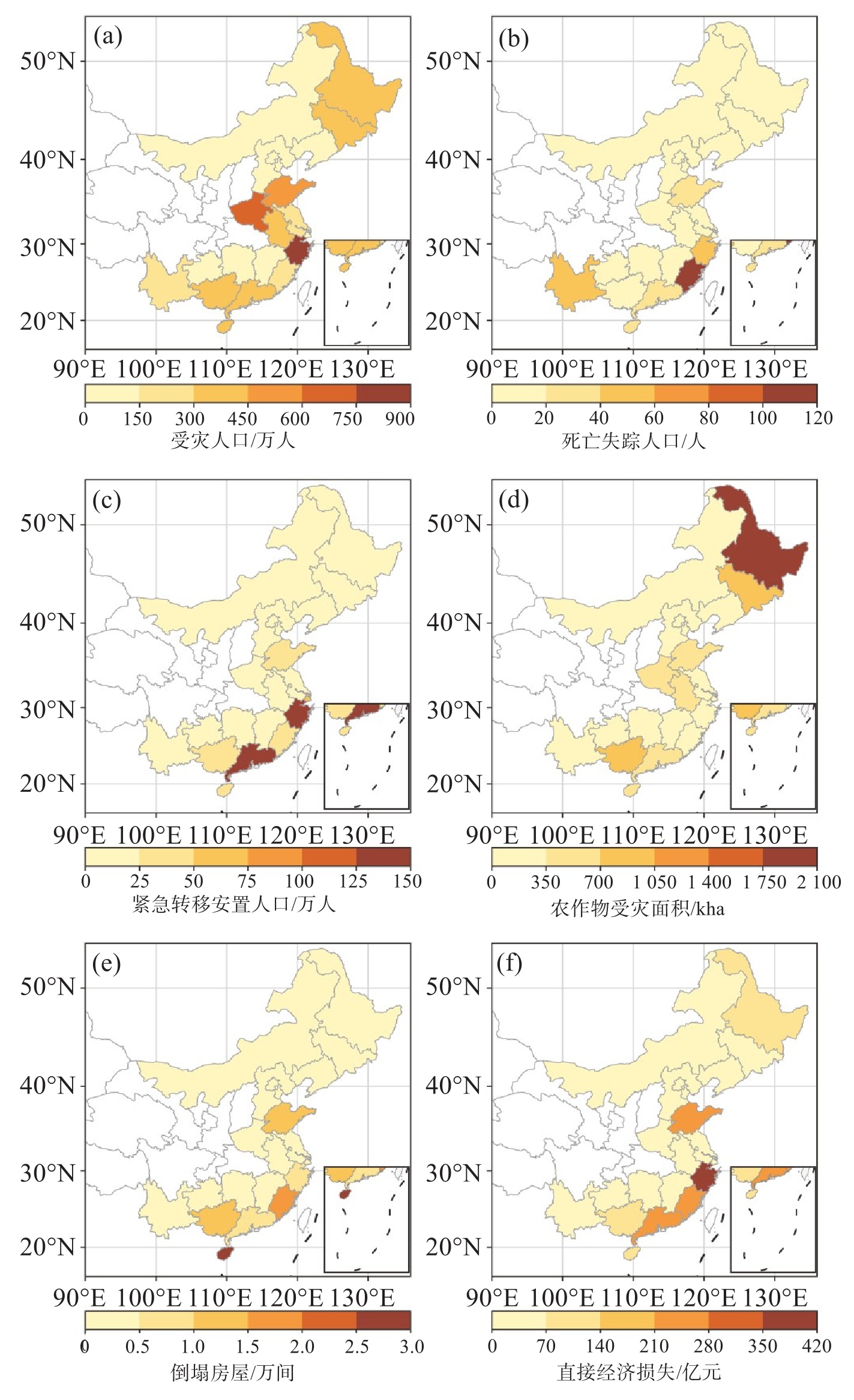
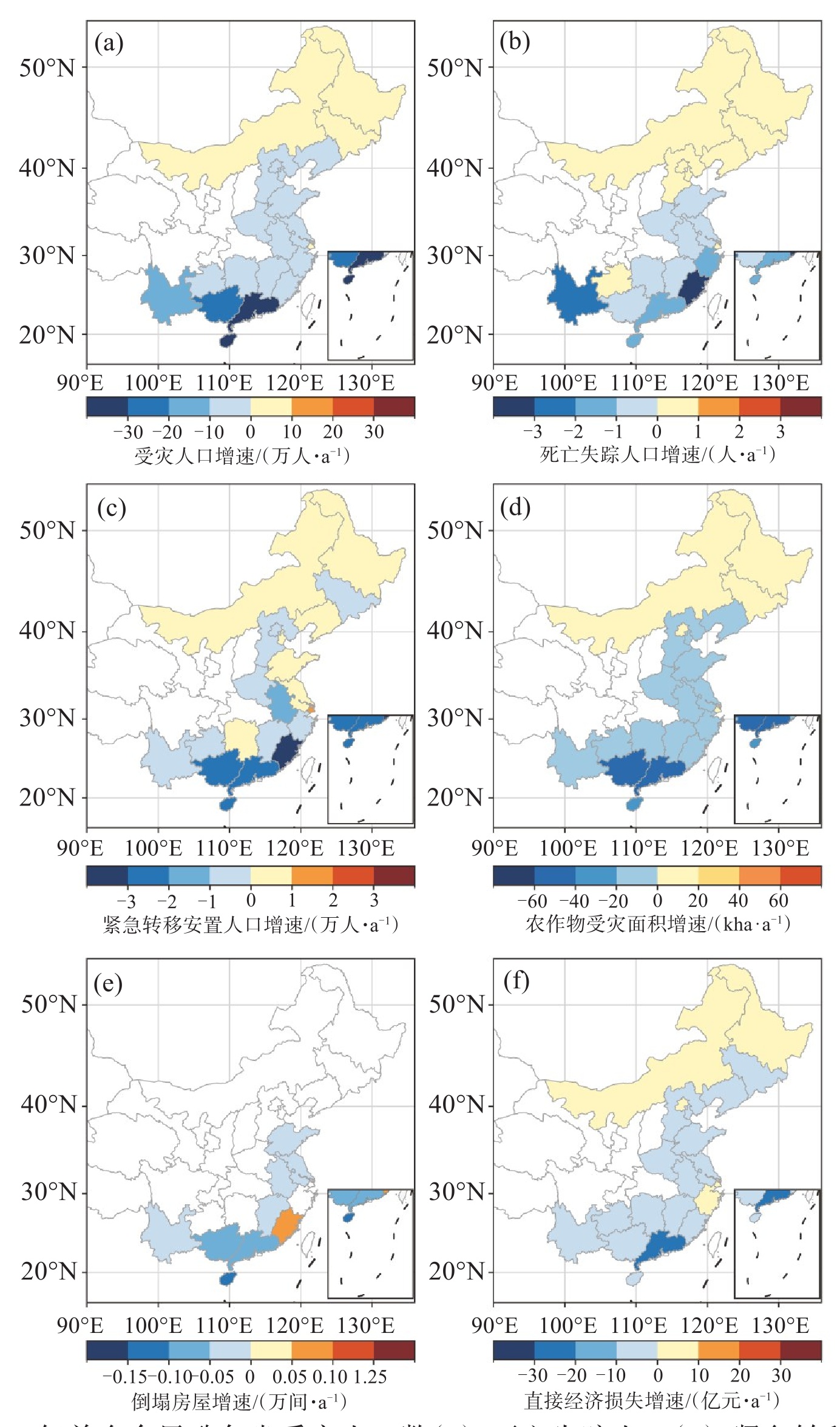
图 9 2014-2023年单个台风致各省受灾人口数(a)、死亡失踪人口(b)、紧急转移安置人口(c)、农作物受灾面积(d)、倒塌房屋(e)、直接经济损失(f)极大值的变化趋势
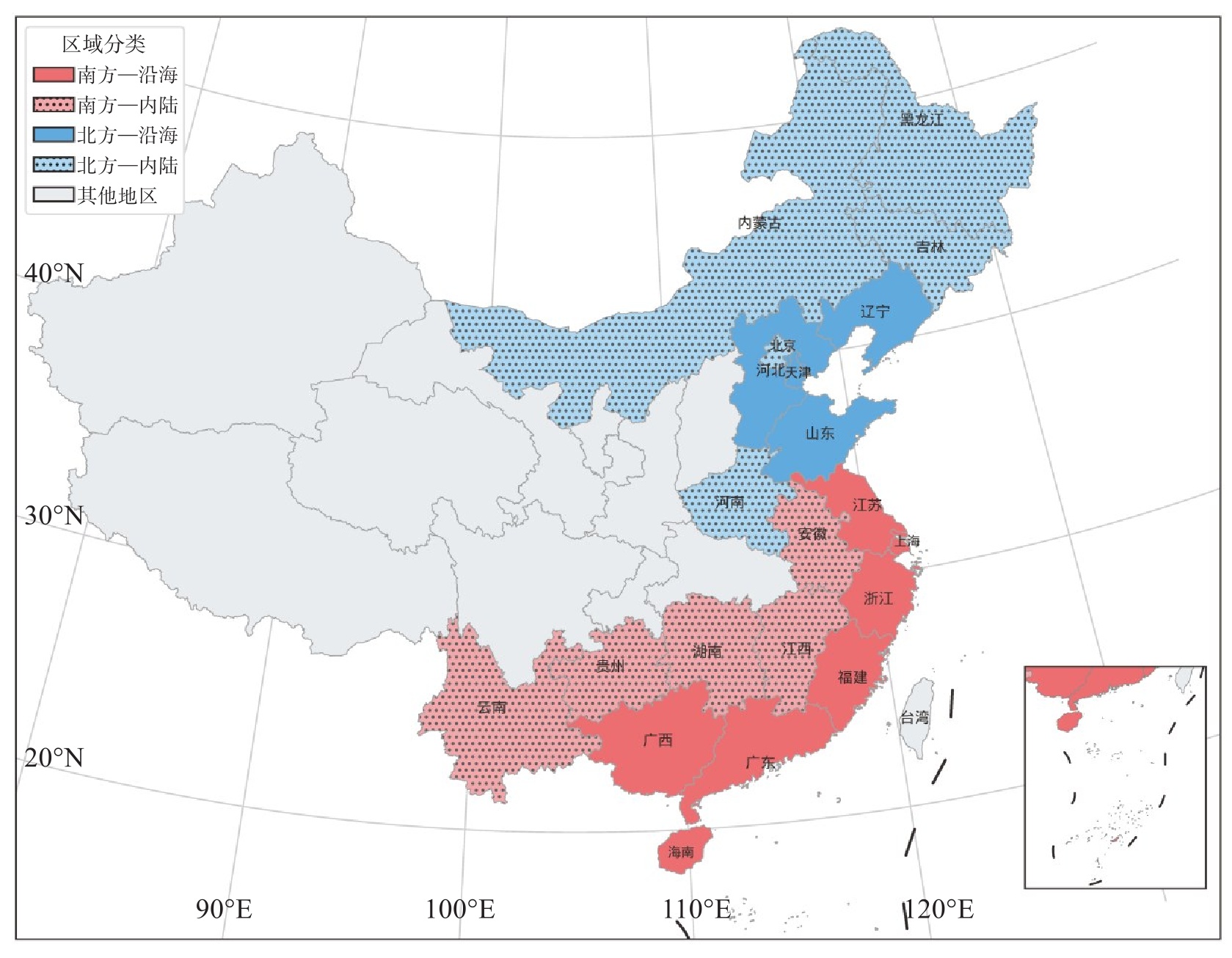
表 1 中国省份(含直辖市)区域划分与归属关系
区域划分 沿海 内陆 南方 浙江、上海、江苏、福建、广东、广西、海南 湖南、安徽、江西、云南、贵州 北方 山东、辽宁、天津、河北 黑龙江、吉林、北京、内蒙古、河南  下载: 导出CSV
表 3 中国台风灾害分区域核心风险类型与防控策略聚焦点
区域 核心风险 防控策略聚焦点 华南 风雨协同效应 提升建筑抗风标准, 优化电网防风设计 华北 广域极端降水 强化跨流域防洪调度与城市内涝治理 东北 强风直接破坏 修订防风工程标准, 加固老旧建筑 西南 暴雨诱发链式灾害 建设地形导向的山洪预警网络
下载: 导出CSV
-
[1] IPCC. Climate Change 2022: Impacts, Adaptation and Vulnerability. Contribution of Working Group Ⅱ to the Sixth Assessment Report of the Intergovernmental Panel on Climate Change[M]. Cambridge: Cambridge University Press, 2022. [2] 中国气象局气候变化中心. 中国气候变化蓝皮书(2023)[M]. 北京: 科学出版社, 2023. [3] Yamaguchi M, Chan J C L, Moon I J, et al. Global warming changes tropical cyclone translation speed[J]. Nature Communications, 2020, 11: 47. [4] Studholme J, Fedorov A V, Gulev S K, et al. Poleward expansion of tropical cyclone latitudes in warming climates[J]. Nature Geoscience, 2022, 15(1): 14-28. [5] Chan J C L. Frequency and intensity of landfalling tropical cyclones in east Asia: Past variations and future projections[J]. Meteorology, 2023, 2(2): 171-190. [6] Liu L, Wang Y Q. Trends in landfalling tropical cyclone-induced precipitation over China[J]. Journal of Climate, 2020, 33(6): 2223-2235. [7] 卢莹, 赵海坤, 赵丹, 等. 1984-2017年影响中国热带气旋灾害的时空特征分析[J]. 海洋学报, 2021, 43(6): 45-61. [8] 柴博语, 徐峰, 徐建军, 等. 近160年西北太平洋副高的年代际变化及其对台风年际变化的影响[J]. 热带气象学报, 2023, 39(2): 276-288. [9] 韩岩松, 姜伟, 肖玉雯, 等. 全球变化背景下热带气旋主要变化特征及影响因素[J]. 地球科学进展, 2023, 38(5): 515-532. [10] 吴婕, 石英. 登陆中国的热带气旋活动及其风雨变化的RegCM4集合预估[J]. 气象学报, 2024, 82(3): 356-370. [11] 王振康, 雍斌. 中国沿海地区热带气旋变化特征分析[J]. 水电能源科学, 2023, 41(4): 22-26. [12] 李冰雪, 史超, 侯精明, 等. 沿海城市台风暴雨时空变化致涝特征模拟[J]. 水科学进展, 2024, 35(3): 440-452. [13] 李铮, 邱兰兰, 王伟, 等。北上台风时空变化特征及其与ENSO的关系[J]. 热带地理, 2024, 44(6): 973-986. [14] 雷小途, 陈佩燕, 杨玉华, 等. 中国台风灾情特征及其灾害客观评估方法[J]. 气象学报, 2009, 67(5): 875-883. [15] Chen P Y, Yu H, Cheung K K W, et al. A potential risk index dataset for landfalling tropical cyclones over the Chinese mainland (PRITC dataset V1.0)[J]. Advances in Atmospheric Sciences, 2021, 38(10): 1791-1802. [16] 丑洁明, 董文杰, 徐洪, 等. 影响中国沿海区域的热带气旋及其经济损失评估[J]. 气象与环境科学, 2022, 45(3): 1-10. [17] 吴吉东, 傅宇, 张洁, 等. 1949-2013年中国气象灾害灾情变化趋势分析[J]. 自然资源学报, 2014, 29(9): 1520-1530. [18] 刘扬, 张立生, 赵慧霞. 中国台风灾害损失与气象要素的关系分析[J]. 气象与环境科学, 2023, 46(4): 1-6. [19] 宋阿伟, 田红, 王胜, 等. 基于风雨综合指数的安徽省台风灾害房屋风险评估方法[J]. 暴雨灾害, 2024, 43(3): 363-370. [20] 刘蔚琴, 唐力生, 谢礼江, 等. 广东台风灾害风雨灾损分离方法[J]. 中国农业气象, 2025, 46(1): 80-88. [21] 曾鹏, 苏朝晖, 方伟华, 等. 基于高精度房屋类型数据的海口市台风次生洪涝灾害损失评估[J]. 灾害学, 2022, 37(4): 155-165. [22] Liu G L, Nong X X, Kou Y, et al. Assessment of typhoon storm surge disaster scale based on expansion model[J]. Journal of Oceanology and Limnology, 2023, 41(2): 518-531. [23] 巢文, 钱晓涛. 基于熵权-TOPSIS法的台风灾害脆弱性评价及保费厘定——以福建省为例[J]. 福建金融, 2023(3): 44-51. [24] Liu Q Y, Qiao F X, Yu Y Q, et al. Bias analysis in the simulation of the western north Pacific tropical cyclone characteristics by two high-resolution global atmospheric models[J]. Advances in Atmospheric Sciences, 2023, 40(4): 634-652. [25] Luo Y H, Du Y. The roles of low-level jets in" $ 21 \cdot 7 $"Henan extremely persistent heavy rainfall event[J]. Advances in Atmospheric Sciences, 2023, 40(3): 350-373. [26] Zhang G S, Mao J Y, Hua W, et al. Synergistic effect of the planetary-scale disturbance, typhoon and meso-β-scale convective vortex on the extremely intense rainstorm on 20 July 2021 in Zhengzhou[J]. Advances in Atmospheric Sciences, 2023, 40(3): 428-446. [27] Yin L, Ping F, Mao J H, et al. Analysis on precipitation efficiency of the"21.7"Henan extremely heavy rainfall event[J]. Advances in Atmospheric Sciences, 2023, 40(3): 374-392. [28] 姚秀萍, 黄逸飞, 包晓红, 等. "23 • 7"华北极端强降水特征和水汽条件研究[J]. 气象学报, 2024, 82(5): 585-599. [29] 聂高臻, 钱奇峰, 贾莉, 等. 2023年西北太平洋和南海台风活动概述[J]. 海洋气象学报, 2024, 44(4): 101-111. [30] 李霁杭, 陈佩燕, 汪洋, 等. 2023年中国台风灾害、风雨影响特征与防灾减灾成效分析[J]. 气象, 2025, 51(12): 1621-1634. [31] 朱男男, 王科, 胡田田, 等. 1949-2019年中心经过渤海的北上台风统计分析[J]. 海洋预报, 2024, 41(3): 90-97. [32] Lu X Q, Yu H, Ying M, et al. Western North Pacific tropical cyclone database created by the China Meteorological Administration[J]. Advances in Atmospheric Sciences, 2021, 38(4): 690-699. [33] Ying M, Zhang W, Yu H, et al. An overview of the China Meteorological Administration tropical cyclone database[J]. Journal of Atmospheric and Oceanic Technology, 2014, 31(2): 287-301. [34] Chen P Y, Yu H, Xu M, et al. A simplified index to assess the combined impact of tropical cyclone precipitation and wind on China[J]. Frontiers of Earth Science, 2019, 13(4): 672-681. [35] Chen P Y, Lei X T, Ying M. Introduction and application of a new comprehensive assessment index for damage caused by tropical cyclones[J]. Tropical Cyclone Research and Review, 2013, 2(3): 176-183. [36] Pearson K. Notes on regression and inheritance in the case of two parents[J]. Proceedings of the Royal Society of London, 1895, 58: 240-242. -

 点击查看大图
图(10) / 表(2)
计量
- 文章访问数: 1
- HTML全文浏览量: 1
- PDF下载量: 0
- 被引次数: 0
 粤公网安备 4401069904700003号
