



Development and Evaluation of Kilometer-scale Regional Atmospheric Reanalysis Data
-
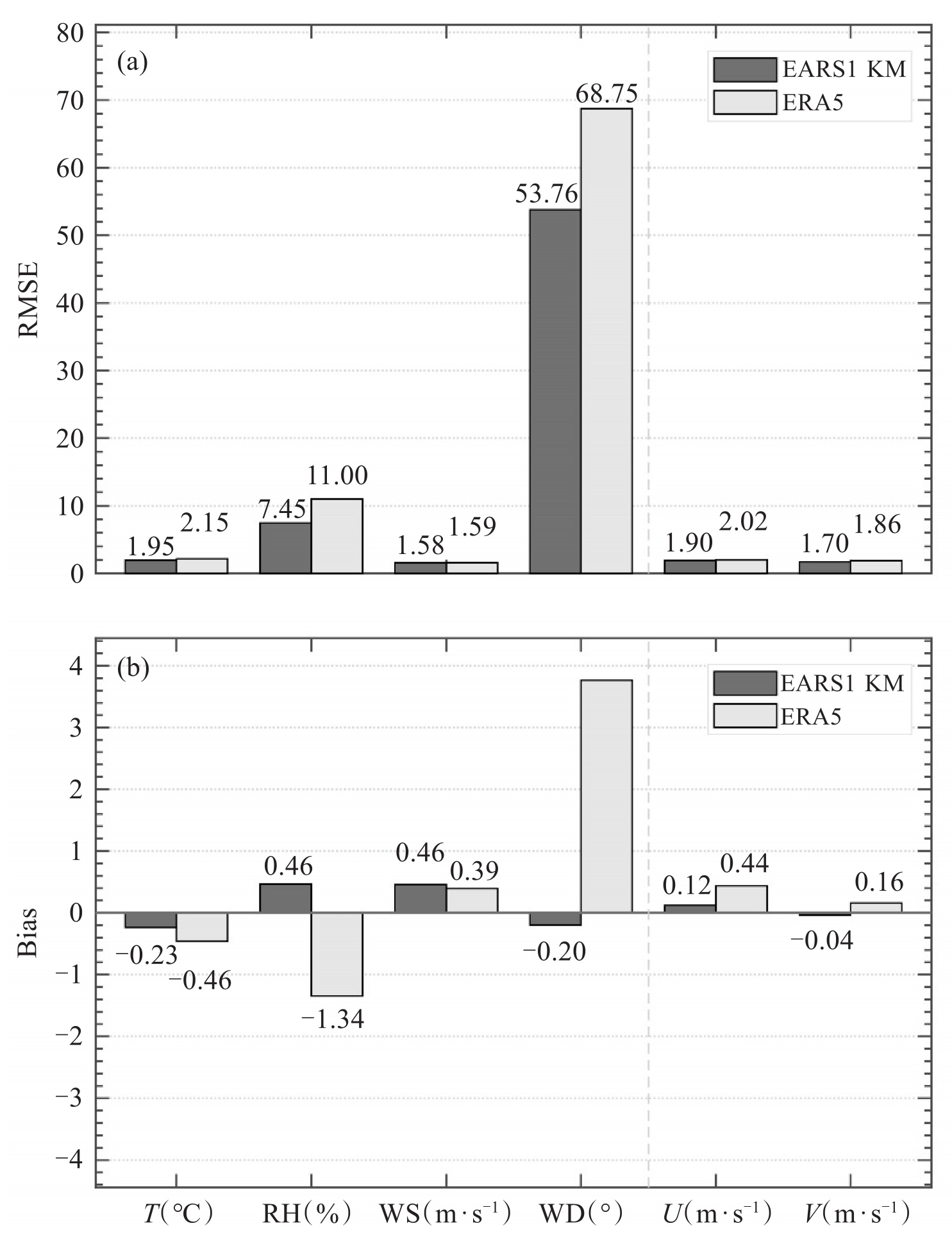
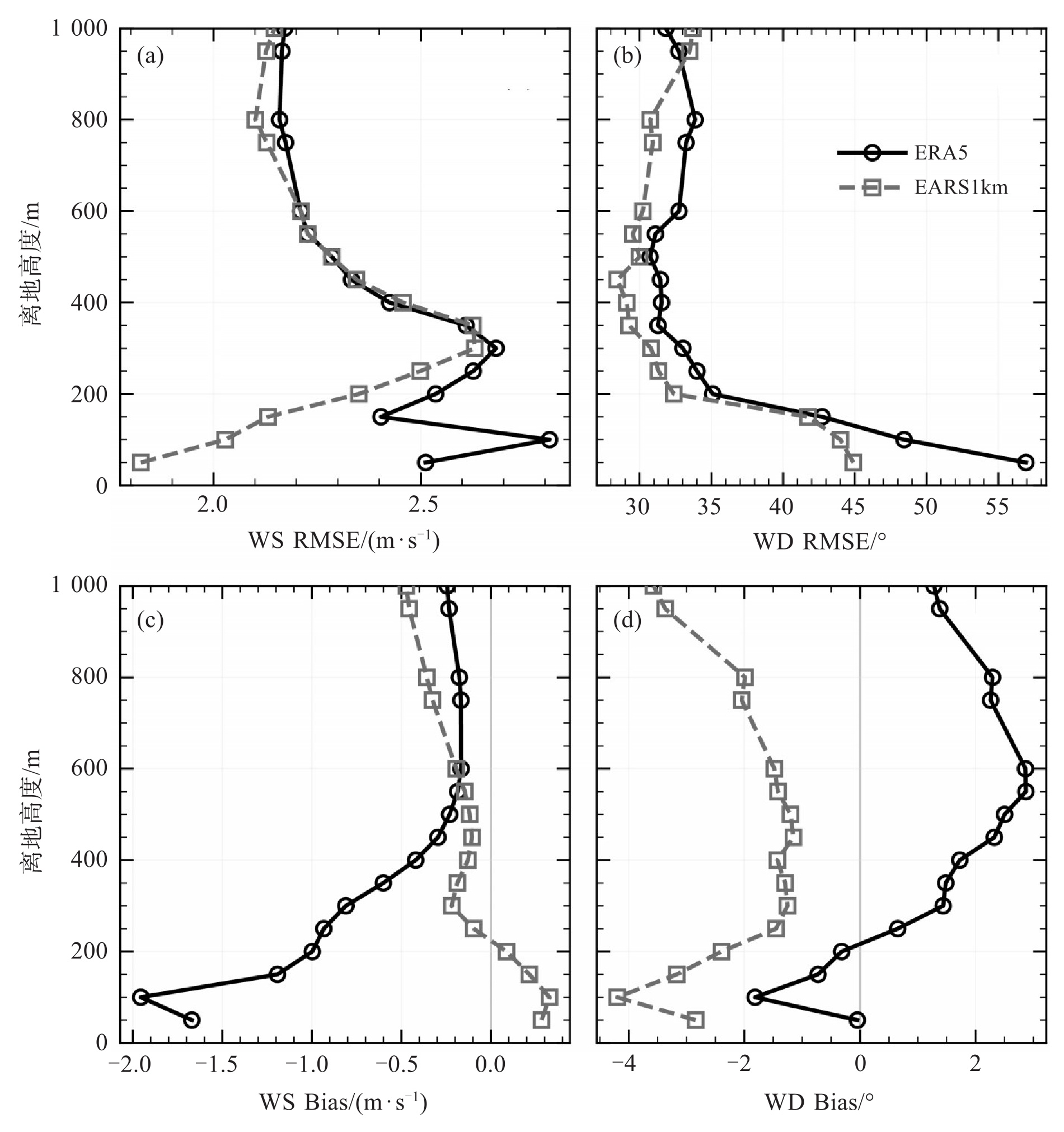
摘要: 高时空分辨率区域大气再分析数据在风能资源评估与开发利用中起着重要的作用。本研究基于东亚区域再分析系统(EARS), 在内蒙古中部地区开展了空间分辨率1 km (简称"EARS1km")、时间分辨率10 min的区域大气再分析数据研制和试验。在对EARS参数优化的基础上, 同化了地面气象加密观测资料, 试验性地研制了2025年再分析数据集。以区域内16个地面站和1个探空站资料为参照, 评估结果表明地面温度、相对湿度、风速、风向、$ U $风和$ V $风的均方根误差(偏差)分别为$ 1.9{\;}^{\circ} \mathrm{C} $($-0.2{\;}^{\circ} \mathrm{C} $)、$ 7.5 \% $($ +0.5 \% $)、$ 1.58 \mathrm{~m} \cdot \mathrm{~s}^{-1}\left(+0.46 \mathrm{~m} \cdot \mathrm{~s}^{-1}\right. $)、$ 53.8^{\circ}\left(-0.2^{\circ}\right)、1.90 \mathrm{~m} \cdot \mathrm{~s}^{-1}\left(+0.12 \mathrm{~m} \cdot \mathrm{~s}^{-1}\right) $和$ 1.70 \mathrm{~m} \cdot \mathrm{~s}^{-1}\left(-0.04 \mathrm{~m} \cdot \mathrm{~s}^{-1}\right) $, EARS 1 km在全部要素的性能均优于ERA5。总体而言, 风向的改进最为显著, 均方根误差由$ 68.7^{\circ} $降至53.8°, 改进率为21.8%。从季节分布来看, 风向均方根误差改进从春季约10°扩大至冬季约20°。EARS1km主导风向一致性系数0.69明显高于ERA5的0.52。进一步分析表明, 草地和灌木风速正偏差偏大。对比探空观测表明, 50~150 m风速改进11%~28%, 平均改进22.2%。新研制的高时空分辨率再分析数据可为风电场选址前期的风能资源精细化评估提供参考。
-
关键词:
- 公里级区域大气再分析 /
- 风场评估 /
- 复杂下垫面 /
- 风能资源
Abstract: High-spatiotemporal-resolution regional atmospheric reanalysis data are vitally important for wind energy resource assessment and development. Based on the East Asia Reanalysis System (EARS), this study develops a 1 km spatial/10 min temporal resolution regional atmospheric reanalysis dataset for central Inner Mongolia (hereafter"EARS1km") for the year 2025. Through optimized EARS parameter settings and assimilation of dense surface meteorological observations, the dataset is experimentally generated. Evaluation against observations from 16 surface stations and one radiosonde station within the domain shows that the root mean square errors (biases) of 2-m temperature, relative humidity, wind speed, wind direction, the $ U $-wind component, and the $ V $-wind component are $ 1.9{\;}^{\circ} \mathrm{C}\left(-0.2{\;}^{\circ} \mathrm{C}\right), 7.5 \%(+0.5 \%) $, $ 1.58 \mathrm{~m} \cdot \mathrm{~s}^{-1}\left(+0.46 \mathrm{~m} \cdot \mathrm{~s}^{-1}\right), 53.8^{\circ}\left(-0.2^{\circ}\right), 1.90 \mathrm{~m} \cdot \mathrm{~s}^{-1}\left(+0.12 \mathrm{~m} \cdot \mathrm{~s}^{-1}\right) $, and $ 1.70 \mathrm{~m} \cdot \mathrm{~s}^{-1}\left(-0.04 \mathrm{~m} \cdot \mathrm{~s}^{-1}\right) $, respectively. EARS1km outperforms ERA5 for all evaluated variables. The most pronounced improvement is in wind direction, with RMSE decreasing from $ 68.7^{\circ} $ to $ 53.8^{\circ} $, corresponding to an improvement rate of 21.8%. Seasonally, the wind direction RMSE improvement increases from about 10° in spring to about $ 20^{\circ} $ in winter. The dominant wind direction consistency coefficient of EARS1km(0.69) is significantly higher than that of ERA5(0.52). Further analysis reveals a relatively large positive wind speed bias over grassland and shrubland. Radiosonde comparisons show wind speed RMSE improvements of 11%-28% at 50-150 m above ground level, with an average improvement of 22.2%. The newly developed high-spatiotemporal-resolution reanalysis dataset provides a valuable reference for refined wind energy resource assessment in the preliminary stage of wind farm siting. -

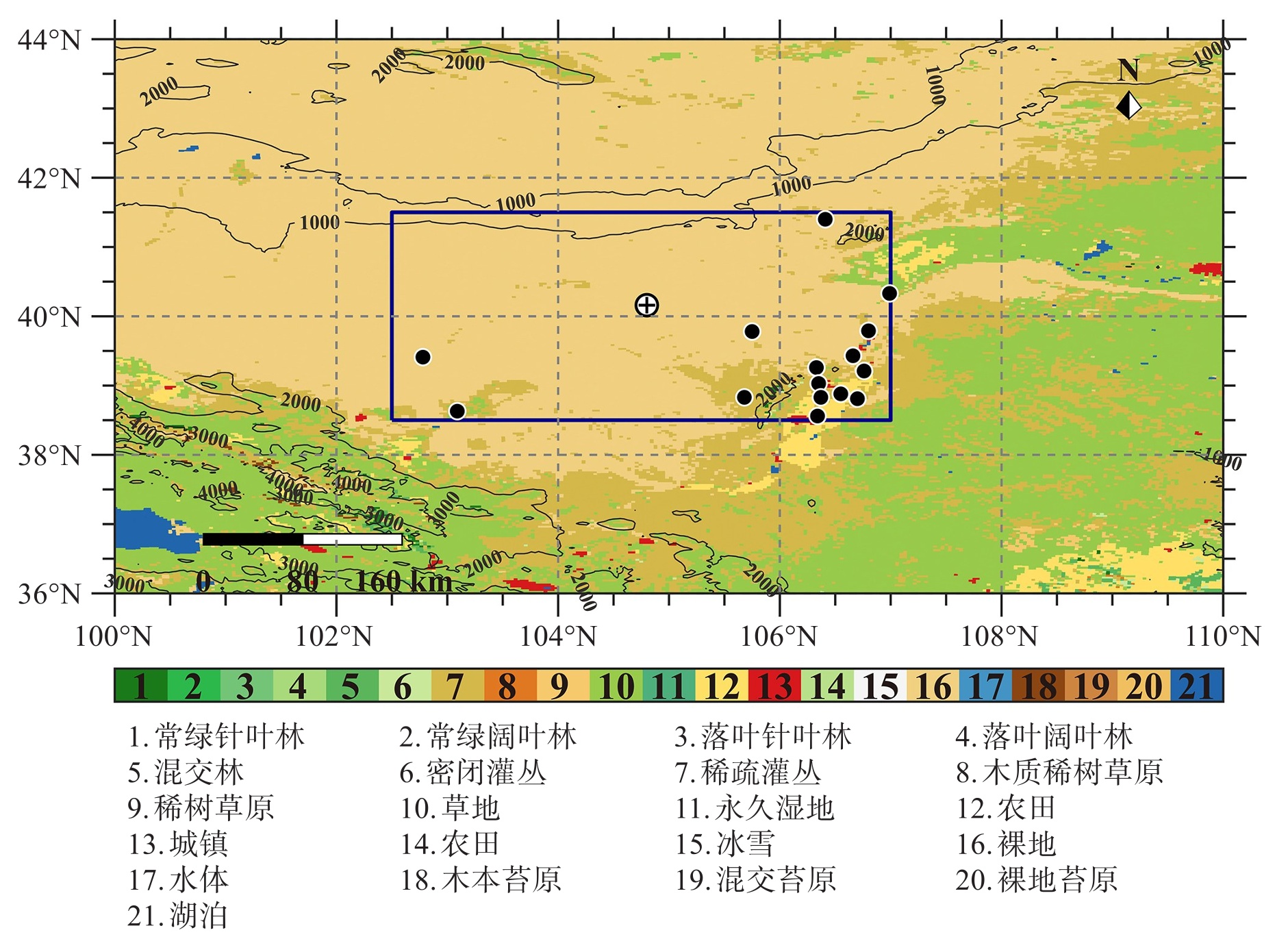
图 1 模式区域空间分布, 外层和内层矩形分别表示分辨率为3 km和1 km区域
填色表示下垫面土地类型, 等值线表示地形高度;黑色点表示地面站点, 圆圈带叉(⊗)表示探空位置。

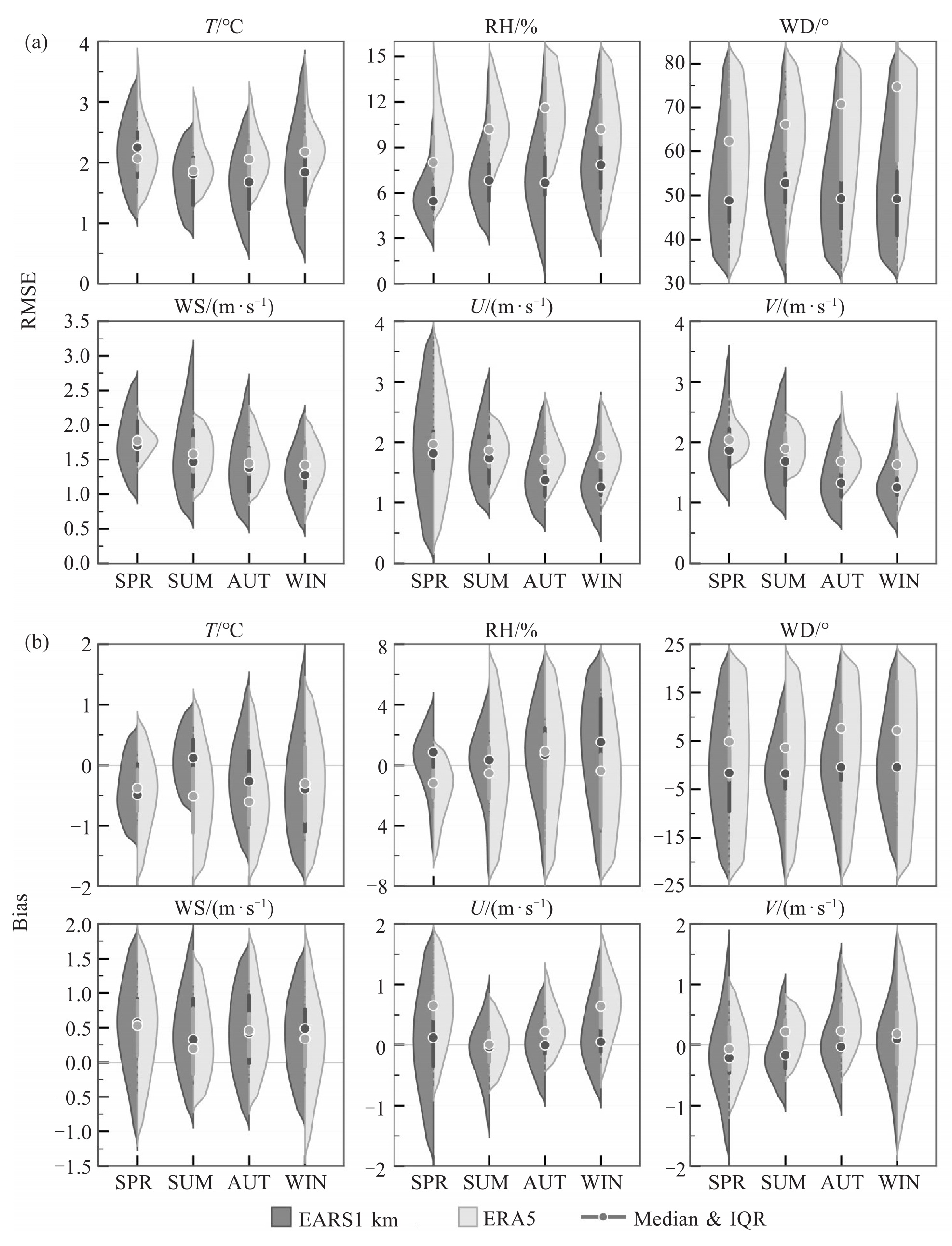
图 3 地面气象要素不同季节误差分布的小提琴图
a.均方根误差(RMSE);b.偏差(Bias)。上排从左至右分别为气温($ T $)、相对湿度(RH)和风向(WD), 下排从左至右分别为风速(WS)、 $ U $风分量和 $ V $风分量。深灰色和浅灰色分别表示EARS1km和ERA5, 圆点和粗线分别表示中位数和四分位距。

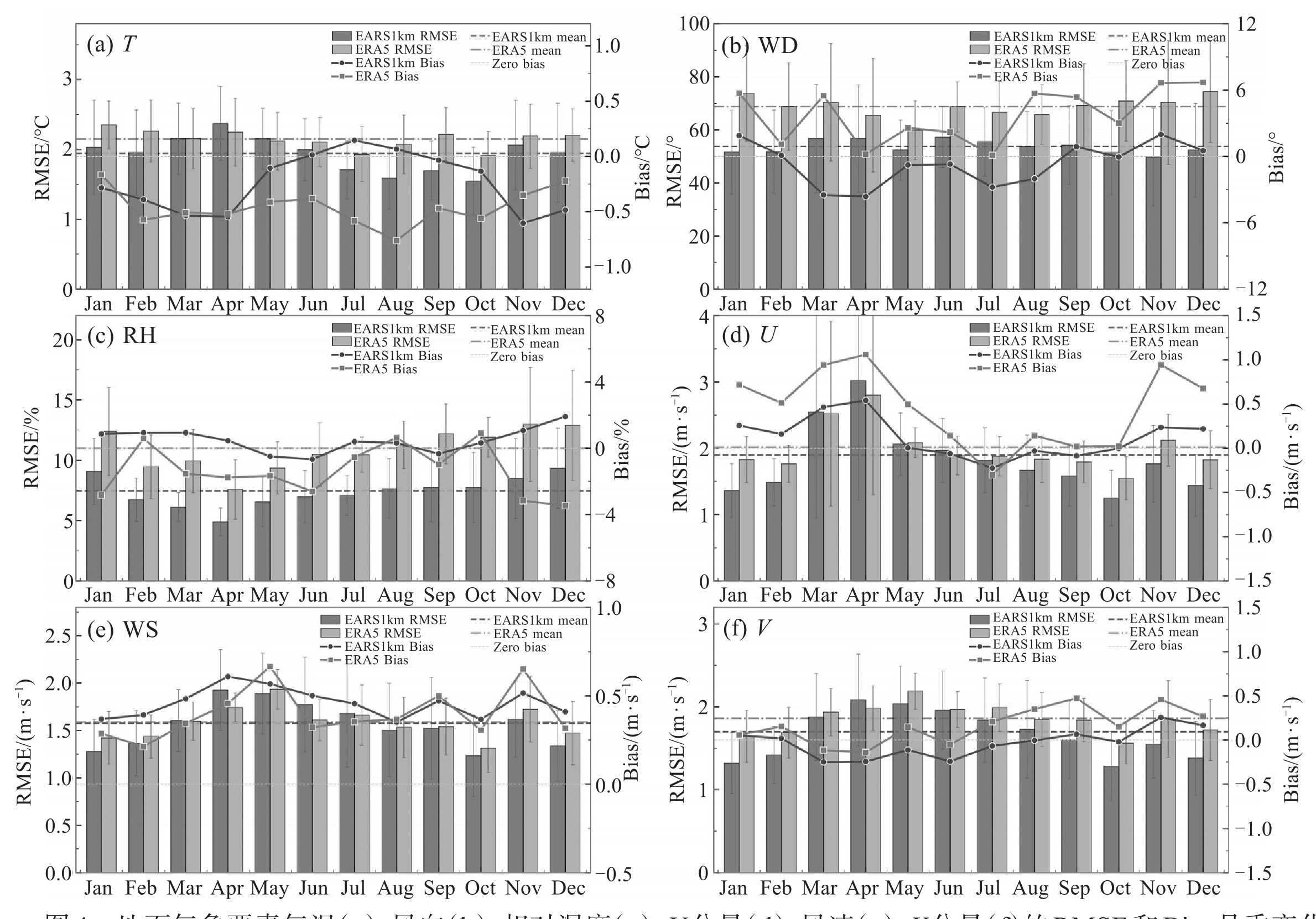
图 4 地面气象要素气温(a)、风向(b)、相对湿度(c)、 $ U $分量(d)、风速(e)、 $ V $分量(f)的RMSE和Bias月季变化
柱状表示RMSE, 折线表示Bias。

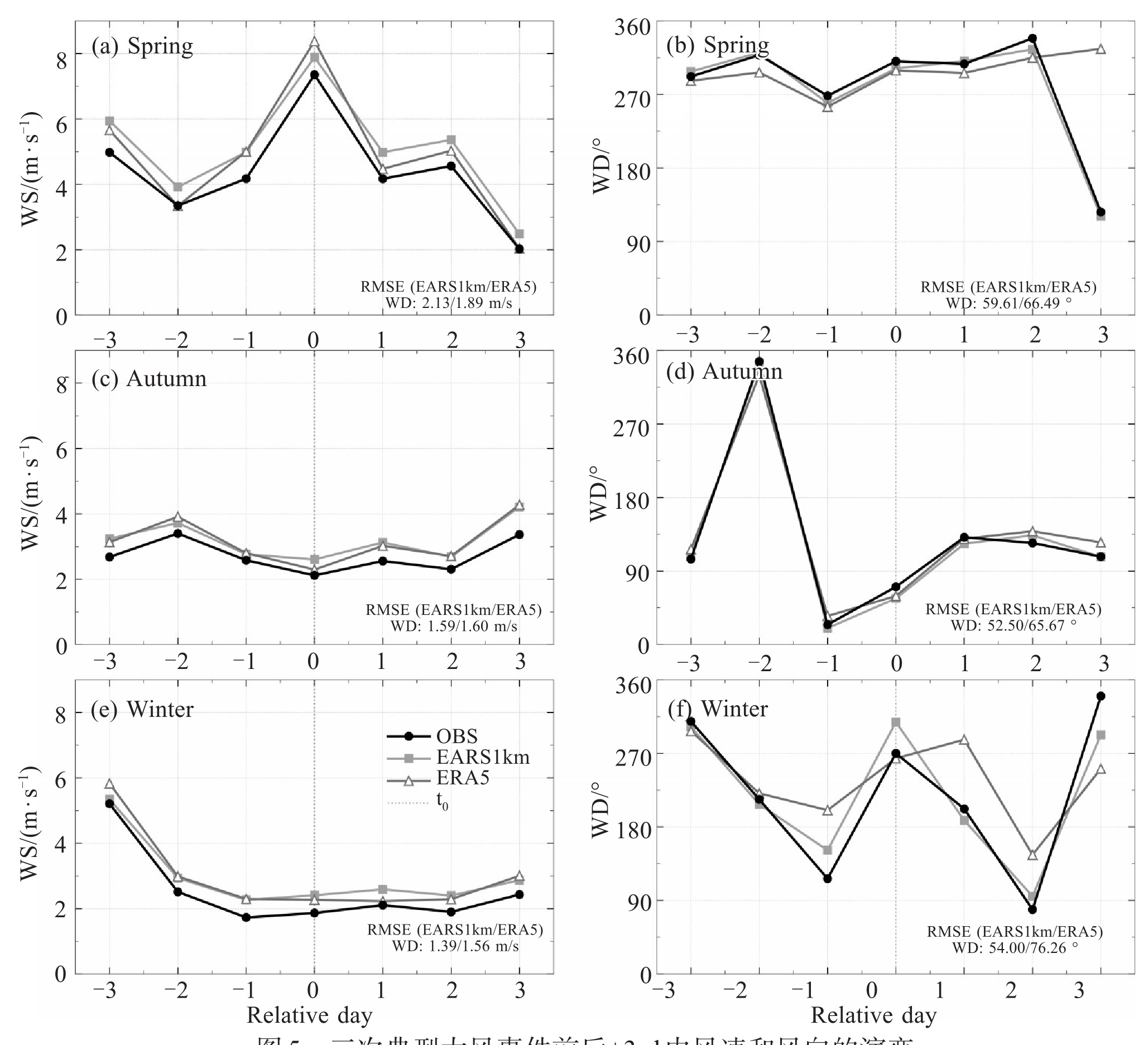
图 5 三次典型大风事件前后 $ \pm 3 \mathrm{~d} $内风速和风向的演变
(a)、(c)、(e)分别为春季强风事件(2025-04-11)、秋季风向急变事件(2025-09-17)和冬季风向急变事件(2025-12-15)的风速, (b)、(d)、(f)为对应事件的风向。黑色圆点、灰色方块和空心三角分别表示观测、EARS1km和ERA5, 坚直虚线标示事件时刻($ t_{0} $), 各子图右下角标注对应时段的RMSE。

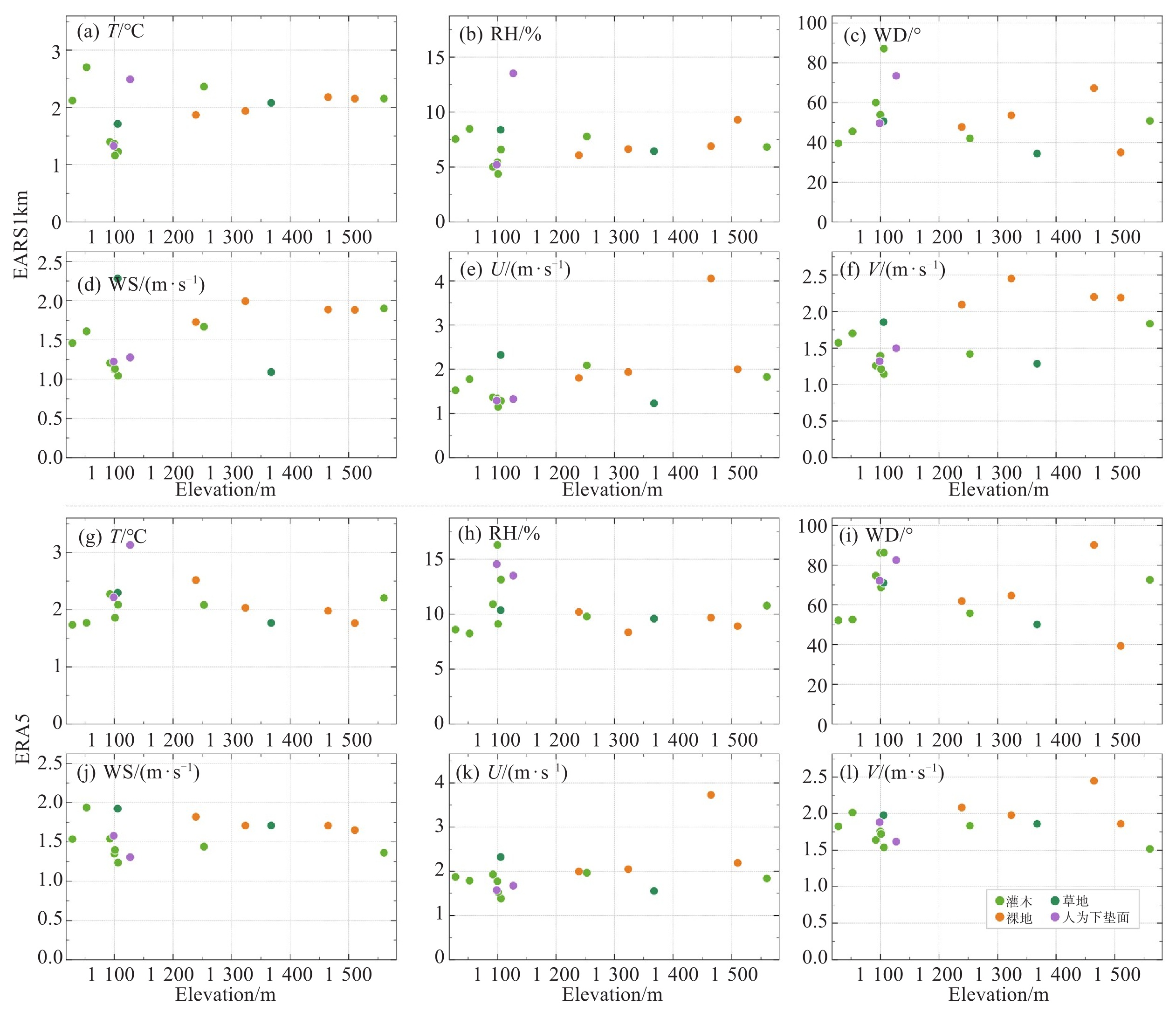
图 6 地面气象要素站点RMSE与海拔的散点分布, a~f为EARS 1km, g~1为ERA5
从左至右、从上到下分别为气温、相对湿度、风向、风速、 $ U $风和 $ V $风, 不同颜色表示不同下垫面类型。

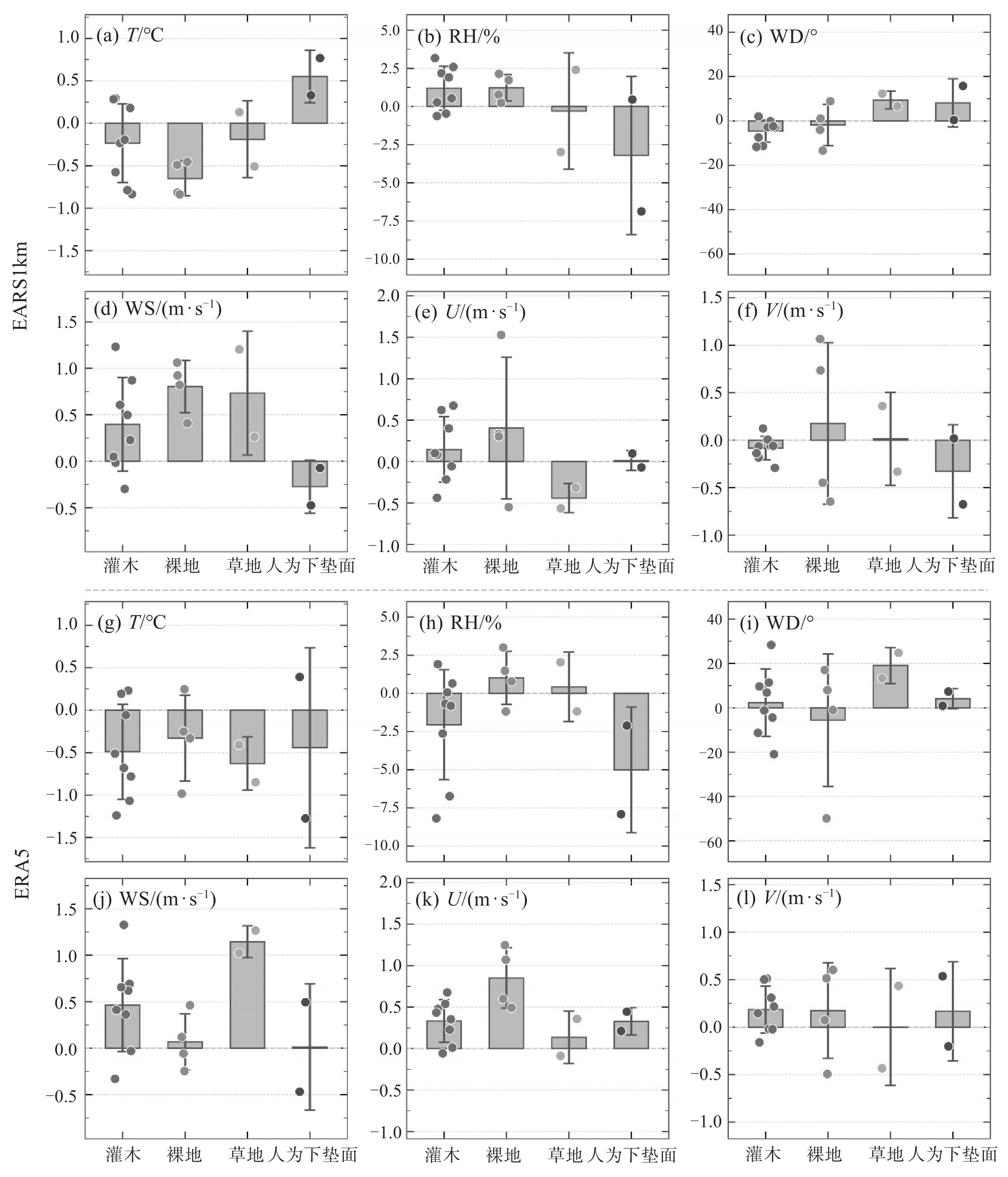
图 7 不同下垫面类型地面气象要素的Bias分布, a~f为EARS1km, g~1为ERA5从左至右、从上到下分别为气温、相对湿度、风向、风速、 $ U $风和 $ V $风, 柱状和误差棒分别表示平均Bias及其标准差, 散点表示各站点Bias。

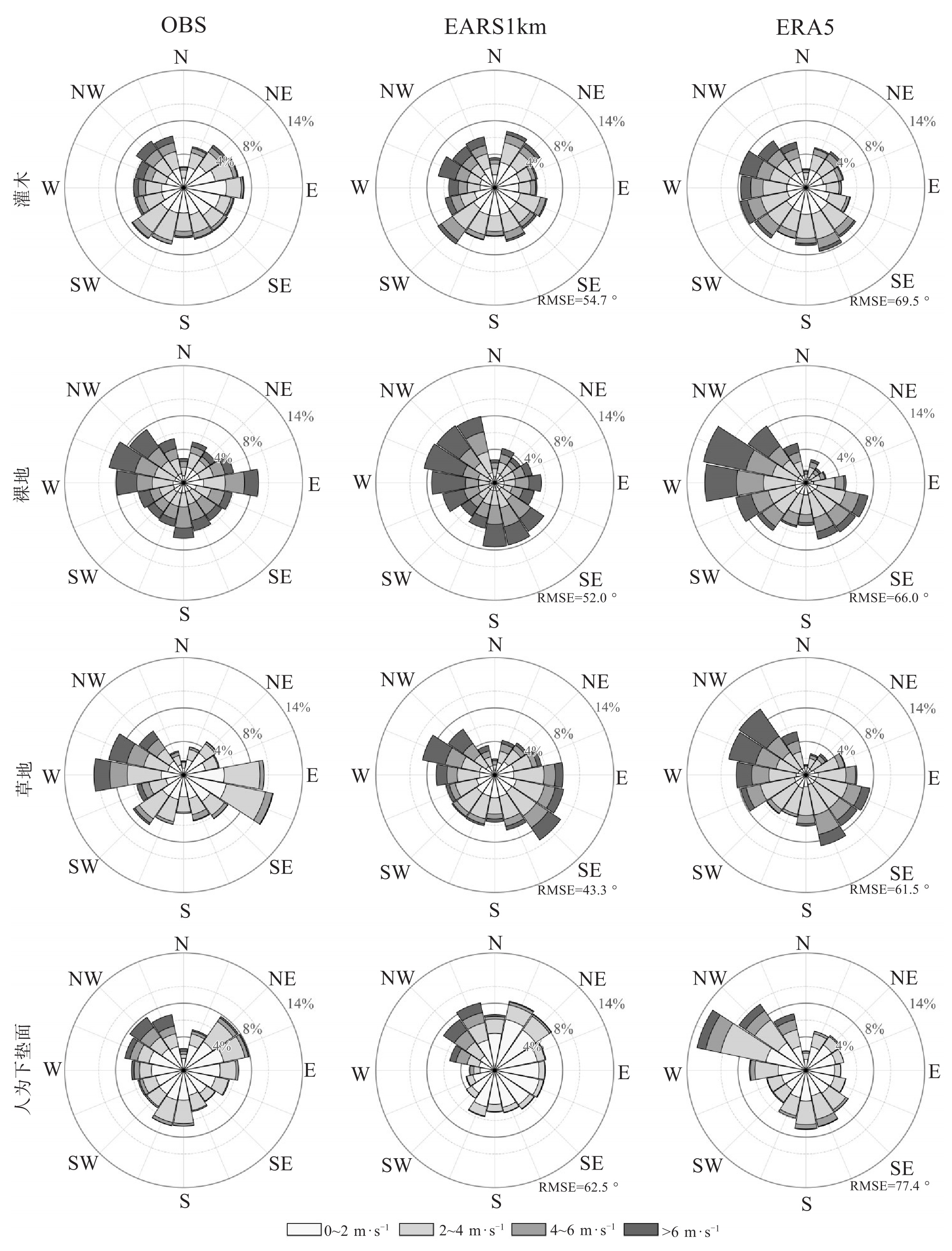
图 9 不同下垫面观测(OBS)、EARS1km和ERA5的风玫瑰对比
a~c.灌木;d~f.裸地;g~i.草地;j~l.人为下垫面。每行由左至右分别为OBS、EARS1km和ERA5。不同灰度表示不同风速等级, EARS1km和ERA5子图右下角标注风向RMSE。
-
[1] Soci C, Hersbach H, Simmons A, et al. The ERA5 global reanalysis from 1940 to 2022[J]. Quarterly Journal of the Royal Meteorological Society, 2024, 150(764): 4014-4048. [2] Hersbach H, Bell B, Berrisford P, et al. The ERA5 global reanalysis[J]. Quarterly Journal of the Royal Meteorological Society, 2020, 146(730): 1999-2049. [3] Fujiwara M, Wright J S, Manney G L, et al. Introduction to the SPARC Reanalysis Intercomparison Project (S-RIP) and overview of the reanalysis systems[J]. Atmospheric Chemistry and Physics, 2017, 17(2): 1417-1452. [4] Staffell I, Pfenninger S. Using bias-corrected reanalysis to simulate current and future wind power output[J]. Energy, 2016, 114(C): 1224-1239. [5] Olauson J. ERA5: the new champion of wind power modelling?[J]. Renewable Energy, 2018, 126: 322-331. [6] Porté-Agel F, Bastankhah M, Shamsoddin S. Wind-turbine and wind-farm flows: a review[J]. Boundary-Layer Meteorology, 2020, 174(1): 1-59. [7] Fleming P, King J, Dykes K, et al. Initial results from a field campaign of wake steering applied at a commercial wind farm-Part 1[J]. Wind Energy Science, 2019, 4(2): 273-285. [8] Dee D P, Uppala S M, Simmons A J, et al. The ERA-Interim reanalysis: configuration and performance of the data assimilation system[J]. Quarterly Journal of the Royal Meteorological Society, 2011, 137(656): 553-597. [9] Gelaro R, McCarty W, Suárez M J, et al. The modern-era retrospective analysis for research and applications, version 2 (MERRA-2)[J]. Journal of Climate, 2017, 30(14): 5419-5454. [10] Jiménez P A, Dudhia J. Improving the representation of resolved and unresolved topographic effects on surface wind in the WRF model[J]. Journal of Applied Meteorology and Climatology, 2012, 51(2): 300-316. [11] Jiménez P A, Dudhia J. On the ability of the WRF model to reproduce the surface wind direction over complex terrain[J]. Journal of Applied Meteorology and Climatology, 2013, 52(7): 1610-1617. [12] Hahmann A N, Rostkier-Edelstein D, Warner T T, et al. A reanalysis system for the generation of mesoscale climatographies[J]. Journal of Applied Meteorology and Climatology, 2010, 49(5): 954-972. [13] Frank C W, Pospichal B, Wahl S, et al. The added value of high resolution regional reanalyses for wind power applications[J]. Renewable Energy, 2020, 148: 1094-1109. [14] Yin J F, Liang X D, Xie Y X, et al. East Asia reanalysis system (EARS)[J]. Earth System Science Data, 2023, 15(6): 2329-2346. [15] Prein A F, Langhans W, Fosser G, et al. A review on regional convection-permitting climate modeling: demonstrations, prospects, and challenges[J]. Reviews of Geophysics, 2015, 53(2): 323-361. [16] Ramirez Camargo L, Gruber K, Nitsch F. Assessing variables of regional reanalysis data sets relevant for modelling small-scale renewable energy systems[J]. Renewable Energy, 2019, 133: 1468-1478. [17] Janjić Z I. The step-mountain eta coordinate model: further developments of the convection, viscous sublayer, and turbulence closure schemes[J]. Monthly Weather Review, 1994, 122(5): 927-945. [18] Huang J, Yin J F, Wang M Z, et al. Evaluation of five reanalysis products with radiosonde observations over the central Taklimakan Desert during summer[J]. Earth and Space Science, 2021, 8(5): e2021EA001707. [19] Holtslag A A M, Svensson G, Baas P, et al. Stable atmospheric boundary layers and diurnal cycles: challenges for weather and climate models[J]. Bulletin of the American Meteorological Society, 2013, 94(11): 1691-1706. [20] Sandu I, Beljaars A, Bechtold P, et al. Why is it so difficult to represent stably stratified conditions in numerical weather prediction (NWP) models?[J]. Journal of Advances in Modeling Earth Systems, 2013, 5(2): 117-133. [21] Feser F, Rockel B, von Storch H, et al. Regional climate models add value to global model data: a review and selected examples[J]. Bulletin of the American Meteorological Society, 2011, 92(9): 1181-1192. [22] Feng J W, Liu H Z, Wang L, et al. Seasonal and inter-annual variation of surface roughness length and bulk transfer coefficients in a semiarid area[J]. Science China Earth Sciences, 2012, 55(2): 254-261. [23] Niu G Y, Yang Z L, Mitchell K E, et al. The community Noah land surface model with multiparameterization options (Noah-MP): 1. Model description and evaluation with local-scale measurements[J]. Journal of Geophysical Research, 2011, 116(D12): D12109. [24] Draxl C, Hahmann A N, Peña A, et al. Evaluating winds and vertical wind shear from Weather Research and Forecasting model forecasts using seven planetary boundary layer schemes[J]. Wind Energy, 2014, 17(1): 39-55. [25] Floors R, Vincent C L, Gryning S E, et al. The wind profile in the coastal boundary layer: wind lidar measurements and numerical modelling[J]. Boundary-Layer Meteorology, 2013, 147(3): 469-491. [26] Bollmeyer C, Keller J D, Ohlwein C, et al. Towards a high-resolution regional reanalysis for the European CORDEX domain[J]. Quarterly Journal of the Royal Meteorological Society, 2015, 141(686): 1-15. [27] Santos-Alamillos F J, Pozo-Vázquez D, Ruiz-Arias J A, et al. Analysis of WRF model wind estimate sensitivity to physics parameterization choice and terrain representation in Andalusia (southern Spain)[J]. Journal of Applied Meteorology and Climatology, 2013, 52(7): 1592-1609. -

 下载:
 点击查看大图
计量
- 文章访问数: 0
- HTML全文浏览量: 0
- PDF下载量: 0
- 被引次数: 0
 粤公网安备 4401069904700003号
