



Comparative Study of Machine Learning Methods for Typhoon Intensity Monitoring in the Western Pacific Based on Satellite Data
-
摘要: 台风是严重影响沿海地区的自然灾害,准确监测其强度对于防灾减灾具有重要意义。基于卫星观测结合深度学习技术已成为台风强度监测的新一代方法,然而不同深度学习方法的准确度并不明确。因此,本文评估了六种基于深度学习的卷积神经网络模型在西太平洋台风强度监测中的表现。本研究利用2015—2024年Himawari-8/9卫星云产品数据和中国气象局台风最佳路径数据,对比分析了LeNet-5、AlexNet、DenseNet-121、VGG-16、ResNet-50以及GoogleNet-InceptionV3等模型的计算效果。本文不仅探讨了这些模型在不同强度台风场景下的适用性和性能表现,还对模型的特征提取步骤进行可视化,旨在更清晰地说明模型之间的差异以及模型工作原理。结果表明,LeNet-5与AlexNet在极弱(TD)和极强(SuperTY)级别下偏差最大;DenseNet-121在各强度下Bias分布较为平均;ResNet-50、VGG-16和GoogleNet-InceptionV3则在中等强度范围(TS、STS、TY、STY)内表现较为稳定。总体来看,GoogleNet-InceptionV3模型估计准确度最高(R2=0.89),但ResNet-50运行速度更快(R2=0.87)。Abstract: Typhoons are natural disasters that severely impact coastal areas, and accurately monitoring their intensity is crucial for disaster prevention and mitigation. Combining satellite observations with deep learning technology has become a pomising new method for typhoon intensity monitoring. However, the accuracy of different deep learning methods remains unclear. This study evaluates the performance of six convolutional neural network models based on deep learning in monitoring typhoon intensity in the Western Pacific. Using Himawari-8 / 9 satellite cloud product data and the China Meteorological Administration's best track data from 2015 to 2024, we analyzed the computational effectiveness of LeNet-5, AlexNet, DenseNet-121, VGG-16, ResNet-50, and GoogleNet-InceptionV3 models. This study not only explores the applicability and performance of these models in different scenarios but also visualizes the feature extraction steps of the models to clarify the differences between them and their working principles. LeNet-5 and AlexNet show the largest biases in extremely weak (TD) and extremely strong (SuperTY) categories; DenseNet-121 maintains relatively uniform bias distribution across all intensity levels; ResNet-50, VGG-16, and GoogleNet-InceptionV3 demonstrate stable performance in medium intensity ranges (TS, STS, TY, STY). Overall, the GoogleNet-InceptionV3 model achieves the highest accuracy with an R2 of 0.89, while ResNet-50, with an R2 of 0.87, offers faster computational speed.
-

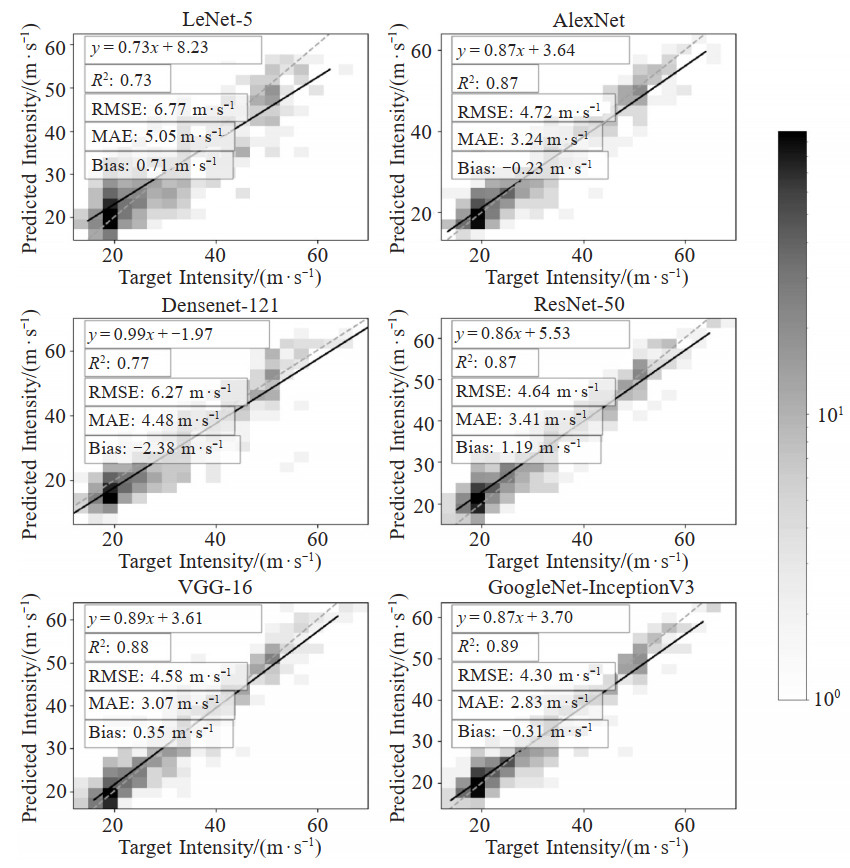
图 1 六个模型在测试集上的估计结果
灰色虚线表示1:1线,黑色实线为真实值与模型估计结果拟合线,色标表示预测值与观测值在二维空间中的样本密度,采用对数尺度(log10),颜色越暖表示该区间内样本数量越多。

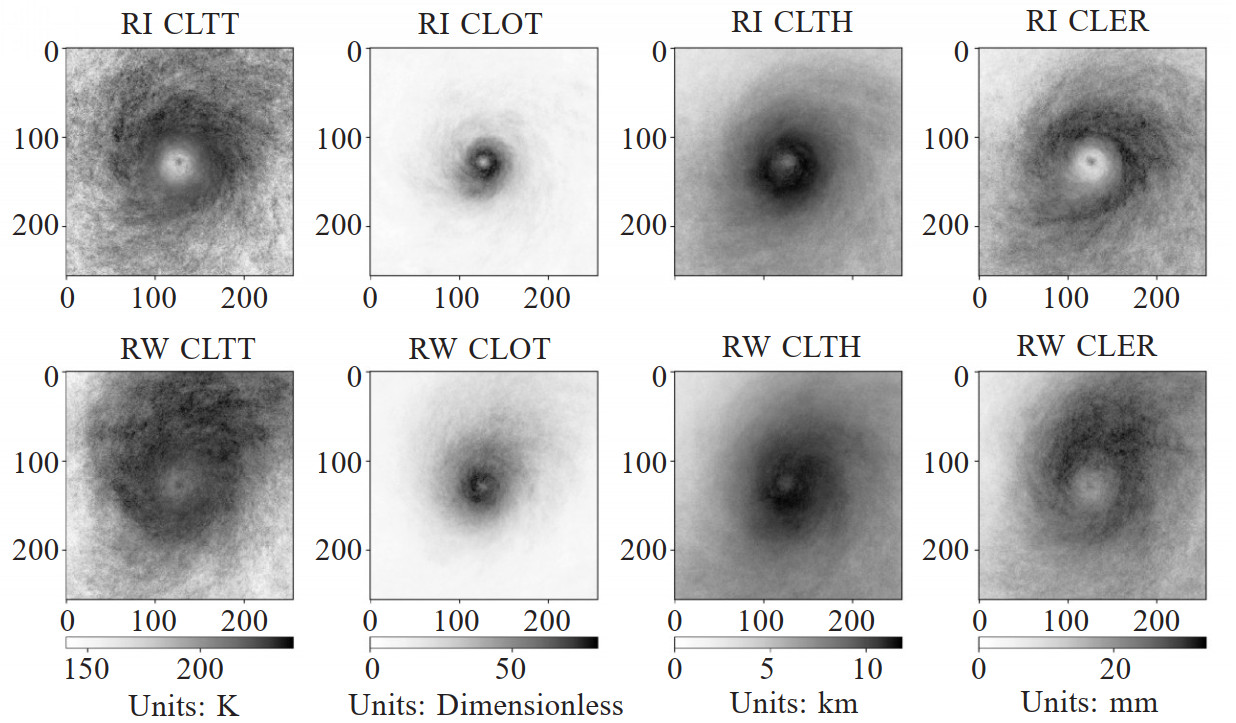
图 6 RI和RW阶段样本对应的原始云产品
上排为RI阶段样本,下排为RW阶段样本;从左至右各列依次为云顶亮温(CLTT)、云光学厚度(CLOT)、云顶高度(CLTH)和云有效半径(CLER)。同一变量在RI与RW阶段采用统一色标范围,不同变量之间色标独立设置。
表 1 六个模型架构

-
[1] Emanuel K. Tropical cyclones[J]. Annual review of earth and planetary sciences, 2003, 31(1): 75-104. [2] Chia H H, Ropelewski C F. The interannual variability in the genesis location of tropical cyclones in the northwest Pacific[J]. Journal of Climate, 2002, 15(20): 2 934-2 944. [3] 陈联寿, 孟智勇. 我国热带气旋研究十年进展[J]. 大气科学, 2001, 25(3): 420-431. [4] 余帆, 李培, 李向军, 等. 近60年西北太平洋台风年代际变化特征及成因的初步分析[J]. 海洋预报, 2012, 29(1): 1-5. [5] 张娇艳, 吴立广, 张强. 全球变暖背景下我国热带气旋灾害趋势分析[J]. 热带气象学报, 2011, 27(4): 442-454. [6] Wang H, Xu M, Onyejuruwa A, et al. Tropical cyclone damages in Mainland China over 2005-2016: Losses analysis and implications[J]. Environment, development and sustainability, 2019, 21: 3 077-3 092. [7] 张康波, 冯明轩, 雷德义. 台风"利奇马"防御工作回顾[J]. 中国防汛抗旱, 2019, 29(11): 1-3. [8] 韩芙蓉, 鹿翔, 冯晓钰, 等. 台风Lekima (1909) 登陆前后动热力结构变化对浙江极端降水的影响[J]. 热带气象学报, 2021, 37(1): 34-48. [9] Emanuel K. Increasing destructiveness of tropical cyclones over the past 30 years[J]. Nature, 2005, 436(7051): 686-688. [10] 许映龙, 张玲, 高拴柱. 我国台风预报业务的现状及思考[J]. 气象, 2010, 36(7): 43-49. [11] 赵珊珊, 任福民, 高歌, 等. 近十年我国热带气旋灾害的特征研究[J]. 热带气象学报, 2015, 31(3): 424-432. [12] 刘喆, 朱元竞, 李万彪, 等. 气象卫星资料在估测热带气旋强度方向的应用进展[J]. 热带气象学报, 2008, 24(5): 550-556. [13] 胡天慧, 余晖, 鲁小琴. 基于卫星遥感的热带气旋定强技术综述[J]. 热带气象学报, 2022, 38(2): 311-320. [14] Velden C S, Goodman B M, Merrill R T. Western North Pacific tropical cyclone intensity estimation from NOAA polar-orbiting satellite microwave data[J]. Monthly Weather Review, 1991, 119(1): 159-168. [15] Brueske K F, Velden C S. Satellite-based tropical cyclone intensity estimation using the NOAA-KLM series Advanced Microwave Sounding Unit (AMSU)[J]. Monthly Weather Review, 2003, 131(4): 687-697. [16] Zhuge X Y, Guan J, Yu F, et al. A new satellite-based indicator for estimation of the western North Pacific tropical cyclone current intensity[J]. IEEE Transactions on Geoscience and Remote Sensing, 2015, 53(10): 5 661-5 676. [17] 张兴海, 端义宏. FY-2F红外亮温资料模拟与偏差分析[J]. 气象, 2014, 40(9): 1 066-1 075. [18] Dvorak V F. Tropical cyclone intensity analysis and forecasting from satellite imagery[J]. Monthly Weather Review, 1975, 103(5): 420-430. [19] Velden C, Harper B, Wells F, et al. The Dvorak tropical cyclone intensity estimation technique: A satellite-based method that has endured for over 30 years[J]. Bulletin of the American Meteorological Society, 2006, 87(9): 1 195-1 210. [20] Olander T L, Velden C S, Kossin J P. The advanced objective dvorak technique (AODT) -latest upgrades and future directions[C]//26th Conference on Hurricanes and Tropical Meteorology. Miami, US. 2004: 294-295. [21] Olander T L, Velden C S. The advanced Dvorak technique: Continued development of an objective scheme to estimate tropical cyclone intensity using geostationary infrared satellite imagery[J]. Weather and Forecasting, 2007, 22(2): 287-298. [22] Pradhan R, Aygun R S, Maskey M, et al. Tropical cyclone intensity estimation using a deep convolutional neural network[J]. IEEE Transactions on Image Processing, 2017, 27(2): 692-702. [23] Chen B F, Chen B, Lin H T, et al. Estimating tropical cyclone intensity by satellite imagery utilizing convolutional neural networks[J]. Weather and Forecasting, 2019, 34(2): 447-465. [24] Pan B, Xu X, Shi Z. Tropical cyclone intensity prediction based on recurrent neural networks[J]. Electronics Letters, 2019, 55(7): 413-415. [25] Rüttgers M, Jeon S, Lee S, et al. Prediction of typhoon track and intensity using a generative adversarial network with observational and meteorological data[J]. IEEE Access, 2022, 10: 48 434-48 446. [26] Wu Y, Geng X, Liu Z, et al. Tropical cyclone forecast using multitask deep learning framework[J]. IEEE Geoscience and Remote Sensing Letters, 2021, 19: 1-5. [27] Albawi S, Mohammed T A, Al-Zawi S. Understanding of a convolutional neural network[C]//2017 international conference on engineering and technology (ICE/ITMC), IEEE, Antalya, Turkey, 2017: 1-6. [28] Gu J, Wang Z, Kuen J, et al. Recent advances in convolutional neural networks[J]. Pattern recognition, 2018, 77: 354-377. [29] Liu L, Chen J, Fieguth P, et al. From BoW to CNN: Two decades of texture representation for texture classification[J]. International Journal of Computer Vision, 2019, 127: 74-109. [30] He K, Sun J. Convolutional neural networks at constrained time cost[C]//Proceedings of the IEEE conference on computer vision and pattern recognition(CVPR). Boston, U.S., 2015: 5 353-5 360. [31] Ma M D, Fergus R. Visualizing and understanding convolutional networks[J/OL]. arXiv: 1311.2901[cs. CV]. [32] Cohen T, Welling M. Group equivariant convolutional networks[C]//International conference on machine learning. PMLR, 2016: 2 990-2 999. [33] LeCun Y, Bengio Y, Hinton G. Deep learning[J]. Nature, 2015, 521(7553): 436-444. [34] 钱奇峰, 王川, 徐雅静, 等. 一种基于深度学习的台风强度估测技术[J]. 气象, 2021, 47(5): 601-608. [35] Zhuo J Y, Tan Z M. Physics-augmented deep learning to improve tropical cyclone intensity and size estimation from satellite imagery[J]. Monthly Weather Review, 2021, 149(7): 2 097-2 113. [36] LeCun Y, Bottou L, Bengio Y, et al. Gradient-based learning applied to document recognition[J]. Proceedings of the IEEE, 1998, 86(11): 2 278-2 324. [37] Krizhevsky A, Sutskever I, Hinton G E. Imagenet classification with deep convolutional neural networks[J]. Advances in neural information processing systems, 2012, 25: 54-90. [38] Combinido J S, Mendoza J R, Aborot J. A convolutional neural network approach for estimating tropical cyclone intensity using satellitebased infrared images[C]//2018 24th International conference on pattern recognition (ICPR). IEEE, Beijing, 2018: 1 474-1 480. [39] Zhang R, Liu Q, Hang R. Tropical cyclone intensity estimation using two-branch convolutional neural network from infrared and water vapor images[J]. IEEE Transactions on Geoscience and Remote Sensing, 2019, 58(1): 586-597. [40] Zhang C J, Wang X J, Ma L M, et al. Tropical cyclone intensity classification and estimation using infrared satellite images with deep learning[J]. IEEE Journal of Selected Topics in Applied Earth Observations and Remote Sensing, 2021, 14: 2 070-2 086. [41] Jiang S, Tao L. Classification and Estimation of Typhoon Intensity from Geostationary Meteorological Satellite Images Based on Deep Learning[J]. Atmosphere, 2022, 13(7): 1113. [42] Simonyan K. Very deep convolutional networks for large-scale image recognition[J]. arXiv preprint arXiv: 1409.1556, 2014. [43] Devaraj J, Ganesan S, Elavarasan R M, et al. A novel deep learning based model for tropical intensity estimation and post-disaster management of hurricanes[J]. Applied Sciences, 2021, 11(9): 4 129. [44] Li L, Shuai Z, Hu J, et al. Classification of tropical cyclone intensity based on deep learning and Yolo V5[C]//International Conference on Artificial Intelligence and Security. Springer International Publishing, Charm, 2022: 280-291. [45] Cui L, Shi L, Yin Q, et al. Application of satellite cloud imagery in track analysis of tropical cyclones[J]. Tropical Cyclone Research and Review, 2013, 2(4): 222-232. [46] Chen B, Chen B F, Lin H T. Rotation-blended CNNs on a new open dataset for tropical cyclone image-to-intensity regression[C]// Proceedings of the 24th ACM SIGKDD international conference on knowledge discovery & data mining. Association for Computing Machinery, New York, U.S., 2018: 90-99. [47] Lu J, Feng T, Li J, et al. Impact of assimilating Himawari‐8‐derived layered precipitable water with varying cumulus and microphysics parameterization schemes on the simulation of Typhoon Hato[J]. Journal of Geophysical Research: Atmospheres, 2019, 124(6): 3 050-3 071. [48] Purbantoro B, Aminuddin J, Manago N, et al. Comparison of Aqua/Terra MODIS and Himawari-8 satellite data on cloud mask and cloud type classification using split window algorithm[J]. Remote Sensing, 2019, 11(24): 2 944. [49] Ying, M., W. Zhang, H. Yu, X. Lu, J. Feng, Y. Fan, Y. Zhu, and D. Chen, 2014: An overview of the China Meteorological Administration tropical cyclone database[J]. Journal of Atmospheric and Oceanic Technology, 31: 287-301. [50] Lu, X. Q., H. Yu, M. Ying, B. K. Zhao, S. Zhang, L. M. Lin, L. N. Bai, and R. J. Wan, 2021: Western North Pacific tropical cyclone database created by the China Meteorological Administration[J]. Advances in Atmospheric Sciences, 38(4): 690-699. [51] Alom M Z, Taha T M, Yakopcic C, et al. A state-of-the-art survey on deep learning theory and architectures[J]. Electronics, 2019, 8(3): 292. [52] Khan A, Sohail A, Zahoora U, et al. A survey of the recent architectures of deep convolutional neural networks[J]. Artificial intelligence review, 2020, 53: 5 455-5 516. [53] Canziani A, Paszke A, Culurciello E. An analysis of deep neural network models for practical applications[J]. arxiv: 1605.07678[cs. CV] [54] Wimmers A, Velden C, Cossuth J H. Using deep learning to estimate tropical cyclone intensity from satellite passive microwave imagery[J]. Monthly Weather Review, 2019, 147(6): 2 261-2 282. [55] Simonyan K, Zisserman A. Very deep convolutional networks for large-scale image recognition[J]. arXiv preprint arXiv: 1409.1556, 2014. [56] Frank W M. The structure and energetics of the tropical cyclone Ⅰ. Storm structure[J]. Monthly Weather Review, 1977, 105(9): 1 119-1 135. [57] Weatherford C L, Gray W M. Typhoon structure as revealed by aircraft reconnaissance. Part Ⅰ: Data analysis and climatology[J]. Monthly Weather Review, 1988, 116(5): 1 032-1 043. [58] Velden C S, Olander T L, Zehr R M. Development of an objective scheme to estimate tropical cyclone intensity from digital geostationary satellite infrared imagery[J]. Weather and Forecasting, 1998, 13(1): 172-186. [59] Sampson C R, Schrader A J. The automated tropical cyclone forecasting system (version 3.2)[J]. Bulletin of the American Meteorological Society, 2000, 81(6): 1 231-1 240. [60] Velden C S, Goodman B M, Merrill R T. Western North Pacific tropical cyclone intensity estimation from NOAA polar-orbiting satellite microwave data[J]. Monthly Weather Review, 1991, 119(1): 159-168. [61] Knapp K R, Kossin J P. New global tropical cyclone data set from ISCCP B1 geostationary satellite observations[J]. Journal of Applied Remote Sensing, 2007, 1(1): 013505. [62] Huang G, Liu Z, Van Der Maaten L, et al. Densely connected convolutional networks[C]//Proceedings of the IEEE conference on computer vision and pattern recognition. 2017: 4 700-4 708. [63] He K, Zhang X, Ren S, et al. Deep residual learning for image recognition[C]//Proceedings of the IEEE conference on computer vision and pattern recognition. IEEE, Honolulu, U.S., 2016: 770-778. [64] Szegedy C, Vanhoucke V, Ioffe S, et al. Rethinking the inception architecture for computer vision[C]//Proceedings of the IEEE conference on computer vision and pattern recognition. IEEE, Honolulu, U.S., 2016: 2 818-2 826. [65] Chen R, Zhang W, Wang X. Machine learning in tropical cyclone forecast modeling: A review[J]. Atmosphere, 2020, 11(7): 676. [66] Lee J, Im J, Cha D H, et al. Tropical cyclone intensity estimation using multi-dimensional convolutional neural networks from geostationary satellite data[J]. Remote Sensing, 2019, 12(1): 108. [67] Kingma D P, Ba J. Adam: A method for stochastic optimization[J]. arXiv preprint arXiv: 1412.6980, 2014. [68] Park S K, Lee E. Synoptic features of orographically enhanced heavy rainfall on the east coast of Korea associated with Typhoon Rusa (2002)[J]. Geophysical Research Letters, 2007, 34(2). [69] Bagtasa G. Contribution of tropical cyclones to rainfall in the Philippines[J]. Journal of Climate, 2017, 30(10): 3 621-3 633. [70] Bender M A, Kurihara Y. A numerical study of the effect of the mountainous terrain of Japan on tropical cyclones[J]. Journal of the Meteorological Society of Japan. Ser. Ⅱ, 1986, 64: 651-663. [71] Kaplan J, DeMaria M, Knaff J A. A revised tropical cyclone rapid intensification index for the Atlantic and eastern North Pacific basins[J]. Weather and forecasting, 2010, 25(1): 220-241. [72] Wood K M, Ritchie E A. A definition for rapid weakening of North Atlantic and eastern North Pacific tropical cyclones[J]. Geophysical Research Letters, 2015, 42(22): 10 091-10 097. [73] Rogers R, Aberson S, Aksoy A, et al. NOAA's hurricane intensity forecasting experiment: A progress report[J]. Bulletin of the American Meteorological Society, 2013, 94(6): 859-882. [74] Rogers R. Convective-scale structure and evolution during a high-resolution simulation of tropical cyclone rapid intensification[J]. Journal of the Atmospheric Sciences, 2010, 67(1): 44-70. [75] Selvaraju R R, Cogswell M, Das A, et al. Grad-cam: Visual explanations from deep networks via gradient-based localization[C]// Proceedings of the IEEE international conference on computer vision. IEEE, Honolulu, U.S., 2017: 618-626. [76] Zeiler M D, Fergus R. Visualizing and understanding convolutional networks[C]//Computer Vision-ECCV 2014: 13th European Conference, Springer International Publishing, Zurich, Switzerland, 2014: 818-833. [77] Yosinski J, Clune J, Nguyen A, et al. Understanding neural networks through deep visualization[J]. arXiv preprint arXiv: 1506.06579, 20 [78] Higa M, Tanahara S, Adachi Y, et al. Domain knowledge integration into deep learning for typhoon intensity classification[J]. Scientific Reports, 2021, 11(1): 12 972. [79] Maskey M, Ramachandran R, Ramasubramanian M, et al. Deepti: Deep-learning-based tropical cyclone intensity estimation system[J]. IEEE journal of selected topics in applied Earth observations and remote sensing, 2020, 13: 4 271-4 281. [80] Chen B F, Chen B, Lin H T, et al. Estimating tropical cyclone intensity by satellite imagery utilizing convolutional neural networks[J]. Weather and Forecasting, 2019, 34(2): 447-465. -

 下载:
下载:
 点击查看大图
图(7) / 表(1)
计量
- 文章访问数: 2
- HTML全文浏览量: 0
- PDF下载量: 0
- 被引次数: 0
 粤公网安备 4401069904700003号