



Correction of O3 and PM2.5 Concentration Forecast in Guangzhou Based on LightGBM
-
摘要: 为了提升空气质量模式对广州市O3和PM2.5浓度预报精度,基于广州市国控站的O3和PM2.5浓度观测以及模式逐小时预报数据,使用Lightgbm算法对0~24小时、24~48小时、48~72小时三种时效的O3和PM2.5浓度模式预报建立订正模型,并利用SHAP方法对订正模型进行解释分析。结果表明:Lightgbm订正模型能够较好提升各站点以及各预报时效的O3和PM2.5浓度预报,订正后各站点的误差分布更一致且明显减小,随着预报时效的增加,订正模型对预报提升的效果略有降低。从各时效总体的订正效果看,O3浓度与观测间的均方根误差、平均绝对偏差、相关系数分别由39.5 μg·m-3、30.3 μg·m-3、0.61提升为23.3 μg·m-3、16.9 μg·m-3、0.86,PM2.5浓度与观测间的均方根误差、平均绝对偏差、相关系数分别由18.3 μg·m-3、12.7 μg·m-3、0.26提升为9.7 μg·m-3、6.9 μg·m-3、0.76。不同时效订正模型中的重要特征差异不大,对于O3浓度订正模型,最重要的特征主要有O3浓度、温度、相对湿度、NO2、短波辐射、风向风速等,对于PM2.5浓度订正模型,最重要的特征主要有气压、空气质量指数、温度、相对湿度、气压、PM10、O3、风向风速等,各特征对订正模型的影响符合O3和PM2.5的生成和累积机理。个例分析进一步证明了订正模型的效果和实用性。Abstract: In order to improve the accuracy of air quality models for predicting O3 and PM2.5 concentrations in Guangzhou, a LightGBM algorithm was employed to establish correction models for O3 and PM2.5 concentration forecasts in three time periods of 0-24 h, 24-48 h, and 48-72 h, using the observations from Guangzhou national control stations and hourly forecast data. The SHAP method was then applied to interpret and analyze the correction models. The results show that the LightGBM correction model can significantly improve the O3 and PM2.5 concentration forecasts for each station and forecast time period. The error of each station significantly reduced and its distribution is more consistent after correction. As the forecast time period increases, the effect of the correction models on forecast improvement slightly decreases. Overall correction effects across all time period showed the root mean square error (RMSE), average absolute deviation (AAD), and correlation coefficient of O3 concentration from the model and observation changed from 39.5 μg·m-3, 30.3 μg·m-3, and 0.61 to 23.3 μg·m-3, 16.9 μg·m-3, and 0.86, respectively. For PM2.5 concentrations, the RMSE, AAD, and correlation coefficient changed from 18.3 μg·m-3, 12.7 μg·m-3, and 0.26 to 9.7 μg·m-3, 6.9 μg·m-3, and 0.76, respectively. Key features among different correction models showed little variation. For the O3 concentration correction model, the most important features mainly include O3 concentration, temperature, relative humidity, NO2, shortwave radiation, wind direction and speed. For the PM2.5 concentration correction model, the most important features mainly include air pressure, air quality index, temperature, relative humidity, air pressure, PM10, O3, wind direction and speed. The influence of each feature on the correction models conforms to the generation and accumulation mechanism of O3 and PM2.5. The case study further proves the effectiveness and practicality of the correction model.
-
Key words:
- LightGBM /
- O3 /
- PM2.5 /
- correction
-

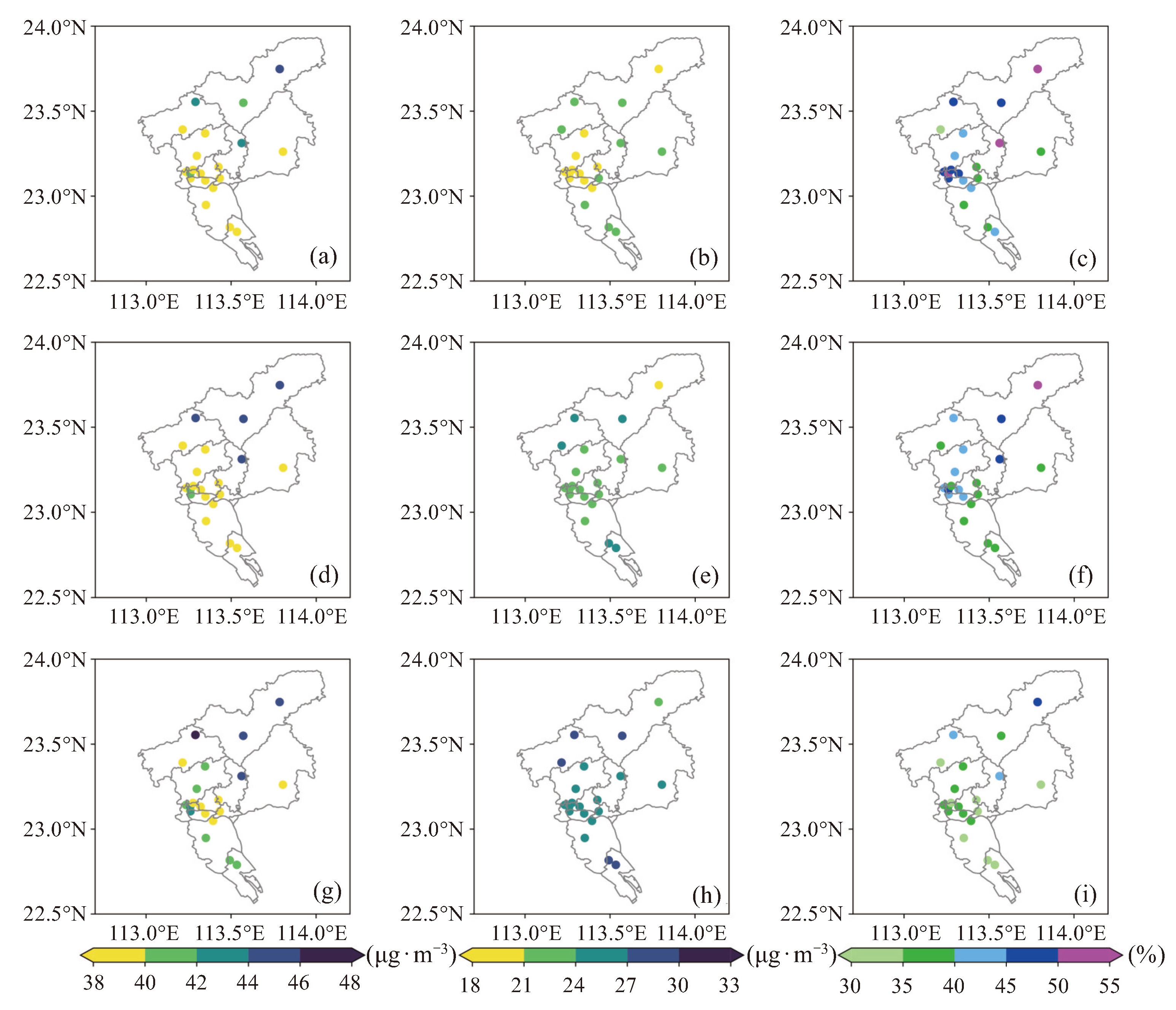
图 2 各观测站不同时效O3浓度预报RMSE,订正前(a、d、g,单位:μg·m-3)、订正后(b、e、h,单位:μg·m-3)以及RMSE减小百分比(c、f、i,单位:%)
a、b、c为0~24小时预报,d、e、f为24~48小时预报,g、h、i为48~72小时预报。

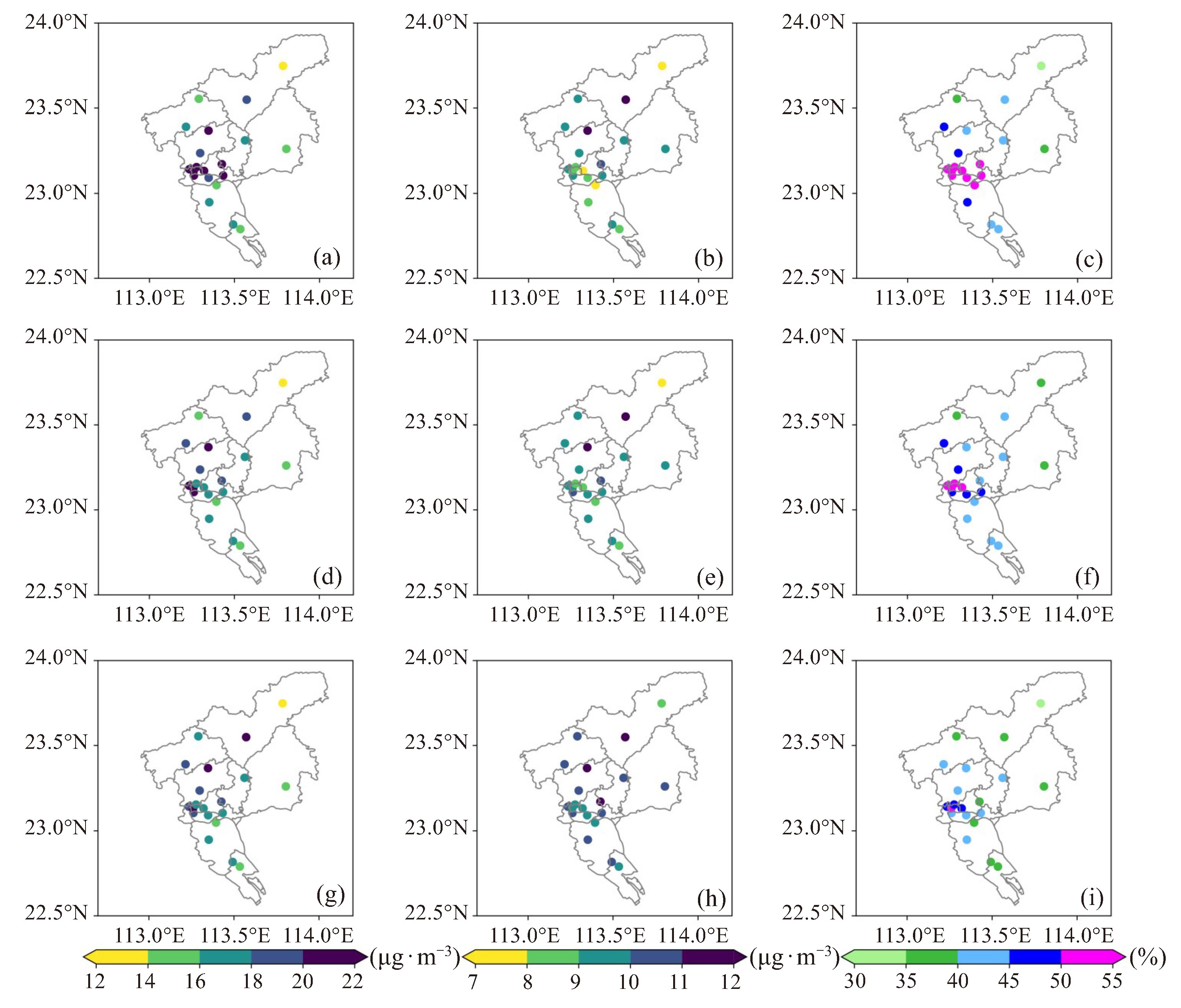
图 3 各观测站不同时效PM2.5浓度预报RMSE,订正前(a、d、g,单位:μg·m-3)、订正后(b、e、h,单位:μg·m-3)以及RMSE减小百分比(c、f、i,单位:%)
a、b、c为0~24小时预报,d、e、f为24~48小时预报,g、h、i为48~72小时预报。
-
[1] Zhao L, Wang L, Tan J, et al. Changes of chemical composition and source apportionment of PM2.5 during 2013-2017 in urban Handan, China[J]. Atmospheric Environment, 2019, 206: 119-131. [2] 黄志炯, 沙青娥, 朱曼妮, 等. 我国PM2.5和臭氧污染前体物排放源清单的现状与质量评估[J]. 科学通报, 2022, 67(18): 1 978-1 994. [3] 李红, 彭良, 毕方, 等. 我国PM2.5与臭氧污染协同控制策略研究[J]. 环境科学研究, 2019, 32(10): 1 763-1 778. [4] 赵秋月, 李荔, 李慧鹏. 国内外近地面臭氧污染研究进展[J]. 环境科技, 2018, 31(5): 72-76. [5] 姜华, 高健, 李红, 等. 我国大气污染协同防控理论框架初探[J]. 环境科学研究, 2022, 35(3): 601-610. [6] Li J, Chen X, Wang Z, et al. Radiative and heterogeneous chemical effects of aerosols on ozone and inorganic aerosols over East Asia[J]. Science of The Total Environment, 2018, 622-623: 1 327-1 342. [7] Stadlober E, Hormann S, Pfeiler B. Quality and performanceof a PM10 daily forecasting model[J]. Atmospheric Environment, 2008, 42(6): 1 098-1 109. [8] 苏筱倩, 安俊琳, 张玉欣, 等. 支持向量机回归在臭氧预报中的应用[J]. 环境科学, 2019, 40(4): 1 697-1 704. [9] Fan J, Wu L, Ma X, et al. Hybrid support vector machines with heuristic algorithms for prediction of daily diffuse solar radiation in air-polluted regions[J]. Renewable Energy, 2020, 145: 2 034-2 045. [10] 丁愫, 陈报章, 王瑾, 等. 基于决策树的统计预报模型在臭氧浓度时空分布预测中的应用研究[J]. 环境科学学报, 2018, 38(8): 3 229-3 242. [11] Jumin E, Zaini N, Ahmed A, et al. Machine learning versus linear regression modelling approach for accurate ozone concentrations prediction[J]. Engineering Applications of Computational Fluid Mechanics, 2020, 14(1): 713-725. [12] Singh K, Gupta S, Rai P. Identifying pollution sources and predicting urban air quality using ensemble learning methods[J]. Atmospheric Environment, 2013, 80: 426-437. [13] 王凯, 胡冬梅, 闫雨龙, 等. 基于深度学习的城市臭氧小时浓度预测模型[J]. 环境化学, 2023, 42(8): 2 609-2 618. [14] Feng X, Li Q, Zhu Y, et al. Artificial neural networks forecasting of PM2.5 pollution using air mass trajectory based geographic model and wavelet transformation[J]. Atmospheric Environment, 2015, 107: 118-128. [15] Gao M, Yin L, Ning J. Artificial neural network model for ozone concentration estimation and Monte Carlo analysis[J]. Atmospheric Environment, 2018, 184: 129-139. [16] 孙弦, 孙磊, 聂会文, 等. 两种空气质量数值模式的应用评估与集合改进研究[J]. 热带气象学报, 2023, 39(3): 361-373. [17] Ma R, Ban J, Wang Q, et al. Random forest model based fine scale spatiotemporal O3 trends in the Beijing-Tianjin-Hebei region in China 2010 to 2017[J]. Environmental Pollution, 2021, 276: 116635. [18] Gao Z, Zhou X. A review of the CAMx, CMAQ, WRF-Chem and NAQPMS models: Application, evaluation and uncertainty factors[J]. Environmental Pollution, 2024, 343: 123183. [19] Hong J, Mao F, Min Q, et al. Improved PM2.5 predictions of WRF-Chem via the integration of Himawari-8 satellite data and ground observations[J]. Environmental Pollution, 2020, 263: 114451. [20] Wang Z, Itahashi S, Uno I, et al. Modeling the long-range transport of particulate matters for January in East Asia using NAQPMS and CMAQ[J]. Aerosol and Air Quality Research, 2017, 17(12): 3 065-3 078. [21] 周广强, 瞿元昊, 余钟奇. 长江三角洲城市臭氧数值预报与释用[J]. 中国环境科学, 2021, 41(1): 28-36. [22] 汤静, 王春林, 谭浩波, 等. 利用PCA-kNN方法改进广州市空气质量模式PM2.5预报[J]. 热带气象学报, 2019, 35(1): 125-134. [23] 马井会, 曹钰, 余钟奇, 等. 深度学习方法在上海市PM2.5浓度预报中的应用[J]. 中国环境科学, 2020, 40(2): 530-538. [24] 李娟, 尉鹏, 戴学之, 等. 基于机器学习方法的西安市数值模拟优化研究[J]. 环境科学研究, 2021, 34(4): 872-881. [25] 周胜, 黄报远, 陈慧英, 等. 珠三角城市群PM2.5和O3污染特征及VOCs组分敏感性分析[J]. 环境工程, 2020, 38(1): 42-47. [26] 沈劲, 王雪松, 李金凤, 等. Models-3/CMAQ和CAMx对珠江三角洲臭氧污染模拟的比较分析[J]. 中国科学: 化学, 2011, 41(11): 1 750-1 762. [27] Emery C, Baker K, Wilson G, Et al. Comprehensive Air Quality Model with Extensions: Formulation and Evaluation for Ozone and Particulate Matter over the US[J]. Atmosphere, 2024, 15: 1158. [28] 孙弦, 孙磊, 聂会文, 等. 两种空气质量数值模式的应用评估与集合改进研究[J]. 热带气象学报, 2023, 39(3): 361-373. [29] Shi Y, Ho H, Xu Y, et al. Improving satellite aerosol optical Depth-PM2.5 correlations using land use regression with microscale geographic predictors in a high-density urban context[J]. Atmospheric Environment, 2018, 190: 23-34. [30] 刘新伟, 黄武斌, 蒋盈沙, 等. 基于LightGBM算法的强对流天气分类识别研究[J]. 高原气象, 2021, 40(4): 909-918. [31] Lundberg S, Erion G, Chen H, et al. From local explanations to global understanding with explainable AI for trees[J]. Nature Machine Intelligence, 2020, 2(1): 56-67. [32] Jiang X, Wang Q, Niu N. Error Analysis and Correction of FENGYUN-4A GⅡRS Temperature Profile Products in Summer over the Qinghai-Tibet Plateau[J]. Remote Sensing, 2024, 16(11): 1881. [33] Hu C, Kang P, Jaffe D, et al. Understanding the impact of meteorology on ozone in 334 cities of China[J]. Atmospheric Environment, 2021, 248: 118221. [34] Jiang X, Wang J, Yang Y, et al. Fluctuations in the"static"atmosphere and their effects on tropospheric ozone distribution[J]. Journal of Atmospheric and Solar-Terrestrial Physics, 2024, 260: 106268. [35] Last J, Sun W, Witschi H. Ozone, NO, and NO2: oxidant air pollutants and more[J]. Environmental Health Perspectives, 1994, 102(s10): 179-184. [36] Chen Z, Chen D, Zhao C, et al. Influence of meteorological conditions on PM2.5 concentrations across China: A review of methodology and mechanism[J]. Environment International, 2020, 139: 105558. [37] Liu Y, Zhou Y, Lu J. Exploring the relationship between air pollution and meteorological conditions in China under environmental governance[J]. Scientific Reports, 2020, 10(1): 14518. [38] Chan C, Yao X. Air pollution in mega cities in China[J]. Atmospheric Environment, 2008, 42: 1-42. -

 下载:
下载:
 点击查看大图
图(7)
计量
- 文章访问数: 1
- HTML全文浏览量: 0
- PDF下载量: 0
- 被引次数: 0
 粤公网安备 4401069904700003号