



Characteristics and Mechanisms of Diurnal Variations of Precipitation During Pre-flood Season over Guangxi Coastal Region Influenced by Topography
-
摘要: 基于2010—2022年前汛期(4—6月)广西国家气象观测站、区域自动气象站逐小时降水数据及ERA5再分析资料,利用K均值聚类算法,依据前汛期降水日变化特征将广西沿海划分为3个研究区域。其中,区域1位于十万大山及其以北地区,区域2位于沿岸及离岸平缓地带,区域3位于六万大山一带。深入分析各区域降水日变化峰值特征及成因,结果表明:(1)广西沿海降水量、降水频率及降水强度日变化受地形分布影响显著。日降水量存在明显的清晨与午后双峰型、清晨单峰型和午后单峰型3种日变化特征;日降水量、日降水强度沿海岸线前沿向内陆递减;日内降水量与降水频率峰值自西南向东北延后约3~4小时。(2)区域1离岸近,海拔高,受海陆风、山地热力环流及夜间低空急流共同调制,日降水量偏少、日降水强度偏弱,但夜间降水最频繁。区域1夜间南支水汽输送强,携水汽翻越高山,配合局地上升气流,导致弱降水频繁;午后地形加热触发局地热力对流,形成日降水量双峰特征。(3)区域2夜间至清晨低层水汽辐合强,配合陆风促进沿岸降水发展,呈清晨单峰特征;其西部受十万大山地形阻挡作用,气流爬升显著,导致降水量多,清晨小时降水强度最强。(4)区域3午后海风叠加高地抬升气流,形成强盛的局地热力垂直环流,热对流降水频繁且强度较大,呈午后单峰特征,降水强度日峰值主要出现在正午12时。Abstract: This study investigates the characteristics of diurnal variations of precipitation during pre-flood season (April-June) over the Guangxi coastal region, using hourly precipitation data from national surface meteorological observatory stations and regional automatic weather stations, as well as ERA5 hourly reanalysis data from 2010 to 2022. Based on the K-means clustering algorithm applied to diurnal precipitation patterns, the study area was divided into three sub-regions: Region 1 in the Shiwan Mountains and their northern regions, Region 2 along the coastline and in the adjacent flat terrain, and Region 3 in the Liuwan Mountains. After analyzing the physical mechanisms driving these peak characteristics, the key findings are as follows. (1) Diurnal variations in precipitation amount, frequency, and intensity are strongly influenced by topography. The diurnal precipitation exhibits three distinct patterns: a bimodal pattern with morning and afternoon peaks, a single morning peak, and a single afternoon peak. Both daily precipitation amount and intensity decrease from the coastal to the inland areas. The peak phases of precipitation amount and frequency are delayed by 3-4 hours propagating from the southwest to the northeast. (2) Region 1, located near the coast at a relatively high elevation, is jointly influenced by land-sea breezes, mountain thermal circulation, and nocturnal low-level jets. Although this region features lower overall precipitation amounts and weaker intensity, it exhibits the highest frequency of nighttime precipitation. Strong nocturnal southward moisture transport interacts with orographic uplift, generating frequent but weak precipitation at night. Conversely, afternoon heating of the terrain triggers local convective activity, forming a double-peak pattern. (3) Region 2 shows a single morning peak driven by intensified low-level moisture convergence and land breezes during nighttime to early morning. The western part of this region is significantly influenced by the blocking effect of the Shiwan Mountains, with enhanced orographic lifting leading to higher precipitation amounts and stronger intensity. (4) Region 3 is characterized by a pronounced afternoon peak of convective precipitation. The inland penetration of the afternoon sea breeze and terrain-induced thermal updrafts generate a robust local vertical thermal circulation. This mechanism destabilizes the atmospheric stratification, leading to intense and frequent afternoon convective rainfall, with the maximum precipitation intensity primarily occurring at noon.
-

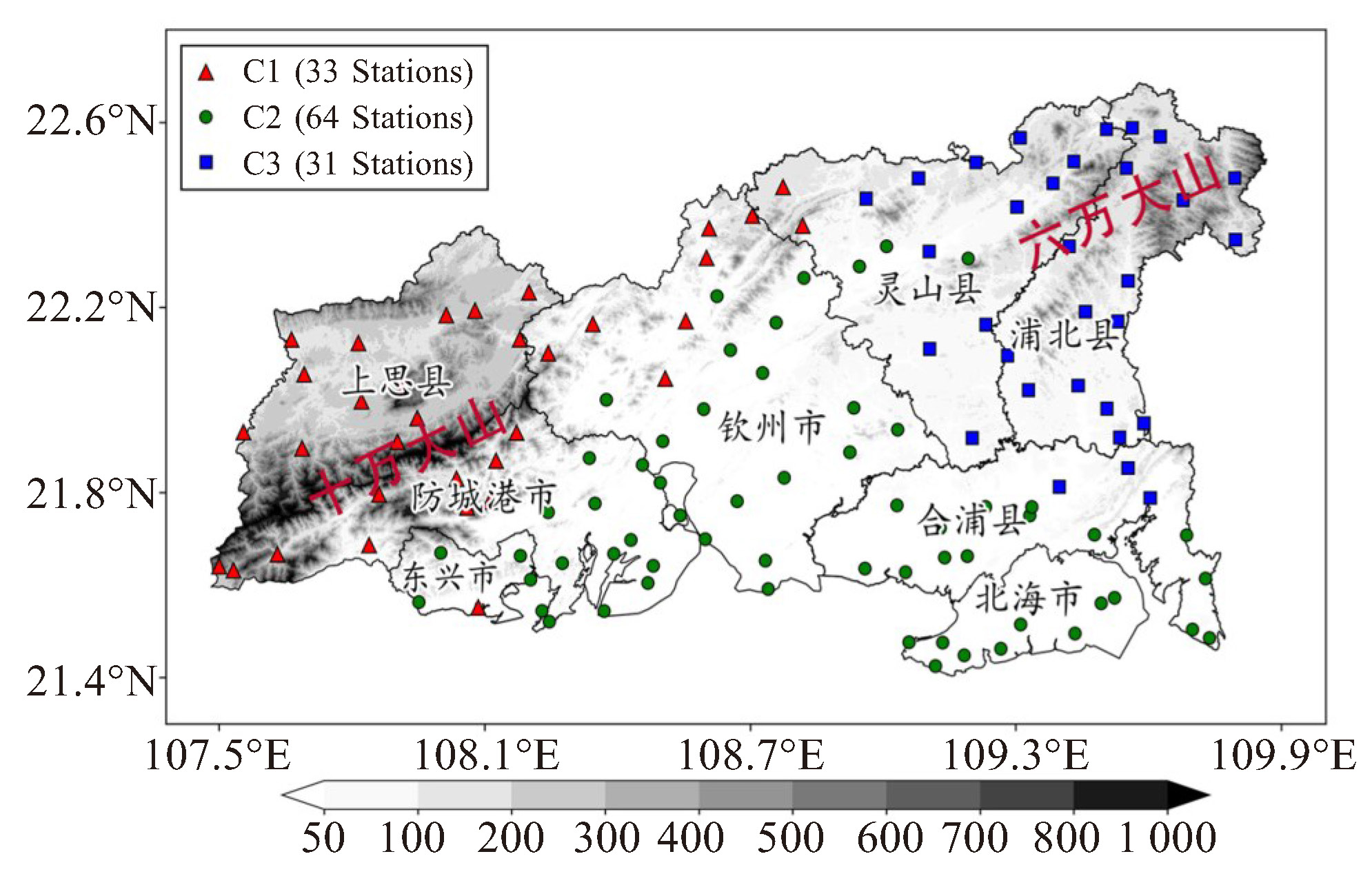
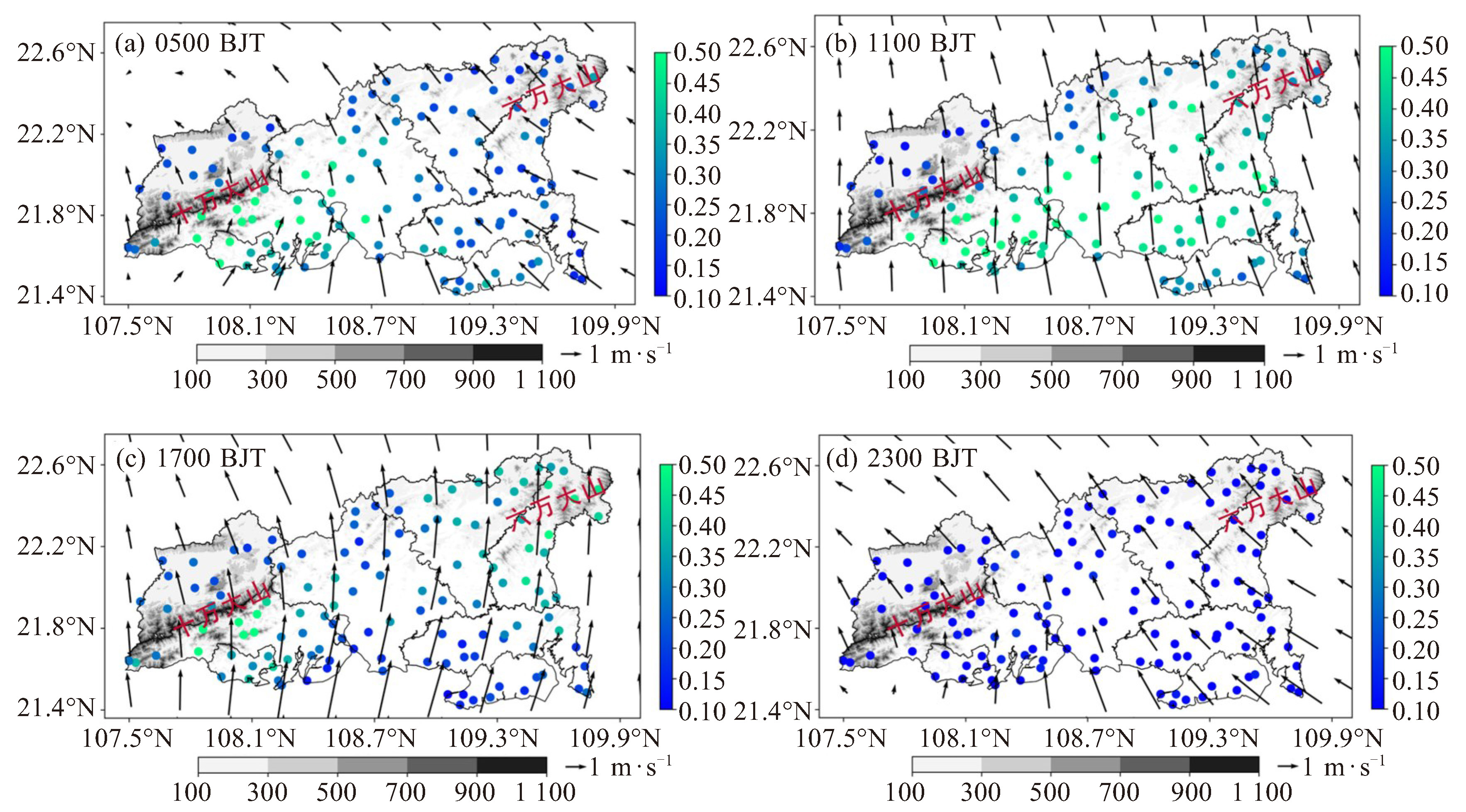
图 1 2010—2022年广西沿海前汛期海拔高度(填色,单位:m)、每6 h间隔的地面1 h平均降水量(散点,单位:mm)与10 m风场(矢量,单位:m·s-1)分布
a.05时;b.11时;c.17时;d.23时。

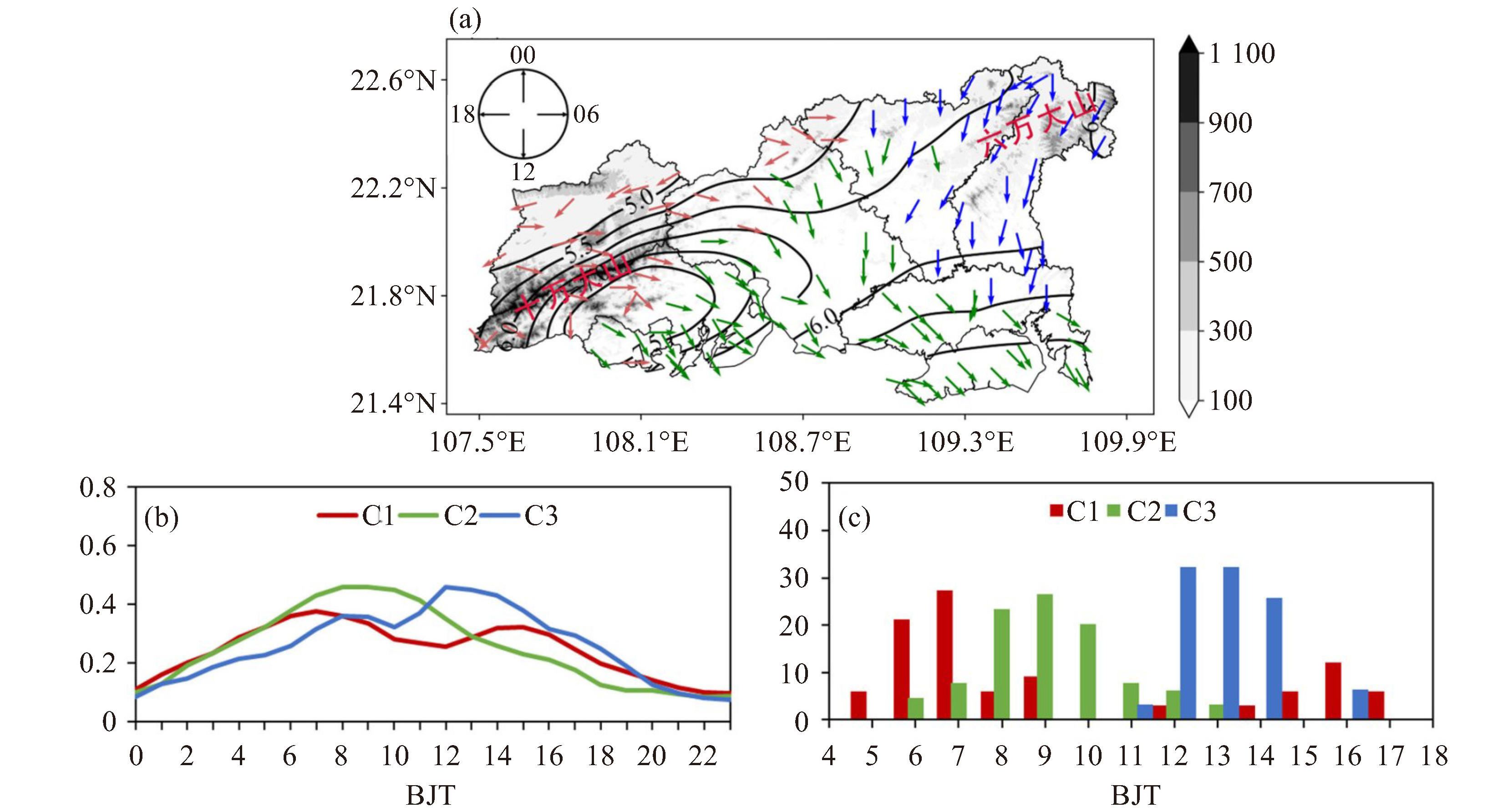
图 3 2010—2022年广西沿海前汛期日平均降水量(等值线:降水量,单位:mm;矢量:峰值时次,左上角为时钟图,矢量箭头所指方向代表峰值出现的时次;填色:海拔高度,单位:m)(a)、3种类型分区降水量日内变化(单位:mm)(b)以及峰值出现时次占比统计(单位:%)(c)

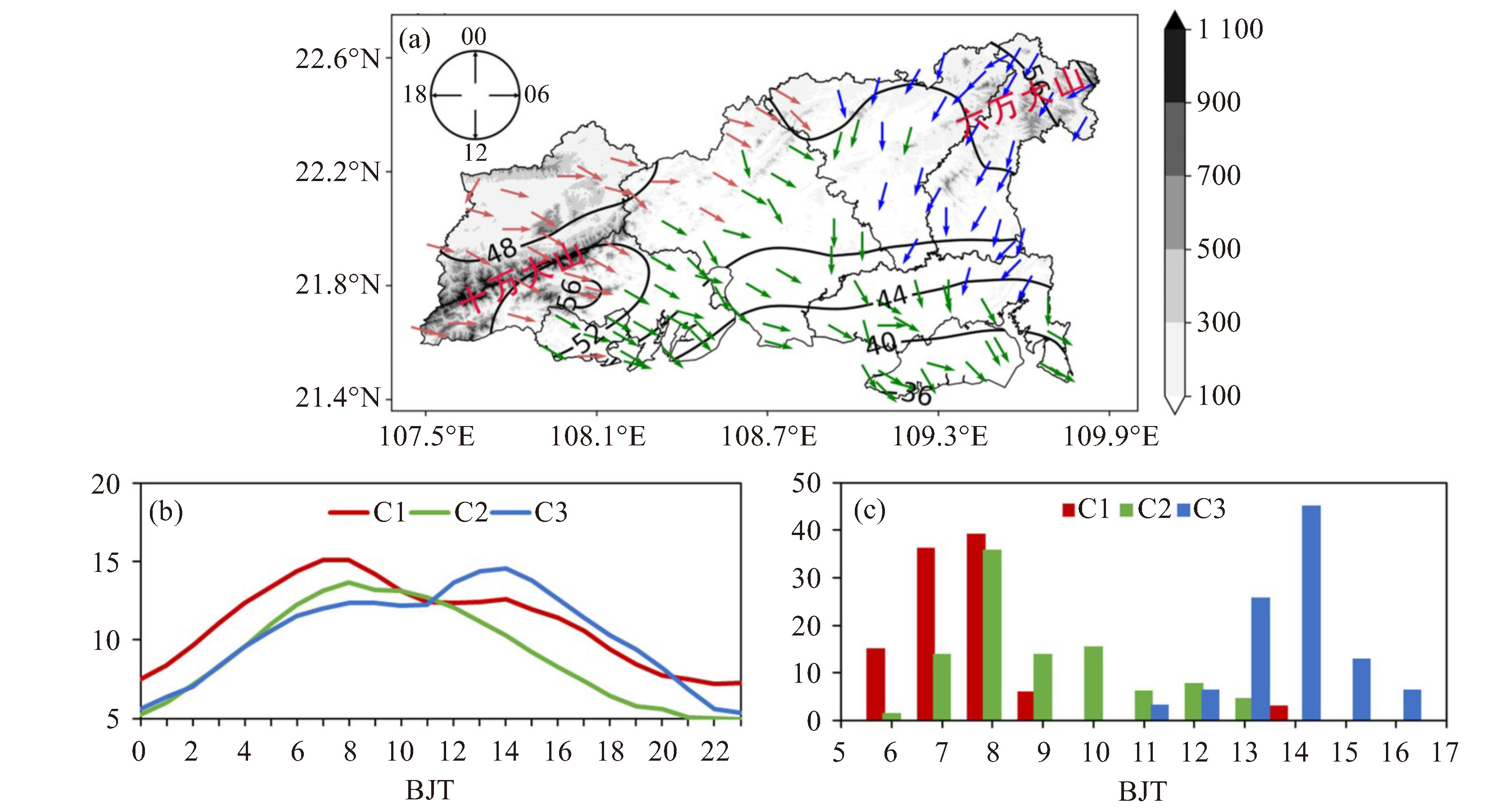
图 4 2010—2022年广西沿海前汛期日平均降水频率(等值线:降水频率,单位:%;矢量:峰值时次,左上角为时钟图,矢量箭头所指方向代表峰值出现的时次;填色:海拔高度,单位:m)(a)、3种类型分区降水频率日内变化(单位:%)(b)以及峰值出现时次占比统计(单位:%)(c)

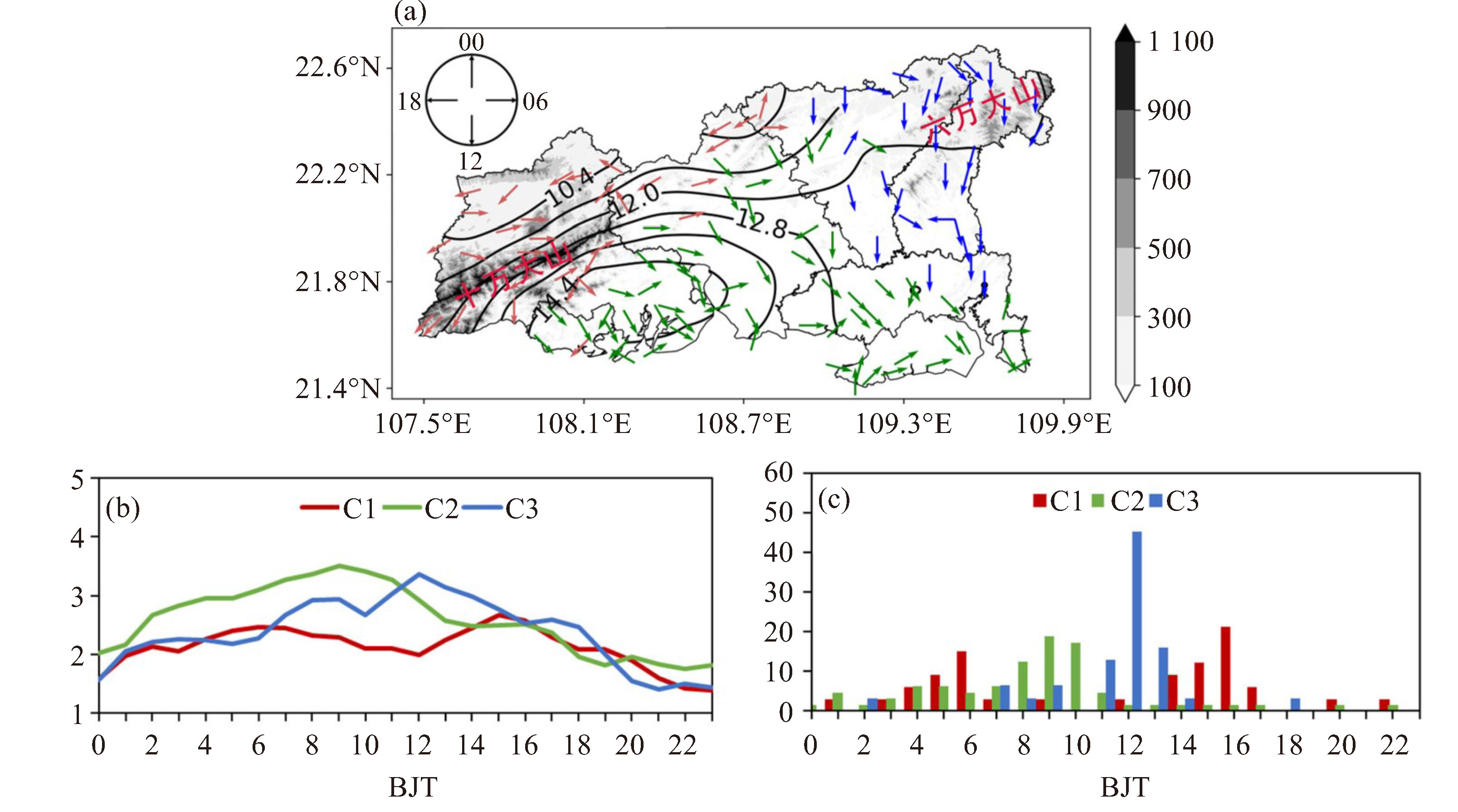
图 5 2010—2022年广西沿海前汛期日平均降水强度(等值线:降水强度,单位:mm·d-1;矢量:峰值时次,右上角为时钟图,矢量箭头所指方向代表峰值出现的时次;填色:海拔高度,单位:m)(a)、3种类型分区降水强度日内变化(单位:mm·h-1)(b)以及峰值时次占比统计(单位:%)(c)

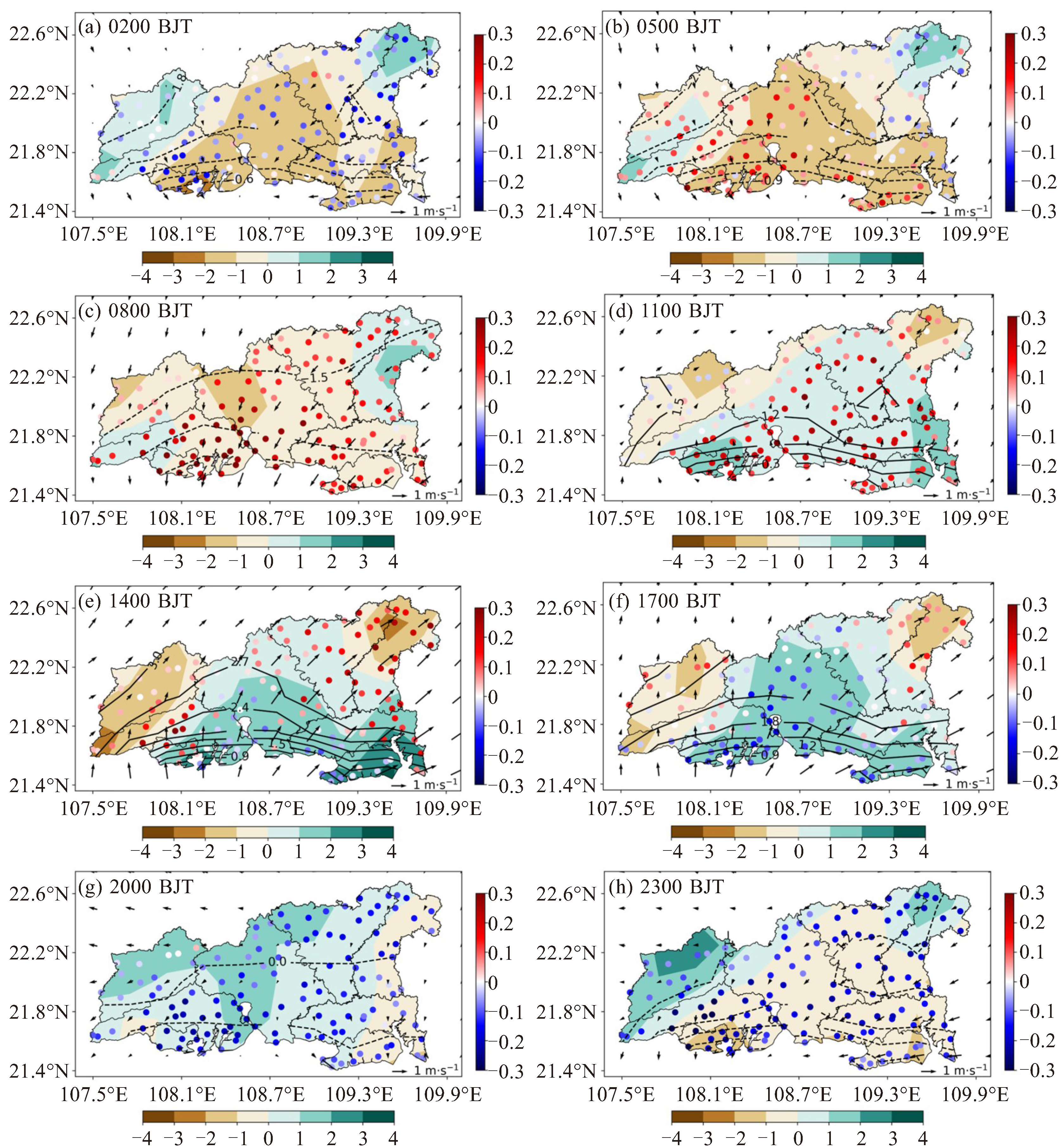
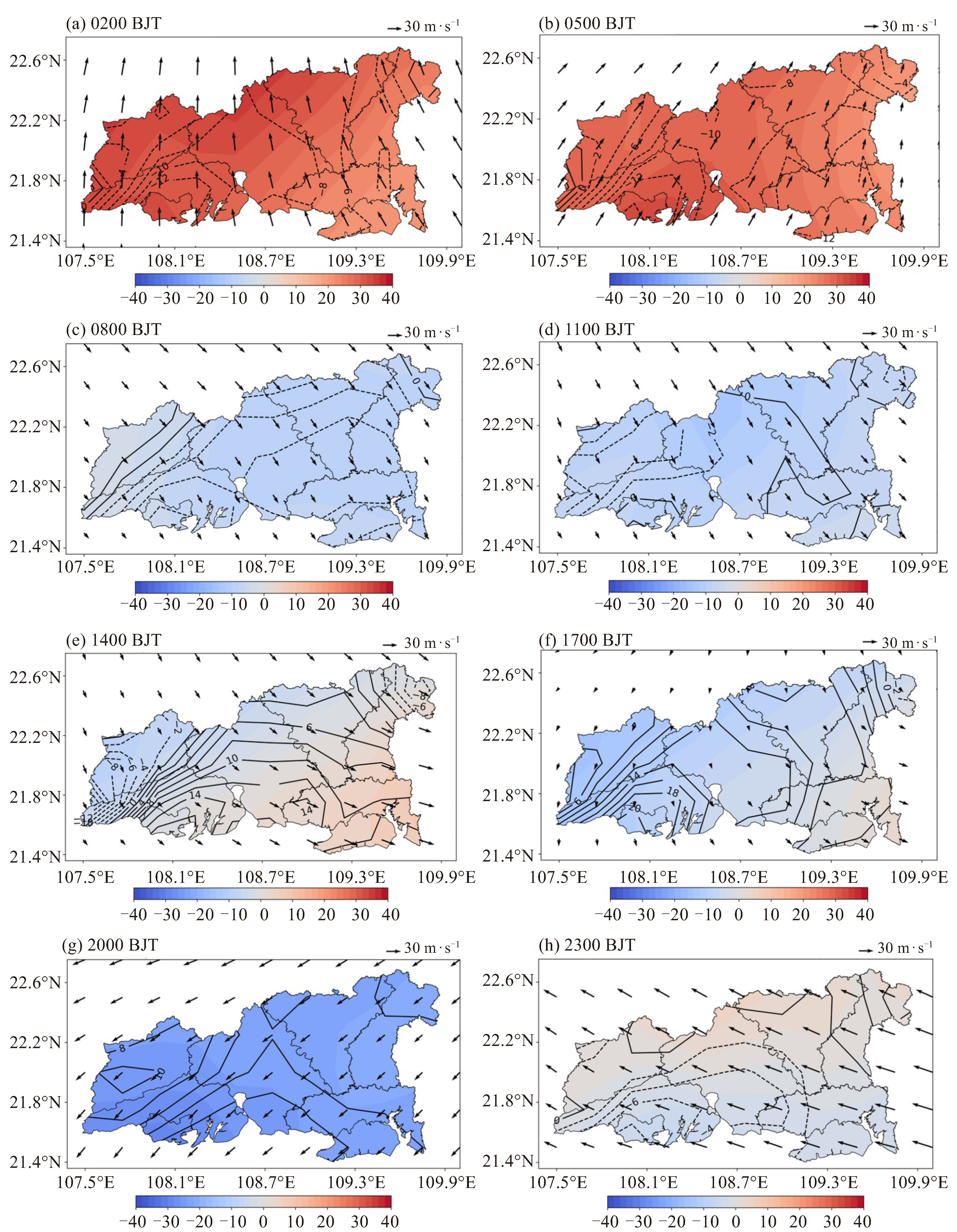
图 6 2010—2022年广西沿海前汛期3 h间隔地面1h降水量(散点,单位:mm)、975 hPa风场(矢量,单位:m·s-1)、2 m气温(等值线,单位:℃)及975 hPa散度(填色,单位:105 s-1)的日偏差

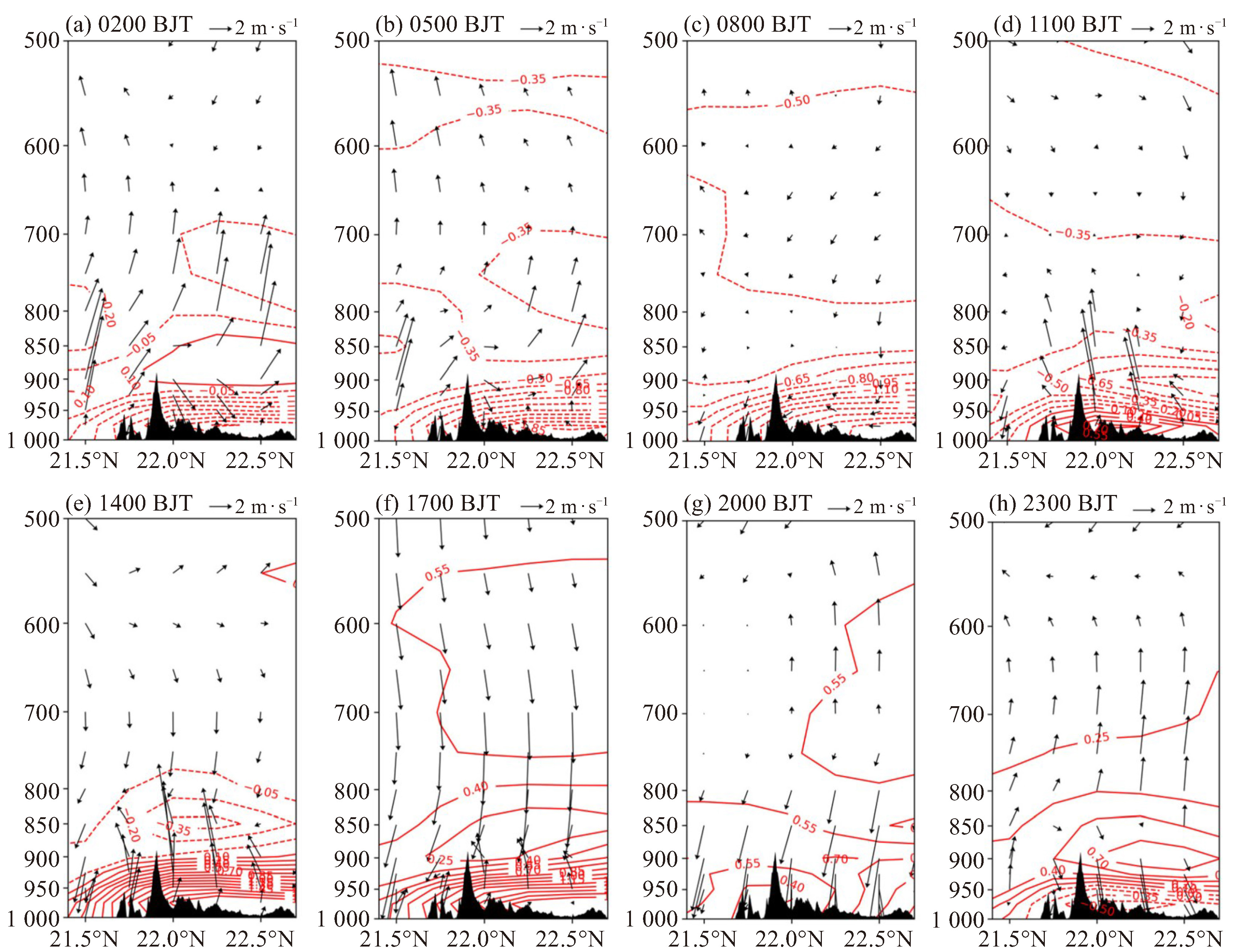
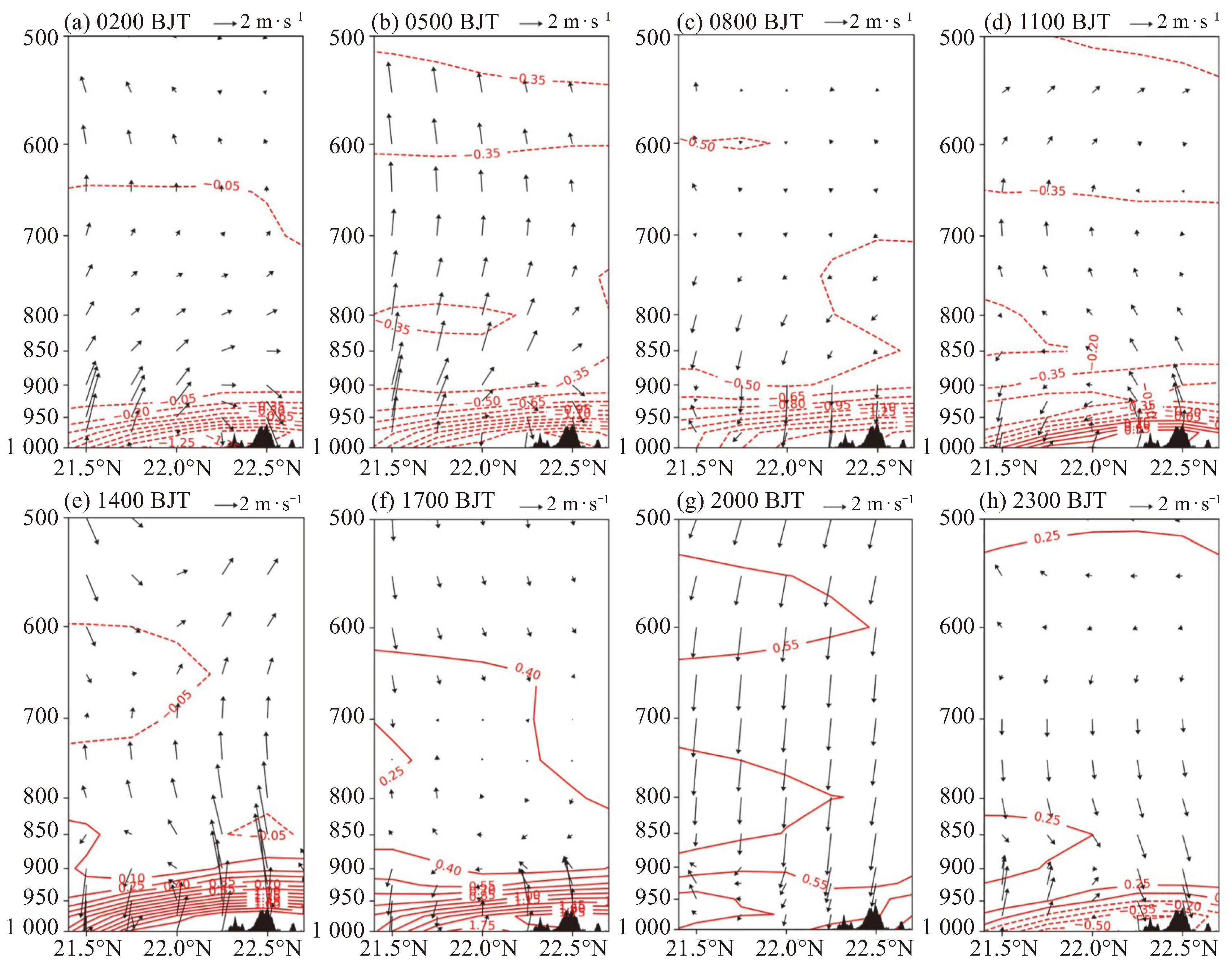
图 7 2010—2022年广西沿海前汛期3 h间隔垂直环流日偏差(矢量,单位:Pa·s-1)及假相当位温θse日偏差(等值线,单位:K)沿十万大山(108 °E)的经向垂直剖面图(黑色阴影为地形)
矢量为垂直速度w×(-50)与风场经向分量v的合成。
-
[1] 宇如聪, 李建, 陈昊明, 等. 中国大陆降水日变化研究进展[J]. 气象学报, 2014, 72(5): 948-968. [2] Li J, Yu R C, Zhou T J. Seasonal variation of the diurnal cycle of rainfall in southern contiguous China[J]. Journal of Climate, 2008, 21(22): 6036-6043. [3] 曾礼, 高艳红, 张果, 等. 华东地区主要地形因子对极端小时降水峰型的影响研究[J]. 大气科学学报, 2023, 46(3): 369-379. [4] Chen G X, Sha W M, Iwasaki T. Diurnal variation of precipitation over southeastern China: spatial distribution and its seasonality[J]. Journal of Geophysical Research: Atmospheres, 2009, 114(D13): 2008JD011103. [5] 苏桐, 张文江, 覃光华, 等. 中国昼夜降水特征的空间分异规律[J]. 水电能源科学, 2024, 42(4): 10-14. [6] 李秀昌, 黄维, 黄小燕, 等. 近60年广西夜间降水与暴雨频次的时空特征分析[J]. 气象研究与应用, 2023, 44(4): 7-13. [7] Westra S, Fowler H J, Evans J P, et al. Future changes to the intensity and frequency of short-duration extreme rainfall: future intensity of sub-daily rainfall[J]. Reviews of Geophysics, 2014, 52(3): 522-555. [8] 梁巧倩, 蒙伟光, 孙喜艳, 等. 广东前汛期锋面强降水和后汛期季风强降水特征对比分析[J]. 热带气象学报, 2019, 35(1): 51-62. [9] 蔡悦幸, 陆希, 杨崧. 华南地区前后汛期极端降水事件对比分析[J]. 中山大学学报(自然科学版), 2018, 57(1): 83-92. [10] 强学民, 杨修群, 孙成艺. 华南前汛期降水开始和结束日期确定方法综述[J]. 气象, 2008, 34(3): 10-15. [11] Chen G X, Lan R Y, Zeng W X, et al. Diurnal variations of rainfall in surface and satellite observations at the monsoon coast (South China)[J]. Journal of Climate, 2018, 31(5): 1703-1724. [12] 刘亚楠, 王东海, 李国平, 等. 南海夏季风爆发前后华南前汛期降水日变化对比分析[J]. 热带气象学报, 2019, 35(3): 365-378. [13] 智协飞, 李佳, 张玲. 双低空急流影响下华南初夏降水日变化的时空分布特征[J]. 大气科学学报, 2022, 45(3): 444-455. [14] 张华龙, 肖柳斯, 陈生, 等. 基于GPM卫星的广东汛期降水日变化特征与评估[J]. 热带气象学报, 2020, 36(3): 335-346. [15] 陈芳丽, 刘显通, 曾丹丹, 等. 珠三角北部一次暖区强降水过程中的地形作用[J]. 热带气象学报, 2022, 38(3): 377-386. [16] 丁乙, 窦晶晶, 王迎春, 等. 华北平原及沿山和沿海五个城市夏季短历时降水过程的日变化分析[J]. 气象学报, 2024, 82(4): 490-509. [17] 赵玉春, 王叶红. 我国东南沿岸及复杂山地后汛期降水日变化的数值研究[J]. 大气科学, 2020, 44(2): 371-389. [18] Yu R C, Yuan W H, Li J, et al. Diurnal phase of late-night against late-afternoon of stratiform and convective precipitation in summer southern contiguous China[J]. Climate Dynamics, 2010, 35(4): 567-576. [19] 李德帅. 基于逐小时资料的华南地区汛期降水时空变化特征及其成因研究[D]. 兰州: 兰州大学, 2016. [20] Chen X C, Zhang F Q, Zhao K. Diurnal variations of the land-sea breeze and its related precipitation over South China[J]. Journal of the Atmospheric Sciences, 2016, 73(12): 4793-4815. [21] Zhao Y C. Diurnal variation of rainfall associated with tropical depression in South China and its relationship to land-sea contrast and topography[J]. Atmosphere, 2014, 5(1): 16-44. [22] 吕翔, 徐海明. 中南半岛地区夏季降水日变化特征[J]. 南京气象学院学报, 2007, 30(5): 632-642. [23] 伍红雨, 杜尧东, 秦鹏. 华南暴雨的气候特征及变化[J]. 气象, 2011, 37(10): 1262-1269. [24] 蒲义良, 郭柏成, 叶朗明, 等. 基于小时降水资料研究广东省降水分布特征[J]. 南京信息工程大学学报(自然科学版), 2020, 12(4): 495-503. [25] 刘宁. 平陆运河工程建设关键问题研究与思考[J]. 水运工程, 2024(6): 1-11. [26] 陈绍河, 郑凤琴, 蔡悦幸, 等. 广西防城港沿海6·16特大暴雨成因及机制探讨[J]. 热带气象学报, 2023, 39(4): 433-442. [27] 廖胜石, 卓健, 陆甲. 基于小时数据的广西汛期降水日变化特征[J]. 气象研究与应用, 2023, 44(2): 27-32. [28] 覃卫坚, 李栋梁. 近50a来广西各级降水气候变化特征分析[J]. 自然资源学报, 2014, 29(4): 666-676. [29] 黄滢, 黄小燕, 林文桦, 等. 广西"雨窝"降雨特征及成因分析[J]. 气象与环境科学, 2023, 46(3): 47-54. [30] 韩微, 翟盘茂. 三种聚类分析方法在中国温度区划分中的应用研究[J]. 气候与环境研究, 2015, 20(1): 111-118. [31] 刘伟东, 尤焕苓, 任国玉, 等. 北京地区自动站降水特征的聚类分析[J]. 气象, 2014(7): 844-851. [32] 杜良敏, 柯宗建, 刘长征, 等. 基于聚类分区的中国夏季降水预测模型[J]. 气象, 2016, 42(1): 89-96. [33] Hersbach H, Bell B, Berrisford P, et al. The ERA5 global reanalysis[J]. Quarterly Journal of the Royal Meteorological Society, 2020, 146(730): 1999-2049. [34] 谭龙. 广西综合气象观测网发展历程回顾[J]. 气象研究与应用, 2020, 41(4): 94-99. [35] 赵玮, 郝翠, 曹洁, 等. 近40年北京地区夏季降水日变化及不同持续时间降水事件的特征[J]. 大气科学, 2022, 46(5): 1167-1176. [36] 朱黎明, 张智欣, 魏庆伟. 基于K均值聚类的中国夏季降水日变化空间分布模式[J]. 气象科技, 2021, 49(4): 552-560. [37] 田义超, 梁铭忠. 北部湾沿海地区植被覆盖对气温和降水的旬响应特征[J]. 自然资源学报, 2016, 31(3): 488-502. [38] 苏志, 余纬东, 黄理, 等. 北部湾海岸带的地理环境及其对气候的影响[J]. 气象研究与应用, 2009, 30(3): 44-47. [39] Dong F, Zhi X F, Zhang L, et al. Diurnal variations of coastal boundary layer jets over the northern South China Sea and their impacts on diurnal cycle of rainfall over Southern China during the early-summer rainy season[J]. Monthly Weather Review, 2021, 149(10): 3341-3363. [40] 伍红雨, 李春梅, 刘蔚琴. 1961—2014年广东汛期小时强降水的日变化特征[J]. 中山大学学报(自然科学版), 2018(5): 10-18. -

 下载:
下载:
 点击查看大图
计量
- 文章访问数: 2
- HTML全文浏览量: 2
- PDF下载量: 0
- 被引次数: 0
 粤公网安备 4401069904700003号