



Lightning Activity and Convective Characteristics of Tropical Cyclones over South China Sea and Northwest Pacific
-
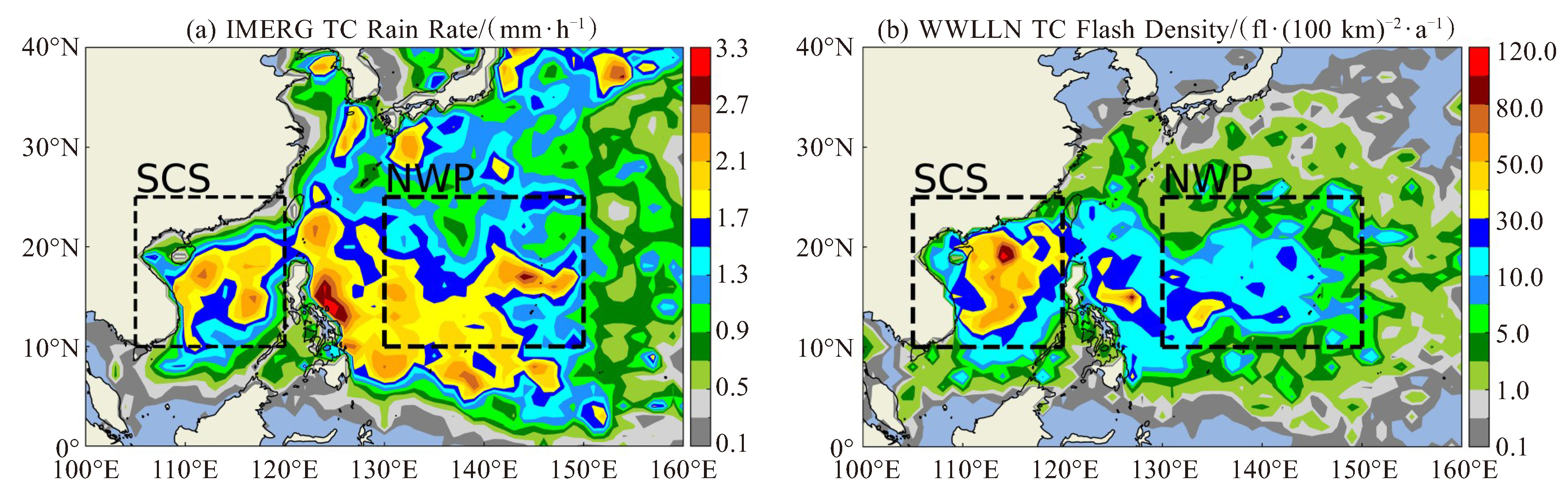
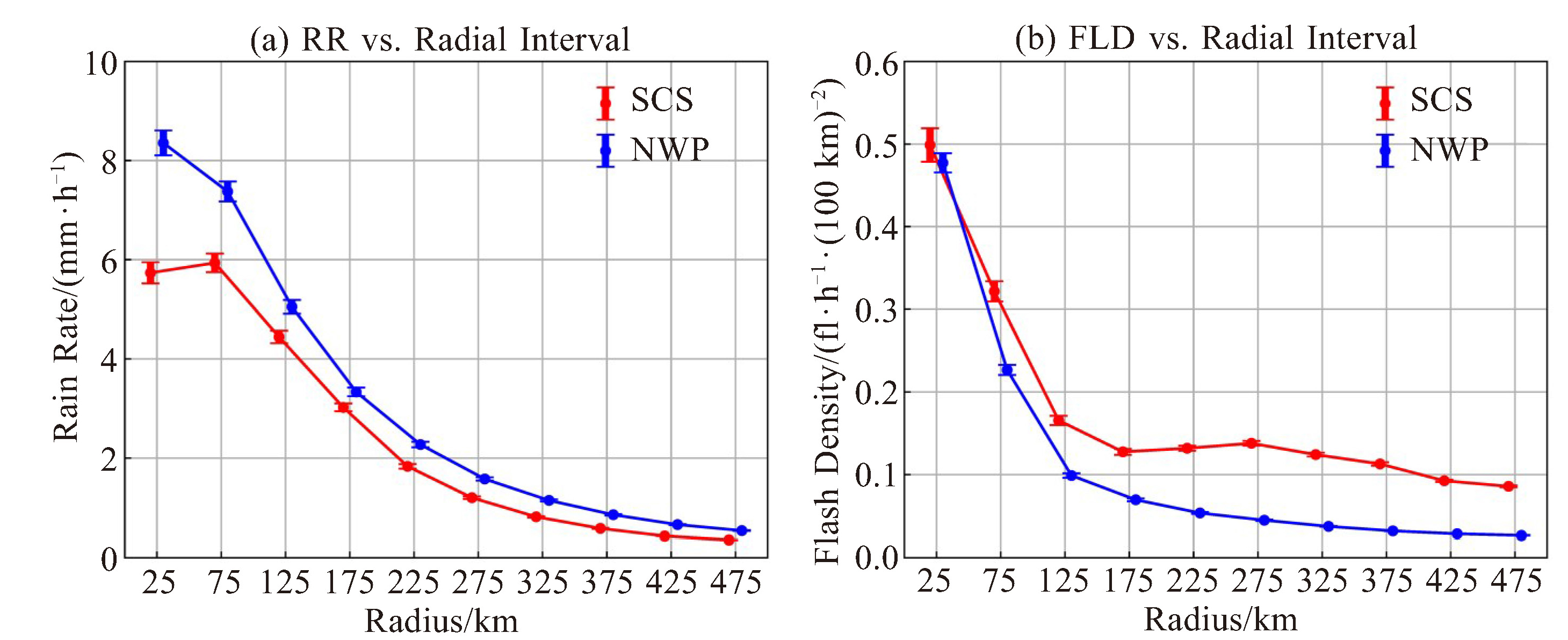
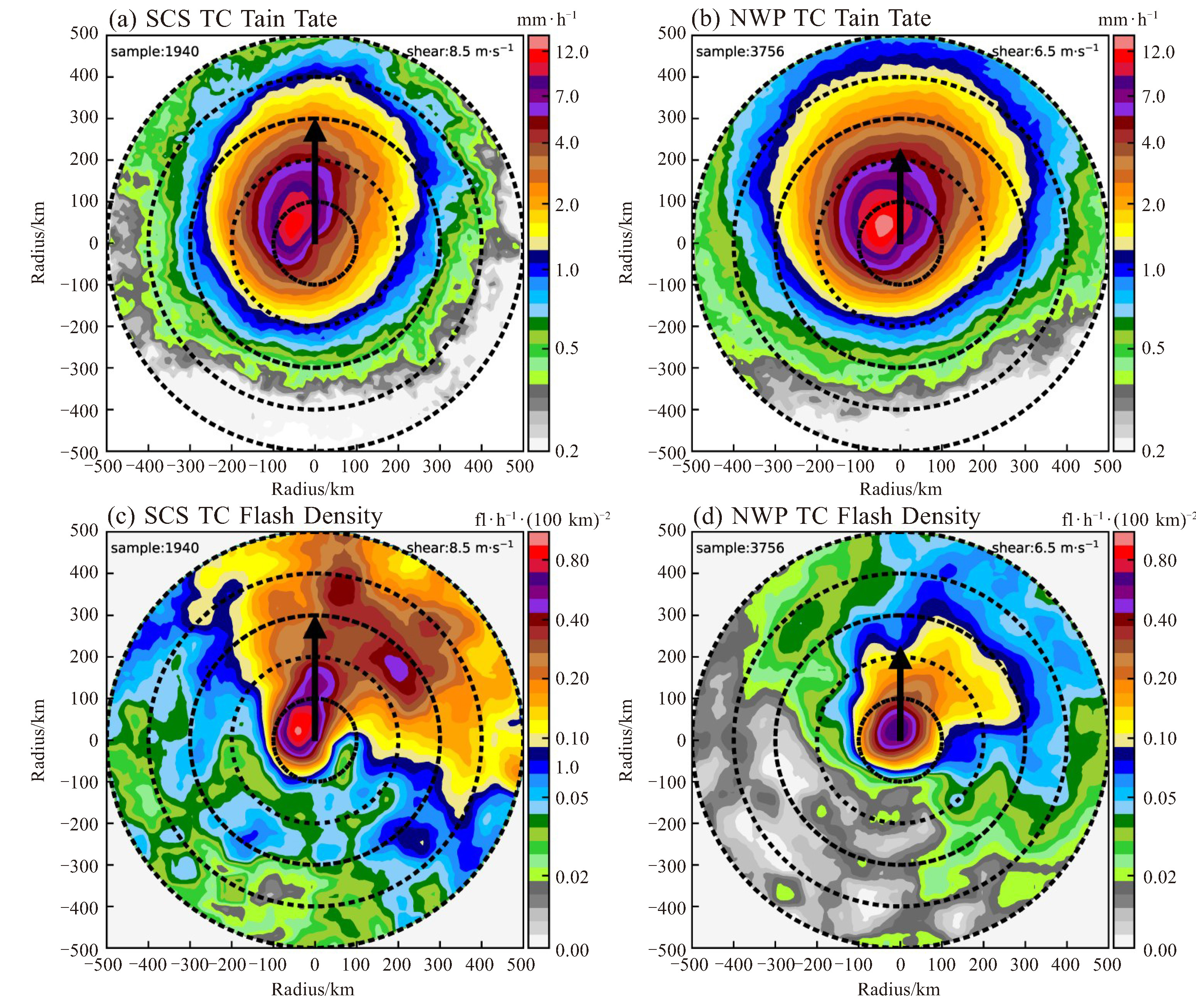
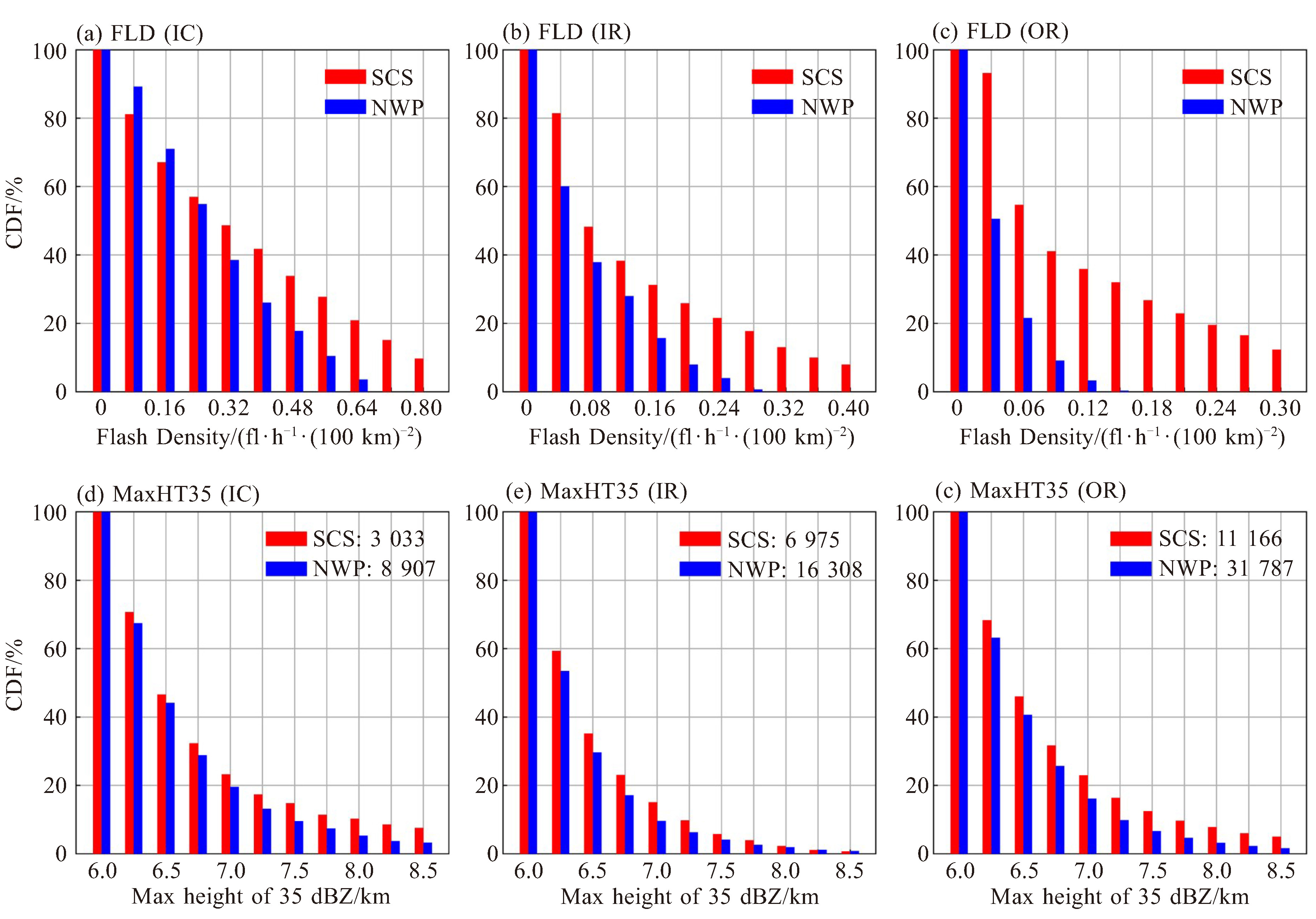
摘要: 基于十几年的全球地基闪电数据、多源卫星观测、再分析资料以及热带气旋最佳路径数据集, 对比研究了热带气旋(Tropical Cyclone,简称TC)在封闭性(南海)和开放性(西北太平洋,简称西太)洋面上闪电活动及降水的差异,并通过分析TC对流结构和环境特征探讨其背后的物理机制。结果表明,南海和西太的TC降水强度和闪电活动呈现相反趋势,西太的TC降水率更高,而南海的TC闪电活动更加频繁且分布更加不对称。两个区域的TC降水都在顺风切变左侧达到峰值,而闪电峰值自内核至外雨带由顺风切变左侧移至右侧。卫星观测显示西太的TC具有更低的85 GHz通道微波亮温,表明该区域TC具有更深厚的冰相粒子层或更多的冰水含量,与较强的地面降水一致;而南海TC强雷达回波(35 dBZ)出现在冰冻层(>6 km)以上的概率更高,反映了其混合相态过程更活跃,有利于闪电的发生。从大尺度环境条件看,西太的海表温度更高、大气不稳定度更强,有利于TC的发展,形成更深厚的云系,从而产生更多降水。相比于西太,南海的垂直风切变较强,使得TC内部对流分布更加不对称,局部形成更强的对流;此外,南海TC的暖云厚度较薄,环境气溶胶浓度较高,均可能抑制TC对流的暖雨过程而增强其冰相过程,使得闪电发生更加频繁。Abstract: This study compares the lightning activity and precipitation of Tropical Cyclones (TCs) over the closed basin (South China Sea, SCS) and the open ocean (Northwest Pacific, NWP) based on the World Wide Lightning Location Network, multi-source satellite observation, reanalysis data and the International Best Track Archive for Climate Stewardship over the past ten years or more, and explores the physical mechanisms by analyzing convective structure and environmental characteristics. The results show that there is an opposite trend between precipitation intensity and lightning activity of TCs over SCS and NWP. The rain rate of TCs over NWP is higher, and the lightning activity of TCs over SCS is more frequent and asymmetric. In these two regions, the rain rate reaches the maximum on the downshear-left side of TCs, while the lightning density peak moves from the downshear-left side of the inner core to the downshear-right side of the outer rainband. Satellite observations show that the Polarization Corrected Temperature at 85 GHz (PCT85) over NWP is lower, indicating that TCs contain a deeper layer of ice particles or more ice water content, consistent with stronger surface precipitation; however, TCs over SCS show a higher probability of strong radar echo (35 dBZ) appearing above the freezing layer (>6 km), reflecting that the mixed-phase process is more active, which is conducive to lightning bursts. From the perspective of large-scale environmental conditions, higher sea surface temperature and stronger atmospheric instability in NWP are conductive to the development of TCs, forming deeper cloud systems and generating more precipitation. Compared to NWP, stronger vertical wind shear in TCs over SCS makes the convective distribution more asymmetric, and locally forms stronger convection; in addition, thinner warm cloud depth and higher aerosol optical depth in TCs over SCS may suppress the warm rain process in TC convection and enhance its ice-phase process, making lightning occur more frequent.
-
Key words:
- tropical cyclones /
- lightning activity /
- precipitation /
- convection /
- remote-sensing satellite
-

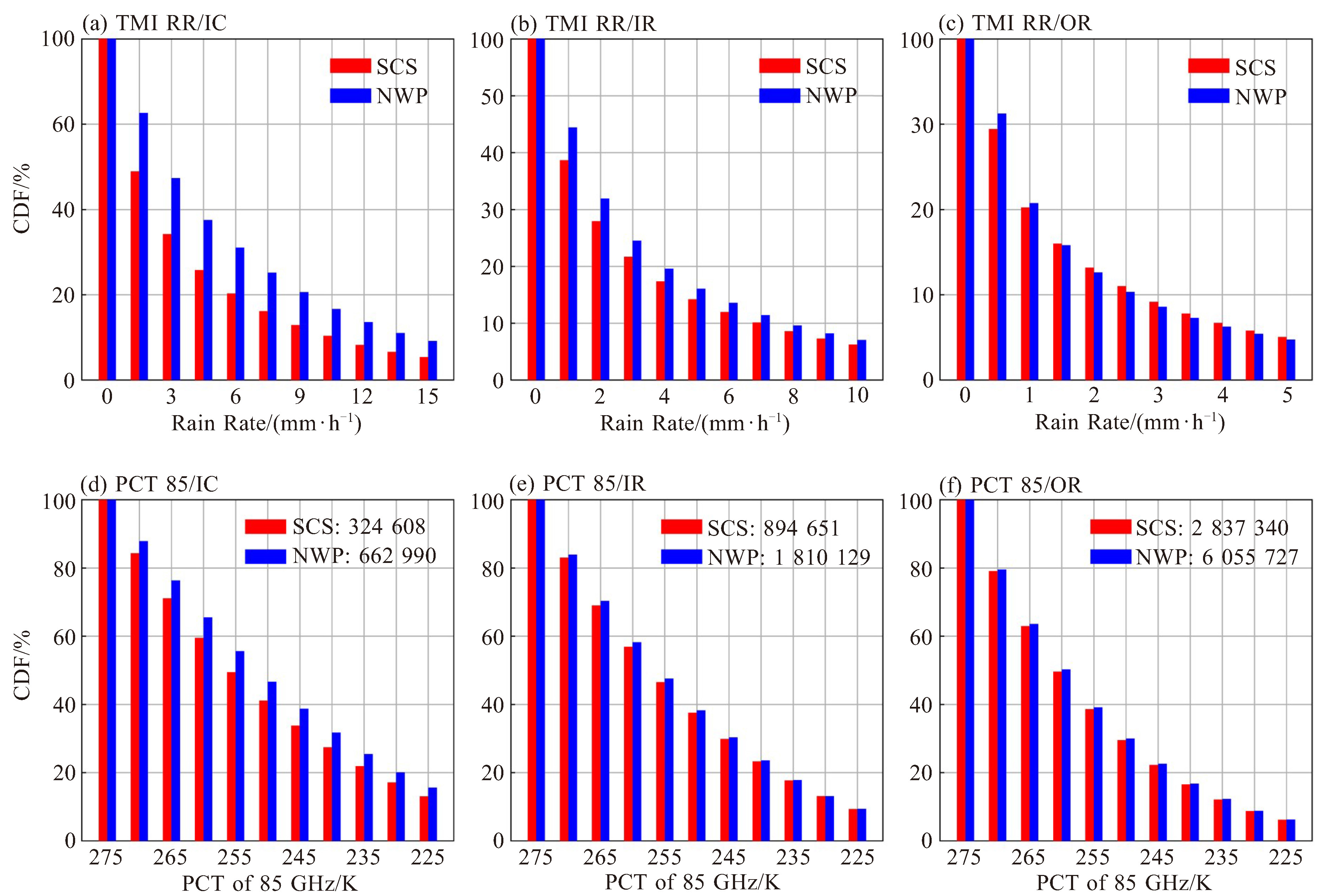
图 5 TC内部不同结构的累计概率分布图
TMI降水率:(a)内核;(b)内雨带;(c)外雨带。PCT85:(d)内核;(e)内雨带;(f)外雨带。红色代表南海,蓝色代表西太。图中数字表示与TC范围重合的TMI轨道像素点个数。

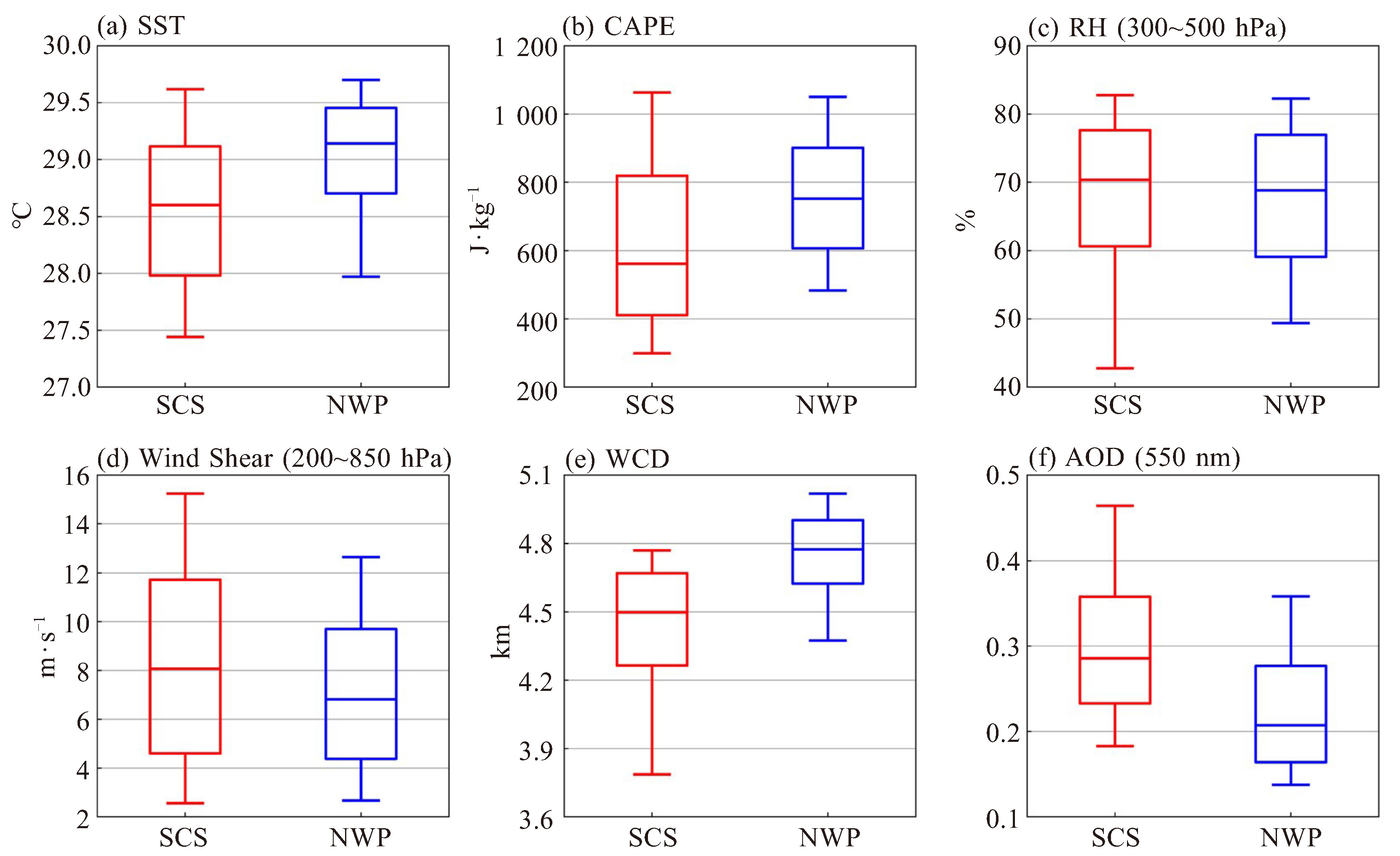
图 7 不同环境变量的箱线图:SST(a);CAPE(b);300~500 hPa的平均RH(c);(d)200~850 hPa垂直风切变;(e)WCD;(f)波段550 nm的AOD
矩形箱内部的横线代表中位数,矩形箱的上下两边分别代表 75%分位数和25%分位数,矩形箱上下两边延伸的最长距离分别代表 90%分位数和10%分位数。除了300~500 hPa的平均RH,其它环境变量在两个区域的差异都通过了置信度95%的t检验。
表 1 根据LIS/OTD年平均闪电密度气候态数据计算的西北太平洋2005—2017年WWLLN闪电调整系数
年份 05 06 07 08 09 10 11 12 13 14 15 16 17 系数 12.0 9.4 10.6 7.4 5.8 5.0 5.3 4.8 4.2 4.1 4.2 4.6 3.1  下载: 导出CSV
表 2 南海和西太的WWLLN/IMERG逐3 h的TC样本和TRMM ITP样本数量
南海 西太 WWLLN/IMERG(2005—2017) 1 940 3 756 TRMM-PR(1998—2013) 276 697 TRMM-TMI(1998—2013) 551 1 117
下载: 导出CSV
-
[1] 陈联寿, 孟智勇. 我国热带气旋研究十年进展[J]. 大气科学, 2001, 25(3): 420-432. [2] 雷小途, 陈佩燕, 杨玉华, 等. 中国台风灾情特征及其灾害客观评估方法[J]. 气象学报, 2009, 67(5): 875-883. [3] 卢莹, 赵海坤, 赵丹, 等. 1984—2017年影响中国热带气旋灾害的时空特征分析[J]. 海洋学报(中文版), 2021, 43(6): 45-61. [4] 杨玉华, 应明, 陈葆德. 近58年来登陆中国热带气旋气候变化特征[J]. 气象学报, 2009, 67(5): 689-696. [5] 张娇艳, 吴立广, 张强. 全球变暖背景下我国热带气旋灾害趋势分析[J]. 热带气象学报, 2011, 27(4): 442-454. [6] 端义宏, 余晖, 伍荣生. 热带气旋强度变化研究进展[J]. 气象学报, 2005, 63(5): 636-645. [7] 端义宏, 方娟, 程正泉, 等. 热带气旋研究和业务预报进展——第九届世界气象组织热带气旋国际研讨会(IWTC-9)综述[J]. 气象学报, 2020, 78(3): 537-550. [8] 陈联寿. 热带气旋研究和业务预报技术的发展[J]. 应用气象学报, 2006, 17(6): 672-681. [9] 陈联寿, 罗哲贤, 李英. 登陆热带气旋研究的进展[J]. 气象学报, 2004, 62(5): 541-549. [10] 陈联寿, 孟智勇, 丛春华. 台风暴雨落区研究综述[J]. 海洋气象学报, 2017, 37(4): 1-7. [11] Stevenson S N, Corbosiero K L, Abarca S F. Lightning in eastern north Pacific tropical cyclones: a comparison to the north Atlantic[J]. Monthly Weather Review, 2016, 144(1): 225-239. [12] Fierro A O, Stevenson S N, Rabin R M. Evolution of GLM-observed total lightning in hurricane maria (2017) during the period of maximum intensity[J]. Monthly Weather Review, 2018, 146(6): 1641-1666. [13] Abarca S F, Corbosiero K L, Vollaro D. The world wide lightning location network and convective activity in tropical cyclones[J]. Monthly Weather Review, 2011, 139(1): 175-191. [14] DeMaria M, DeMaria R T, Knaff J A, et al. Tropical cyclone lightning and rapid intensity change[J]. Monthly Weather Review, 2012, 140(6): 1828-1842. [15] Xu W X, Rutledge S A, Zhang W J. Relationships between total lightning, deep convection, and tropical cyclone intensity change[J]. Journal of Geophysical Research: Atmospheres, 2017, 122(13): 7047-7063. [16] Cecil D J, Zipser E J, Nesbitt S W. Reflectivity, ice scattering, and lightning characteristics of hurricane eyewalls and rainbands. part Ⅰ: quantitative description[J]. Monthly Weather Review, 2002, 130(4): 769-784. [17] Molinari J, Moore P, Idone V. Convective structure of hurricanes as revealed by lightning locations[J]. Monthly Weather Review, 1999, 127(4): 520-534. [18] Fierro A O, Mansell E R. Relationships between electrification and storm-scale properties based on idealized simulations of an intensifying hurricane-like vortex[J]. Journal of the Atmospheric Sciences, 2018, 75(2): 657-674. [19] Davis C A, Jones S C, Riemer M. Hurricane vortex dynamics during Atlantic extratropical transition[J]. Journal of the Atmospheric Sciences, 2008, 65(3): 714-736. [20] 费建芳, 刘磊, 黄小刚, 等. 热带气旋眼墙非对称结构的研究综述[J]. 气象学报, 2013, 71(5): 987-995. [21] Stevenson S N, Corbosiero K L, DeMaria M, et al. A 10-year survey of tropical cyclone inner-core lightning bursts and their relationship to intensity change[J]. Weather and Forecasting, 2018, 33(1): 23-36. [22] 程小平, 费建芳, 李湘成, 等. 台风双眼墙形成及眼墙替换过程的研究进展[J]. 地球物理学报, 2021, 64(6): 1857-1868. [23] Zhang W J, Rutledge S A, Xu W X, et al. Inner-core lightning outbreaks and convective evolution in Super Typhoon Haiyan (2013)[J]. Atmospheric Research, 2019, 219: 123-139. [24] Reasor P D, Montgomery M T, Marks F D Jr, et al. Low-wavenumber structure and evolution of the hurricane inner core observed by airborne dual-Doppler radar[J]. Monthly Weather Review, 2000, 128(6): 1653-1680. [25] Reasor P D, Montgomery M T, Grasso L D. A new look at the problem of tropical cyclones in vertical shear flow: vortex resiliency[J]. Journal of the Atmospheric Sciences, 2004, 61(1): 3-22. [26] Corbosiero K L, Molinari J. The relationship between storm motion, vertical wind shear, and convective asymmetries in tropical cyclones[J]. Journal of the Atmospheric Sciences, 2003, 60(2): 366-376. [27] Corbosiero K L, Molinari J. The effects of vertical wind shear on the distribution of convection in tropical cyclones[J]. Monthly Weather Review, 2002, 130(8): 2110-2123. [28] Lin S J, Chou K H. The lightning distribution of tropical cyclones over the western north Pacific[J]. Monthly Weather Review, 2020, 148(11): 4415-4434. [29] Chen S S, Knaff J A, Marks F D Jr. Effects of vertical wind shear and storm motion on tropical cyclone rainfall asymmetries deduced from TRMM[J]. Monthly Weather Review, 2006, 134(11): 3190-3208. [30] Ueno M. Observational analysis and numerical evaluation of the effects of vertical wind shear on the rainfall asymmetry in the typhoon inner-core region[J]. Journal of the Meteorological Society of Japan Ser Ⅱ, 2007, 85(2): 115-136. [31] Xu W X, Jiang H Y, Kang X B. Rainfall asymmetries of tropical cyclones prior to, during, and after making landfall in South China and Southeast United States[J]. Atmospheric Research, 2014, 139: 18-26. [32] Solorzano N N, Thomas J N, Holzworth R H. Global studies of tropical cyclones using the World Wide Lightning Location Network[C]//Proceedings of the AMS 2008 meeting, New Orleans, LA, USA. 2008. [33] Zhang W J, Zhang Y J, Zheng D, et al. Lightning climatology over the northwest Pacific region: an 11-year study using data from the World Wide Lightning Location Network[J]. Atmospheric Research, 2018, 210: 41-57. [34] Zhang W J, Zhang Y J, Zheng D, et al. Quantifying the contribution of tropical cyclones to lightning activity over the Northwest Pacific[J]. Atmospheric Research, 2020, 239: 104906. [35] Pan L X, Qie X S, Wang D F. Lightning activity and its relation to the intensity of typhoons over the Northwest Pacific Ocean[J]. Advances in Atmospheric Sciences, 2014, 31(3): 581-592. [36] Christian H J, Blakeslee R J, Boccippio D J, et al. Global frequency and distribution of lightning as observed from space by the Optical Transient Detector[J]. Journal of Geophysical Research: Atmospheres, 2003, 108(D1): ACL4-1-ACL4-15. [37] Virts K S, Wallace J M, Hutchins M L, et al. Highlights of a new ground-based, hourly global lightning climatology[J]. Bulletin of the American Meteorological Society, 2013, 94(9): 1381-1391. [38] Albrecht R I, Goodman S J, Buechler D E, et al. Where are the lightning hotspots on earth?[J]. Bulletin of the American Meteorological Society, 2016, 97(11): 2051-2068. [39] Houze R A Jr. Clouds in tropical cyclones[J]. Monthly Weather Review, 2010, 138(2): 293-344. [40] Khain A, Cohen N, Lynn B, et al. Possible aerosol effects on lightning activity and structure of hurricanes[J]. Journal of the Atmospheric Sciences, 2008, 65(12): 3652-3677. [41] Thornton J A, Virts K S, Holzworth R H, et al. Lightning enhancement over major oceanic shipping lanes[J]. Geophysical Research Letters, 2017, 44(17): 9102-9111. [42] Johnson R H, Ciesielski P E. Characteristics of the 1998 summer monsoon onset over the northern South China Sea[J]. Journal of the Meteorological Society of Japan Ser Ⅱ, 2002, 80(4): 561-578. [43] Yuan T, Qie X S. Study on lightning activity and precipitation characteristics before and after the onset of the South China Sea summer monsoon[J]. Journal of Geophysical Research: Atmospheres, 2008, 113(D14): 2007JD009382. [44] Xu W X, Zipser E J, Liu C T. Rainfall characteristics and convective properties of Mei-yu precipitation systems over South China, Taiwan, and the South China Sea. Part Ⅰ: TRMM observations[J]. Monthly Weather Review, 2009, 137(12): 4261-4275. [45] 李雪, 任福民, 杨修群, 等. 南海和西北太平洋热带气旋活动的区域性差异分析[J]. 气候与环境研究, 2010, 15(4): 504-510. [46] Abarca S F, Corbosiero K L, Galarneau T J Jr. An evaluation of the Worldwide Lightning Location Network (WWLLN) using the National Lightning Detection Network (NLDN) as ground truth[J]. Journal of Geophysical Research: Atmospheres, 2010, 115(D18): 2009JD013411. [47] Hutchins M L, Holzworth R H, Virts K S, et al. Radiated VLF energy differences of land and oceanic lightning[J]. Geophysical Research Letters, 2013, 40(10): 2390-2394. [48] Rudlosky S D, Shea D T. Evaluating WWLLN performance relative to TRMM/LIS[J]. Geophysical Research Letters, 2013, 40(10): 2344-2348. [49] Wang F, Qie X S, Wang D F, et al. Lightning activity in tropical cyclones and its relationship to dynamic and thermodynamic parameters over the northwest Pacific[J]. Atmospheric Research, 2018, 213: 86-96. [50] Hou A Y, Kakar R K, Neeck S, et al. The global precipitation measurement mission[J]. Bulletin of the American Meteorological Society, 2014, 95(5): 701-722. [51] Nesbitt S W, Zipser E J, Cecil D J. A census of precipitation features in the tropics using TRMM: radar, ice scattering, and lightning observations[J]. Journal of Climate, 2000, 13(23): 4087-4106. [52] Liu C T, Zipser E J, Cecil D J, et al. A cloud and precipitation feature database from nine years of TRMM observations[J]. Journal of Applied Meteorology and Climatology, 2008, 47(10): 2712-2728. [53] Fierro A O, Mansell E R. Electrification and lightning in idealized simulations of a hurricane-like vortex subject to wind shear and sea surface temperature cooling[J]. Journal of the Atmospheric Sciences, 2017, 74(6): 2023-2041. [54] Spencer R W, Goodman H M, Hood R E. Precipitation retrieval over land and ocean with the SSM/I: identification and characteristics of the scattering signal[J]. Journal of Atmospheric and Oceanic Technology, 1989, 6(2): 254-273. [55] Xu W X, Zipser E J. Properties of deep convection in tropical continental, monsoon, and oceanic rainfall regimes[J]. Geophysical Research Letters, 2012, 39(7): L07802. [56] Liu C T, Cecil D J, Zipser E J, et al. Relationships between lightning flash rates and radar reflectivity vertical structures in thunderstorms over the tropics and subtropics[J]. Journal of Geophysical Research: Atmospheres, 2012, 117(D6): 2011JD017123. [57] Zipser E J. Deep cumulonimbus cloud systems in the tropics with and without lightning[J]. Monthly Weather Review, 1994, 122(8): 1837-1851. [58] Zhang G J, McPhaden M J. The relationship between sea surface temperature and latent heat flux in the equatorial Pacific[J]. Journal of Climate, 1995, 8(3): 589-605. [59] Williams E R, Geotis S G, Renno N, et al. A radar and electrical study of tropical"hot towers"[J]. Journal of the Atmospheric Sciences, 1992, 49(15): 1386-1395. [60] Williams E, Stanfill S. The physical origin of the land-ocean contrast in lightning activity[J]. Comptes Rendus Physique, 2002, 3(10): 1277-1292. [61] Fuchs B R, Rutledge S A, Bruning E C, et al. Environmental controls on storm intensity and charge structure in multiple regions of the continental United States[J]. Journal of Geophysical Research: Atmospheres, 2015, 120(13): 6575-6596. [62] Stolz D C, Rutledge S A, Pierce J R. Simultaneous influences of thermodynamics and aerosols on deep convection and lightning in the tropics[J]. Journal of Geophysical Research: Atmospheres, 2015, 120(12): 6207-6231. [63] Takahashi T. Riming electrification as a charge generation mechanism in thunderstorms[J]. Journal of the Atmospheric Sciences, 1978, 35(8): 1536-1548. [64] Xu W X. Thunderstorm climatologies and their relationships to total and extreme precipitation in China[J]. Journal of Geophysical Research: Atmospheres, 2020, 125(19): e2020JD033152. [65] Andreae M O, Rosenfeld D, Artaxo P, et al. Smoking rain clouds over the Amazon[J]. Science, 2004, 303(5662): 1337-1342. [66] Rosenfeld D, Lohmann U, Raga G B, et al. Flood or drought: how do aerosols affect precipitation?[J]. Science, 2008, 321(5894): 1309-1313. [67] Kucienska B, Raga G B, Koren I, et al. Do aerosols affect lightning : A global study of a relation between aerosol optical depth and cloud to ground lightning[C]//Proceedings of the XV International Conference on Atmospheric Electricity, Norman, OK, USA. 2014: 15-20. [68] Wang Y, Wan Q, Meng W, et al. Long-term impacts of aerosols on precipitation and lightning over the Pearl River Delta megacity area in China[J]. Atmospheric Chemistry and Physics, 2011, 11(23): 12421-12436. -

 点击查看大图
图(7) / 表(2)
计量
- 文章访问数: 2
- HTML全文浏览量: 1
- PDF下载量: 0
- 被引次数: 0
 粤公网安备 4401069904700003号