



Triggering and Dual Polarization Radar Characteristics Analysis of a Strong Convection in Warm Sector Ahead of the Front
-
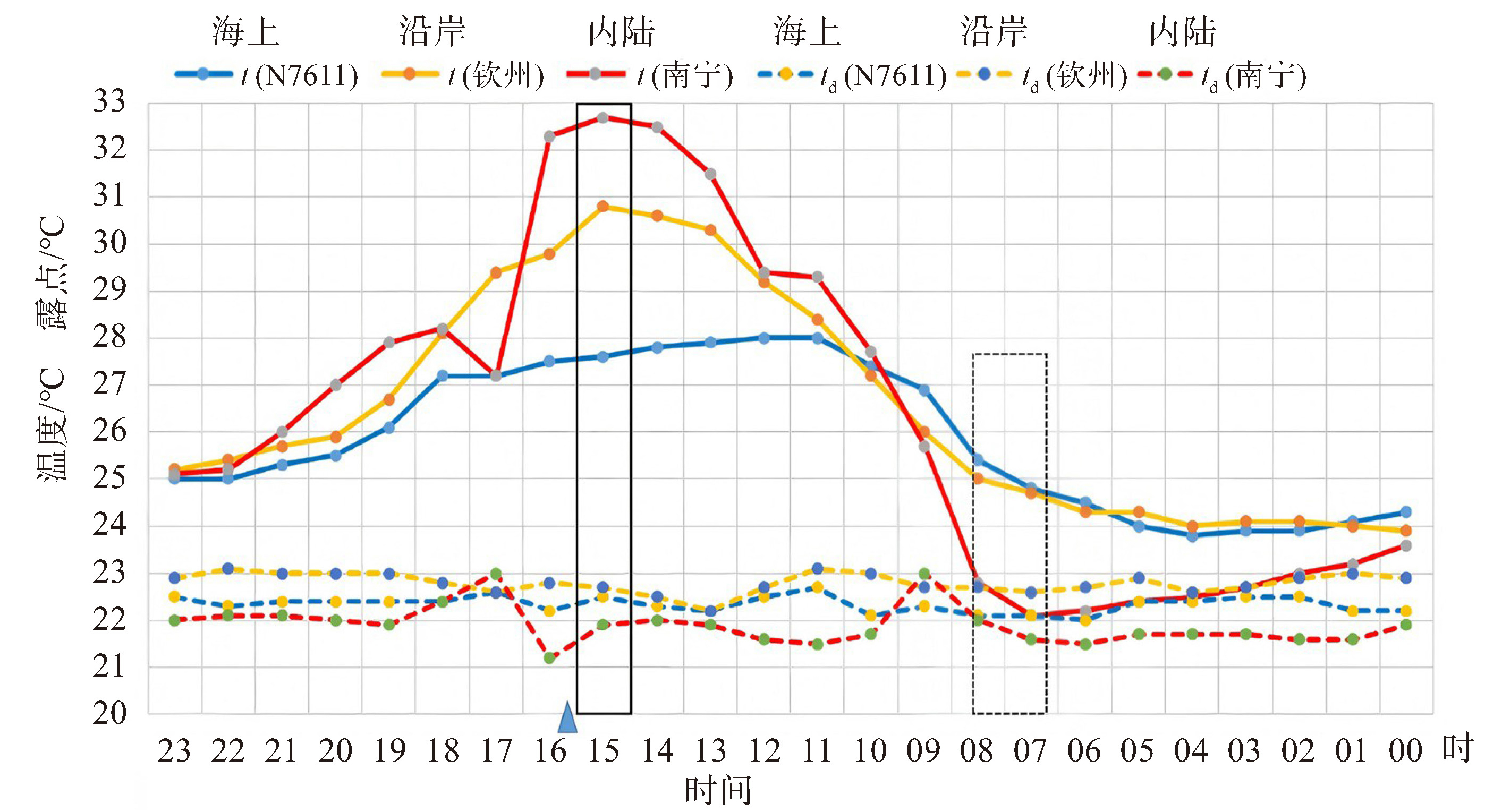
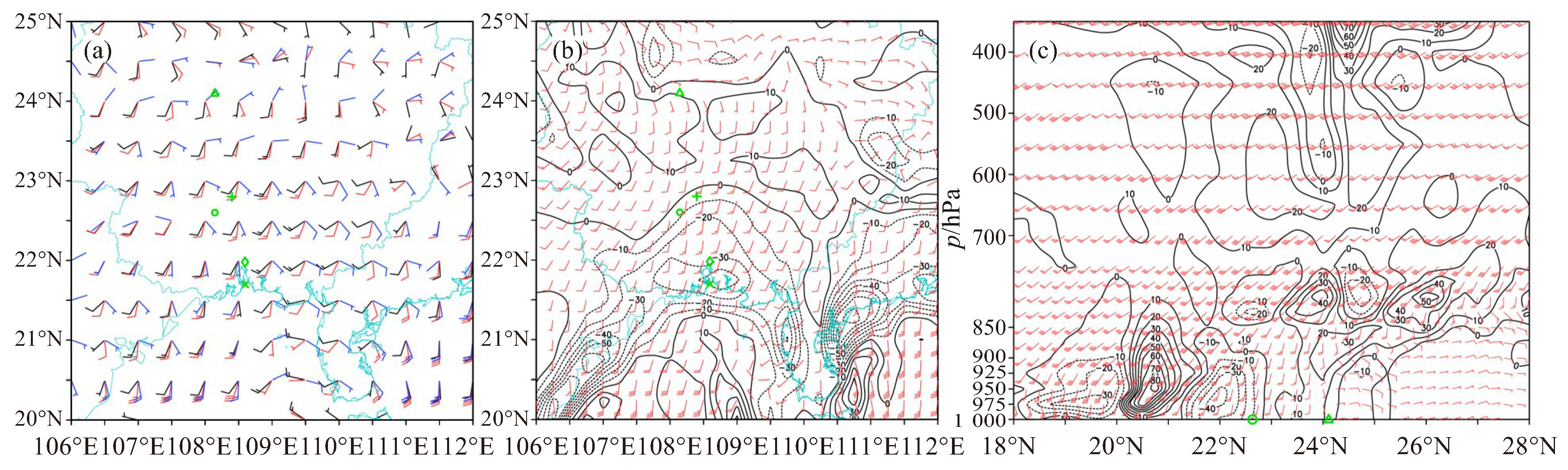
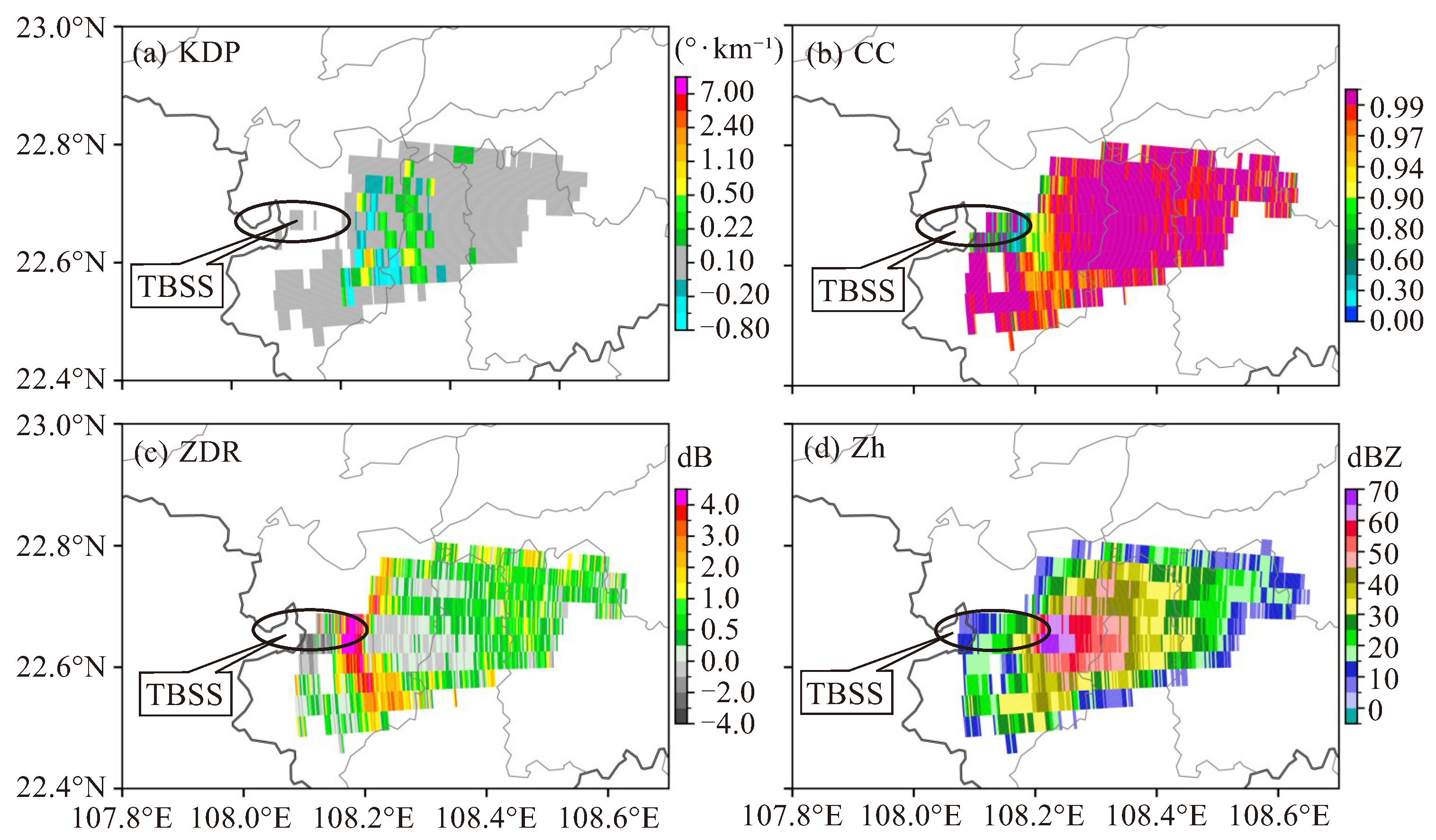
摘要: 利用SA波段双偏振雷达、FY-2G黑体亮温、地面加密观测、常规观测及ERA5再分析资料,使用天气学诊断和系统风分离推算海风贡献的方法对2023年“3.23”锋前暖区强对流的触发及双偏振雷达特征进行了分析。结果表明:(1)在暖区对流生成前,即使环境条件很好,但预报员没有分析出暖区中的抬升触发条件而漏报;(2)在暖低压发展、低层暖平流强迫背景下,午后锋前暖区里的中尺度辐合加强,且出现西南干暖气流与向岸湿冷气流的汇合;通过系统风分离推算海风贡献,证实了午后南宁受到海风影响,海风加强深入至内陆约100 km,带来水汽和浅薄冷平流,与低层中尺度辐合共同作用触发了对流。(3)强单体A、B的三体散射长钉TBSS伸出前均出现明显的前兆特征,即回波呈“短钉”状,反射率因子较强(Zh,45~65 dBZ)、对应小的差分反射率因子(ZDR,0 dB左右)、小的相关系数(CC,0.9~0.95),起始位置Zh较弱(10~25 dBZ)、ZDR很大(6~7 dB)、CC小且嘈杂(0.6~0.9)、KDP≈0 °·km-1或缺值,且中末端的弱回波尚未伸展。TBSS特征表现为反射率因子核(即冰雹核)极强(Zh在65~71 dBZ之间dBZ,CC小、ZDR为负值、KDP空洞),其径向前方伸出较长且呈“火焰”状的弱回波、对应的相关系数CC和径向速度V均较小且嘈杂、ZDR呈现“先大后小”特征。成熟阶段的强单体B呈现悬垂、有界弱回波区以及双涡旋结构等超级单体雹暴云结构。(4)Zh、ZDR、CC等偏振参量联合使用提供了更确切识别三体散射及发现三体散射前兆特征的信号,有利冰雹的早期预警。Abstract: The triggering of the strong convection process in the warm sector ahead of the front that occurred on March 23, 2023, is analyzed using SA-band dua-polarization radar, FY-2G blackbody brightness temperature (TBB), ground encrypted observation data, routine observation data, and ERA5 reanalysis data, together with the method of synoptic meteorological diagnosis and a method for calculating sea breeze contribution through system wind separation. The results showed that: (1) Before warm-sector convection initiation, forecasters may fail to predict convective events (resulting in false negatives) due to an insufficient diagnosis of triggering conditions within the warm sector, even when favorable environmental parameters are present. (2) In the background of warm low pressure development and low-level warm advection forcing, mid-scale convergence in the warm sector ahead of the front strengthens in the afternoon, and the convergence of southwest dry warm airflow and onshore wet cold airflow appears. Calculating the contribution of sea breeze through system wind separation confirms that Nanning is affected by sea breeze in the afternoon. The sea breeze strengthens and penetrates about 100 km inland, bringing water vapor and shallow cold advection, which work together with low-level mesoscale convergence to trigger convection. (3) The three body scattering spikes (TBSS) of cells A and B exhibit obvious precursor characteristics before extending. The radar echo exhibits short spikes, characterized by a robust reflectivity core (Zh; 45~65 dBZ) collocated with minimal differential reflectivity (ZDR≈0 dB) and slightly depressed cross-correlation coefficient (CC; 0.9~0.95). At the initiation region, weaker reflectivity (Zh; 10~25 dBZ) coincides with anomalously elevated ZDR values (6~7 dB), low and noisy CC (0.6~0.9), and near-zero or missing specific differential phase (KDP). Notably, the weak echo segments at mid-to-end remain not yet stretched out.The TBSS feature is that the reflectivity core (a hail core) is extremely strong (Zh=65~71 dBZ, CC small, ZDR negative, KDP void), characterized by a long and flame-like weak echo extending radially in front of the reflectance core. The corresponding correlation coefficient(CC) and radial velocity (V) are both small and noisy. ZDR presents a"big first, small later" pattern. In the mature stage, cell B presents super-individual hailstorm cloud structures such as overhangs, a bounded weak echo region (BWER), and double vortex structures. (4) The combined use of polarization parameters such as Zh, ZDR, CC provides a more accurate signal for identifying TBSS and discovering precursor characteristics of TBSS, which is beneficial for early warning of hail.
-

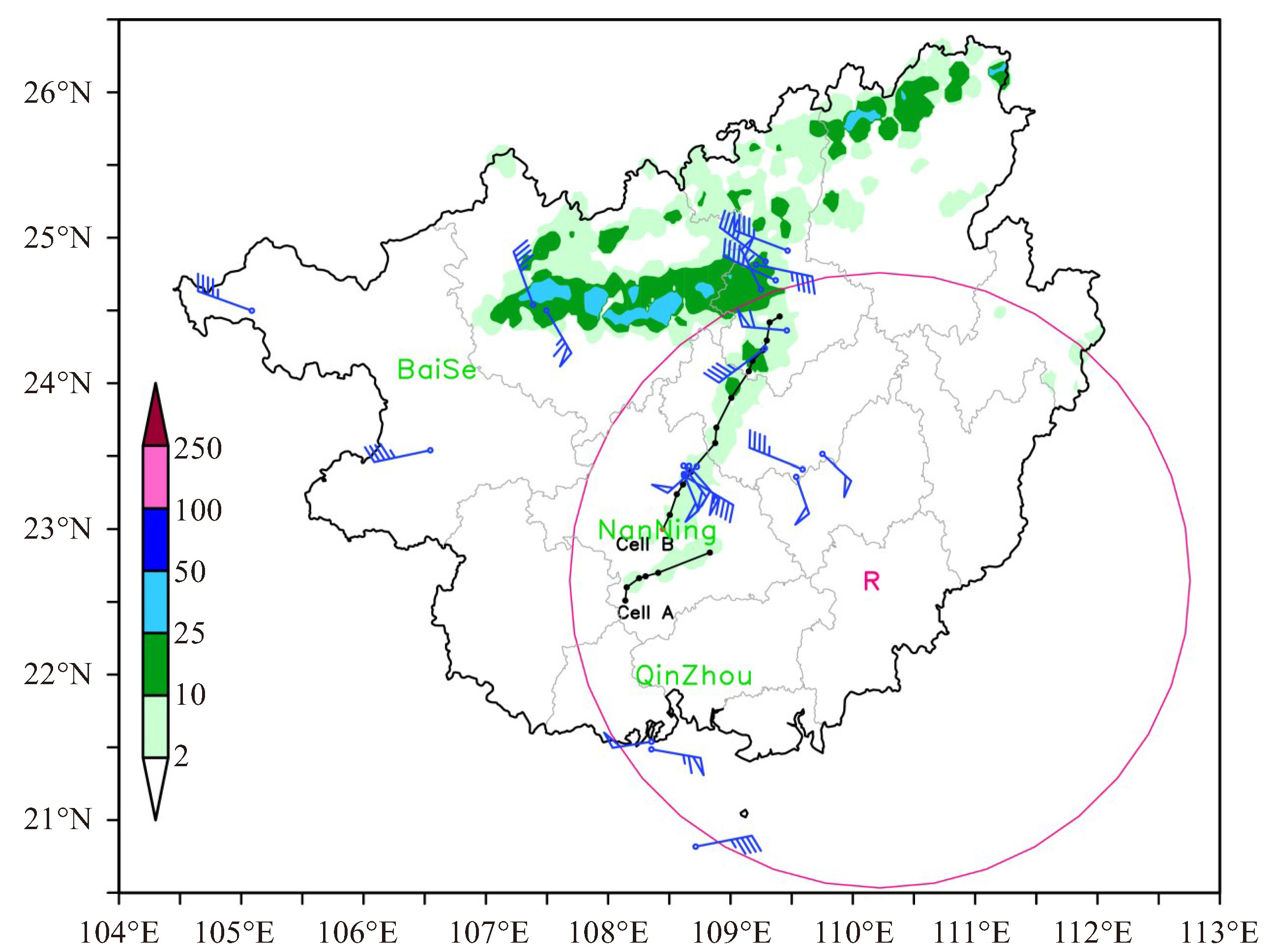
图 1 2023年3月23日下午南宁附近两个对流单体(A、B)的移动路径图、15—19时广西区累计降水量(填色,单位:mm)和17 m·s-1以上极大风(高山站除外)
R为玉林雷达站的位置, 红圈为230 km探测距离环,BaiSe为百色,NanNing为南宁,QinZhou为钦州。

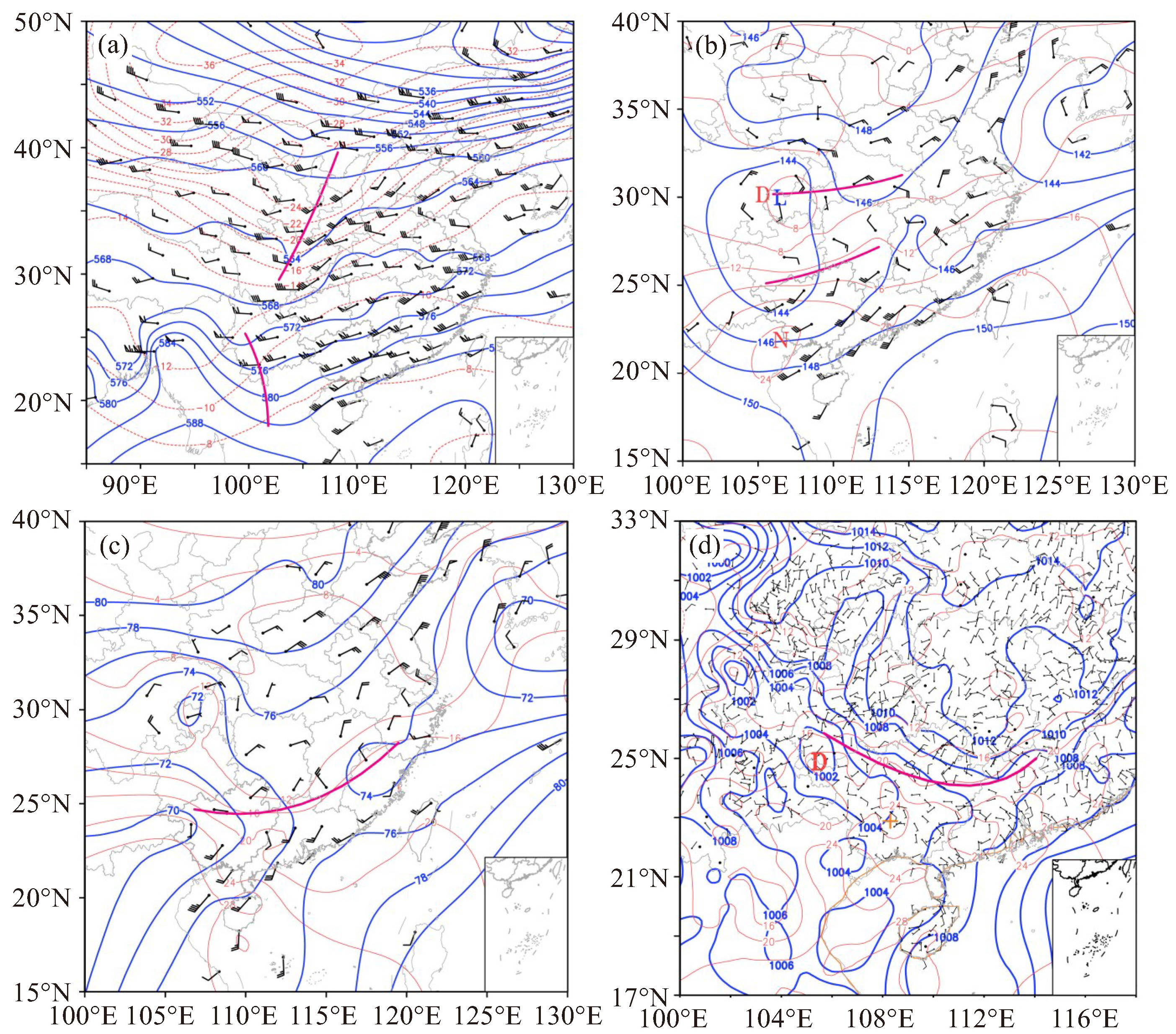
图 2 2023年3月23日08时500 hPa(a),850 hPa(b),925 hPa(c),地面(d)天气图
蓝色等值线:气压层为等高线(dagpm)、地面为海平面气压(hPa),红色等值线:等温线(℃)。

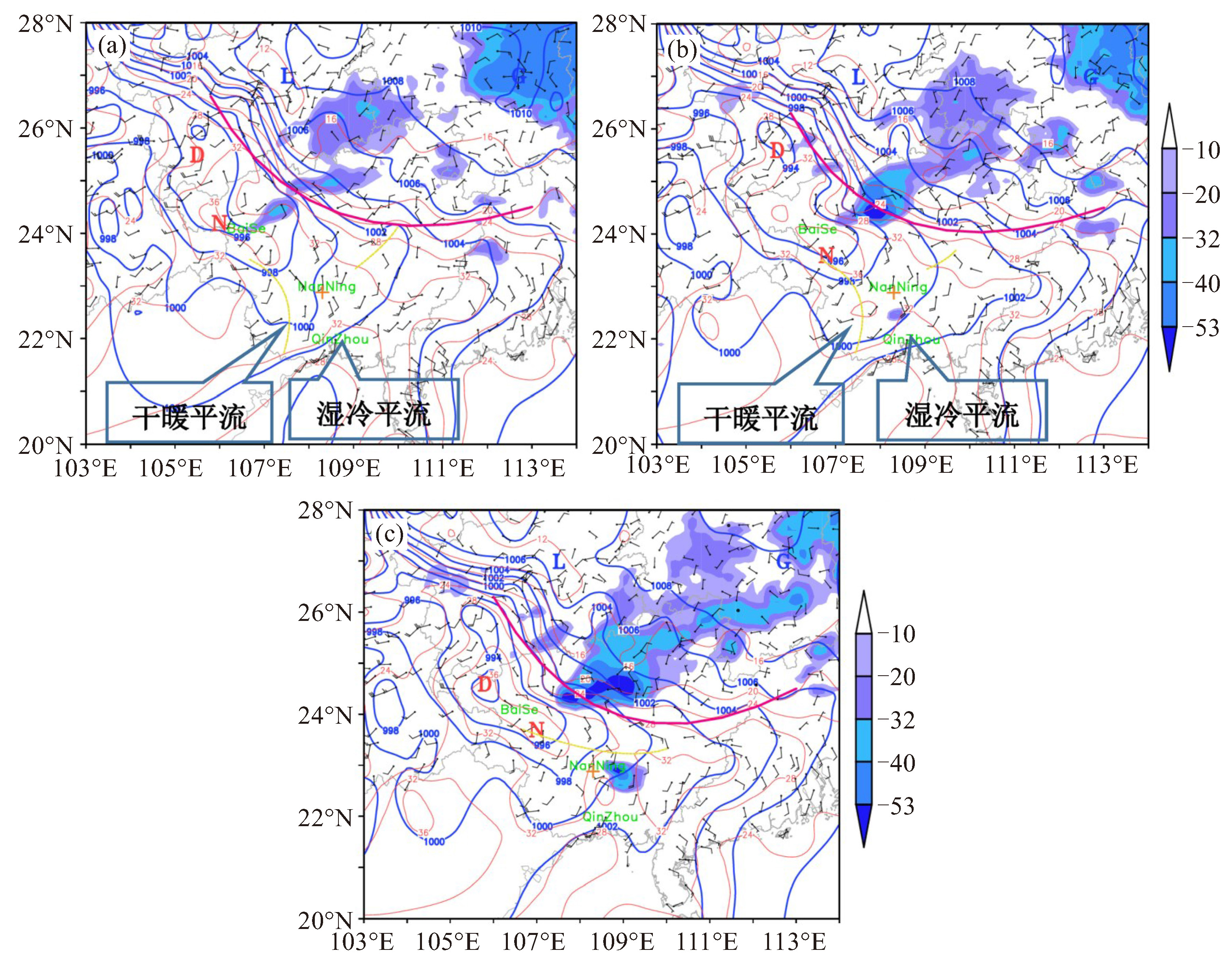
图 3 2023年3月23日下午南宁暖区对流初生(15:40)前后地面天气图叠加同时次的FY-2G黑体亮温(阴影,单位:℃)
a.15:00;b.16:00;c.17:00;蓝色等值线:海平面气压(hPa), 红色等值线:等温线(℃),BaiSe为百色,NanNing为南宁,QinZhou为钦州。

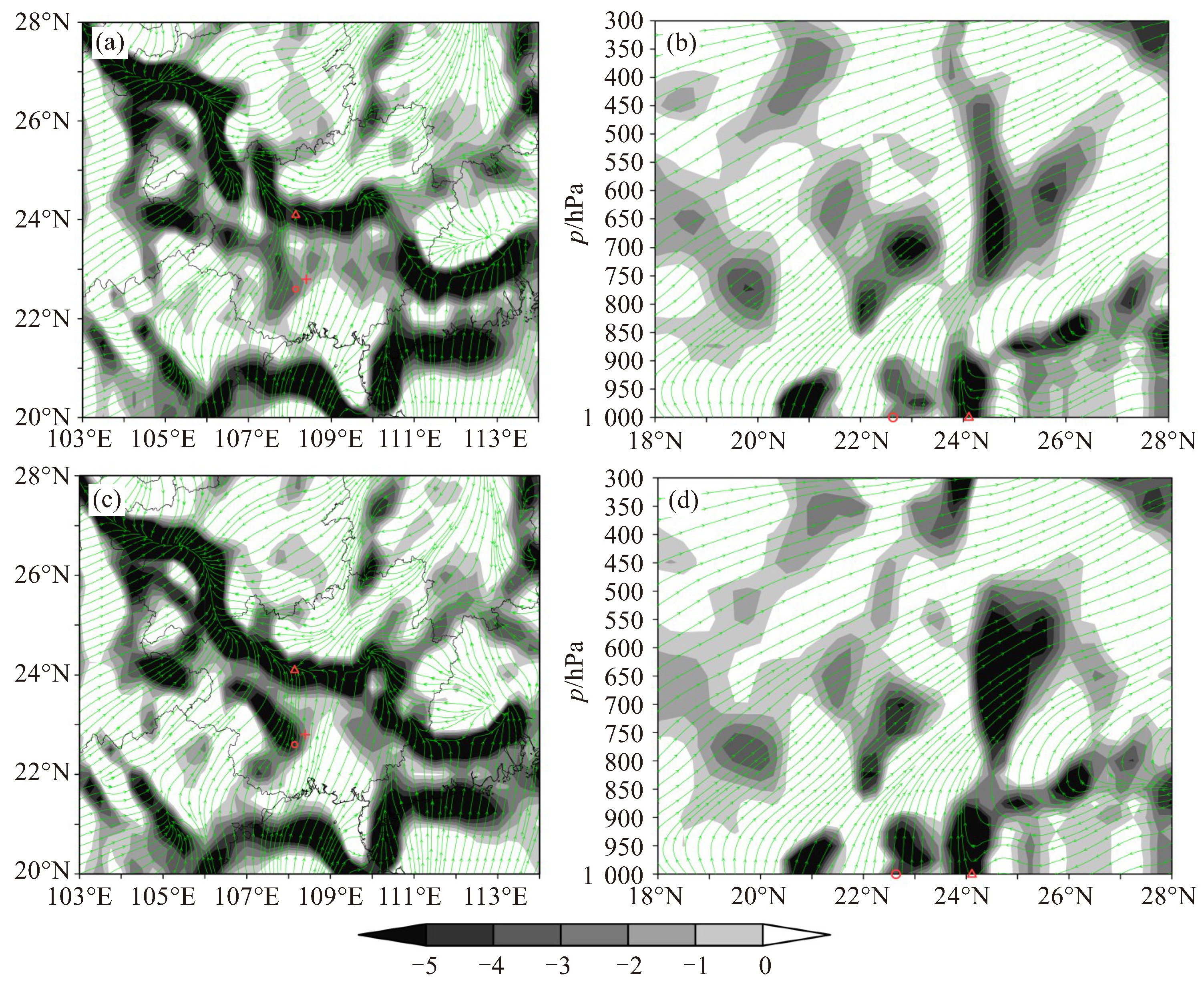
图 5 2023年3月23日15时(a、b)、16时(c、d)基于ERA5资料的1 000 hPa流场和散度场(阴影,单位:10-5 s-1)(a、c)及其沿暖区初始对流所在经度(108.145 °E)的垂直剖面(b、d),
暖区初始对流位置,北侧静止锋,南宁国家气象站。

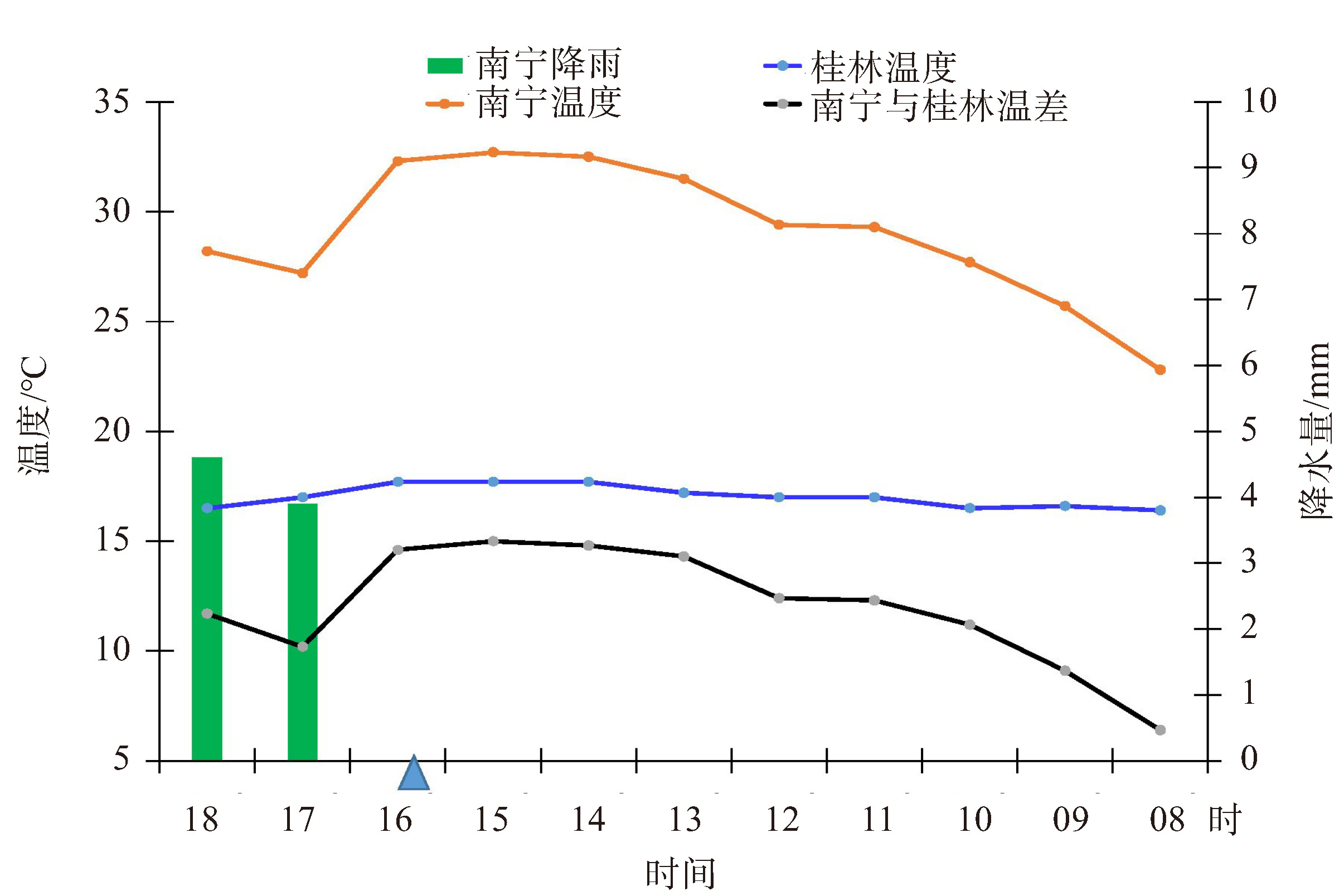
图 7 1 000 hPa 2023年3月23日14时(红色风杆)与08时(蓝色风杆)风矢量差(黑色风杆)(a),14时风场和温度平流场(b,等值线,单位:10-5 K)及其沿暖区初始对流所在经度(108.145 °E)的垂直剖面图(c)
暖区初始对流位置,北侧静止锋,南宁国家气象站,钦州国家气象站,海岛气象站N7611。

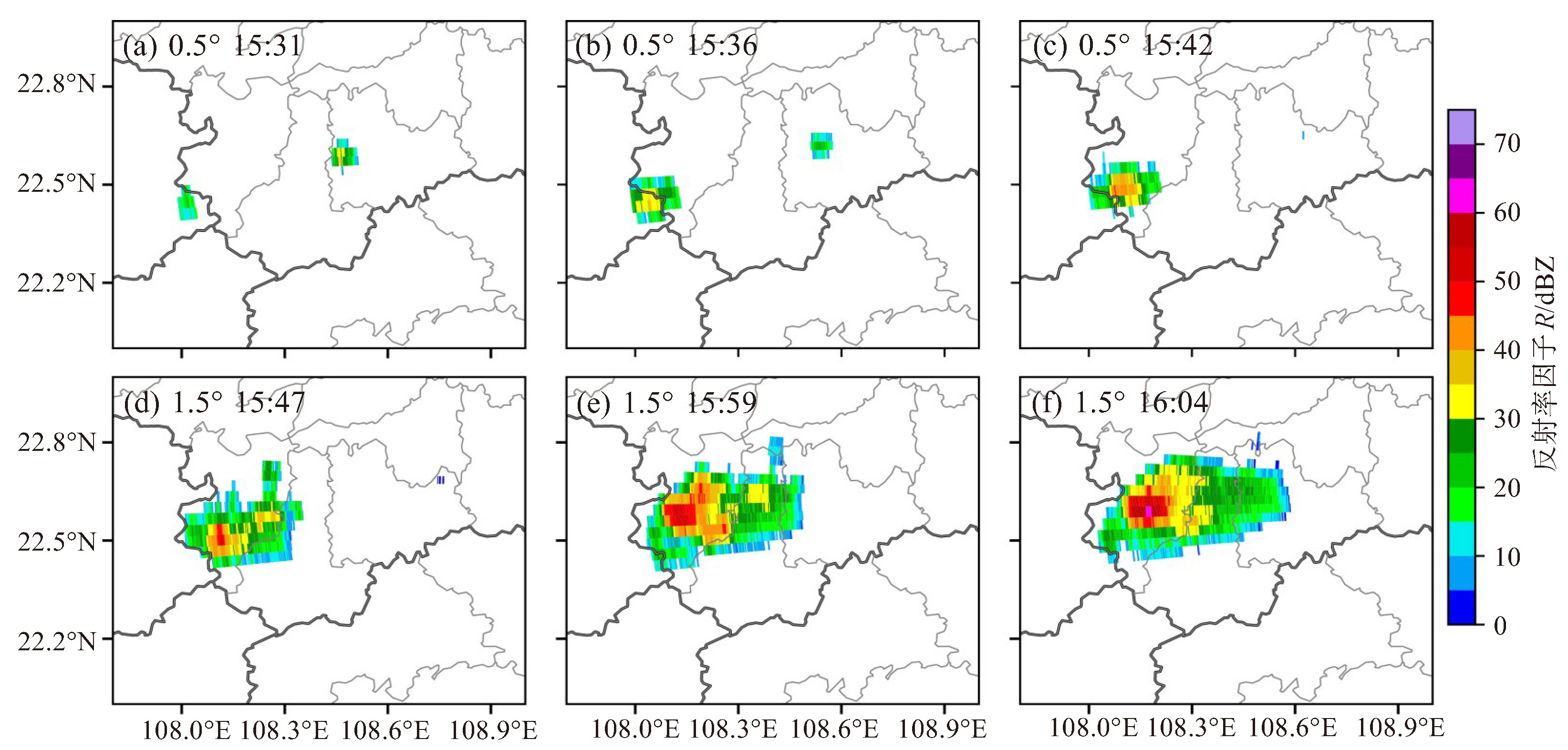
图 9 2023年3月23日类超级单体A的玉林雷达反射率因子演变,0.5 °仰角初生阶段15:31(a)、15:36(b)、15:42(c); 1.5 °仰角发展阶段15:47(d)、15:59(e)、16:04(f)

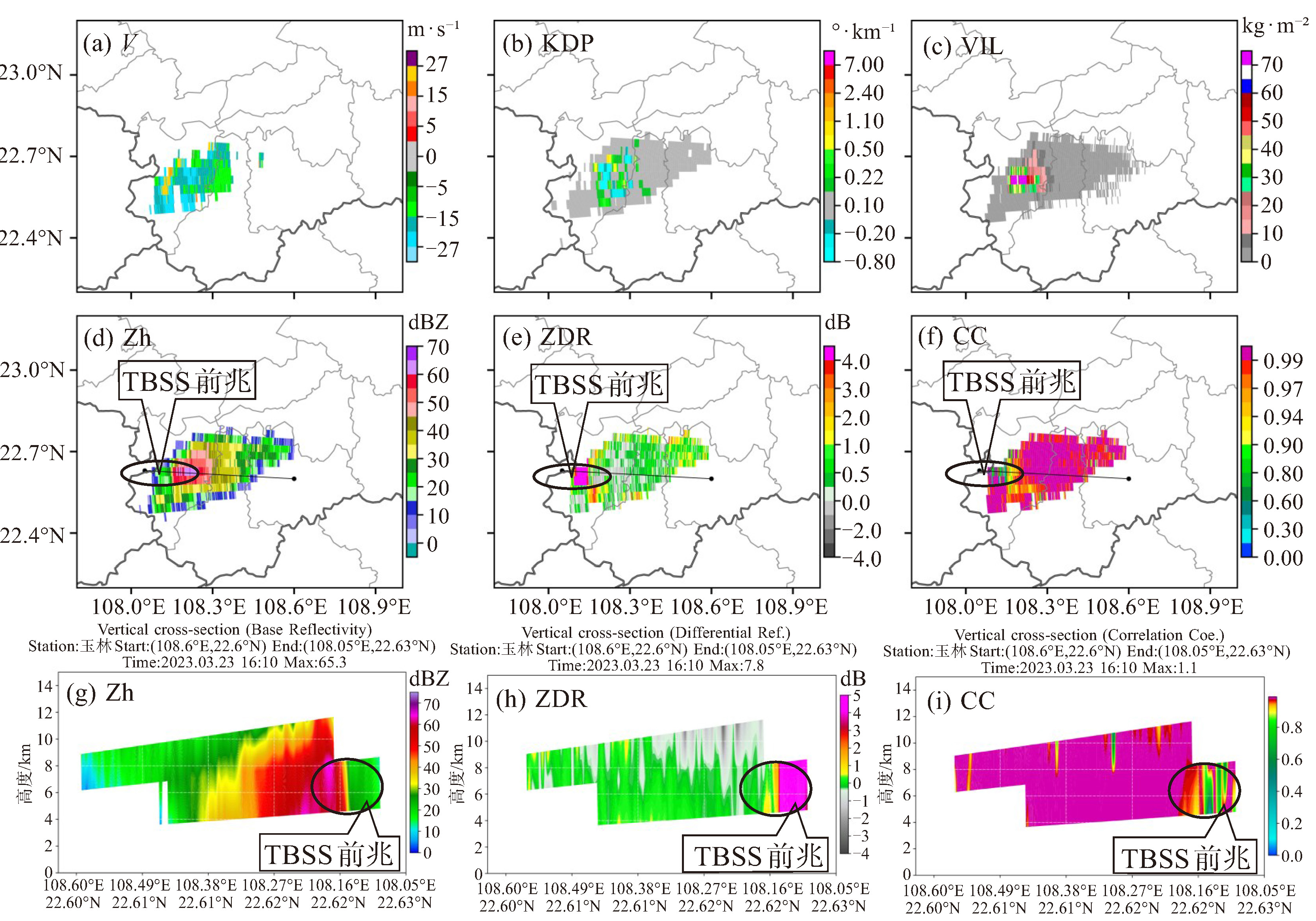
图 10 2023年3月23日16:10成熟阶段类超级单体A玉林雷达0.5 °仰角径向速度V(a)、差分相移率KDP(b)、垂直积分液态含水量VIL(c)、反射率因子Zh(d)及其垂直剖面(g)、差分反射率ZDR(e)及其剖面(h)、相关系数CC(f)及其剖面(i)
椭圆所示为三体散射前兆特征,线段为剖面线。

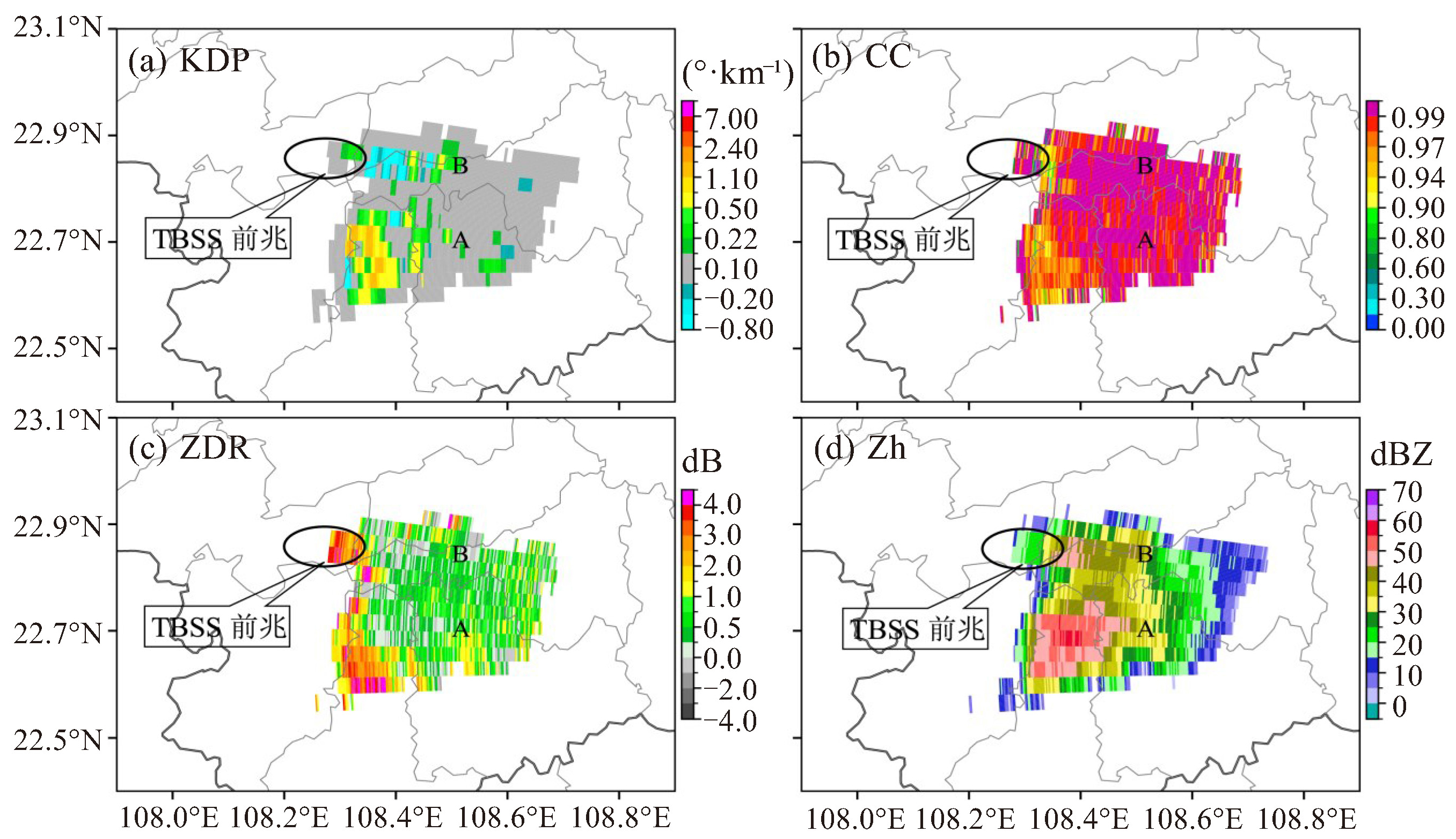
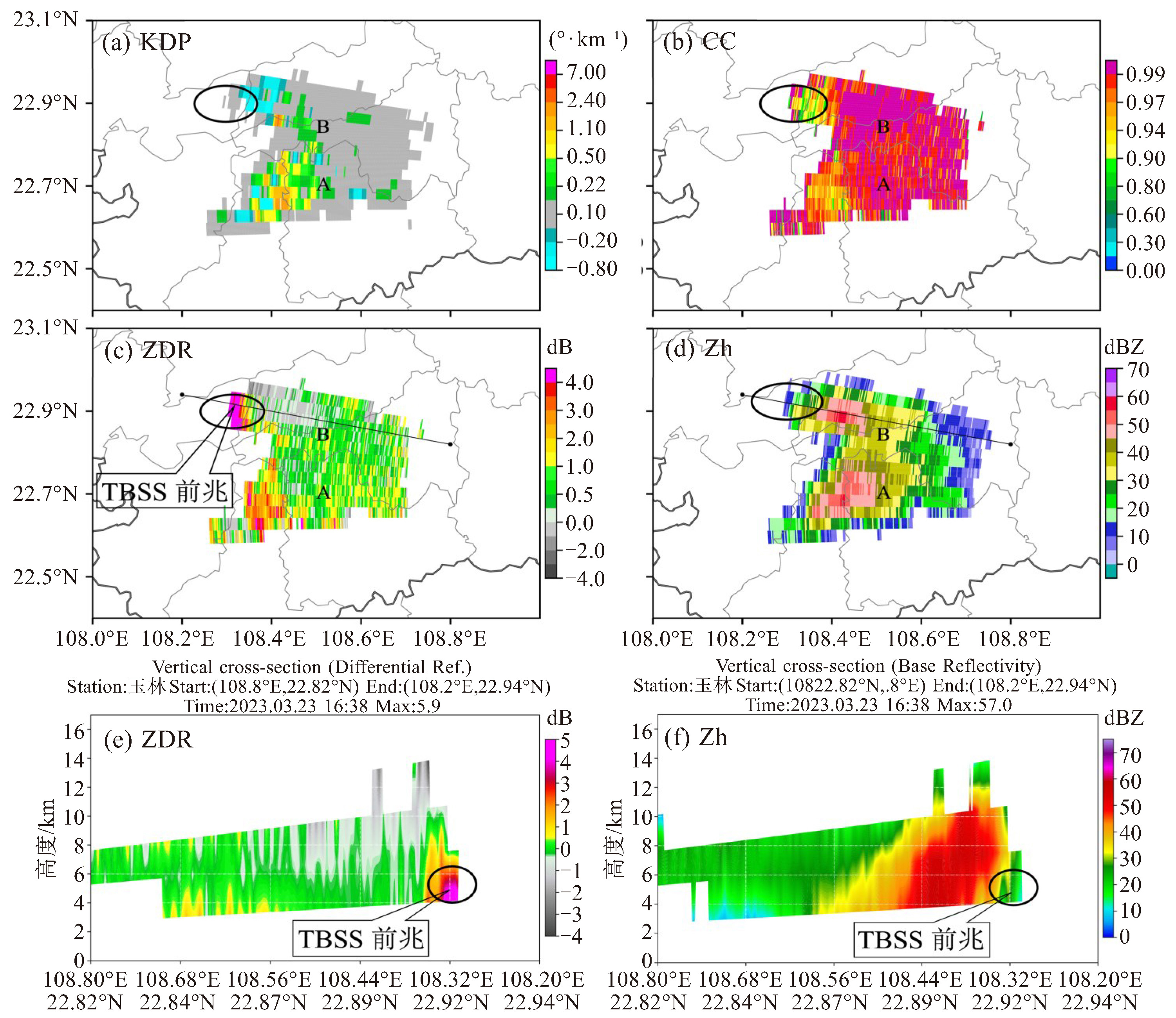
图 13 2023年3月23日16:38发展阶段的对流单体B 0.5 °仰角的偏振参量KDP(a)、CC(b)、ZDR(c)及其剖面(e)、Zh(d)及其剖面(f)
椭圆所示为三体散射前兆特征,线段为剖面线。

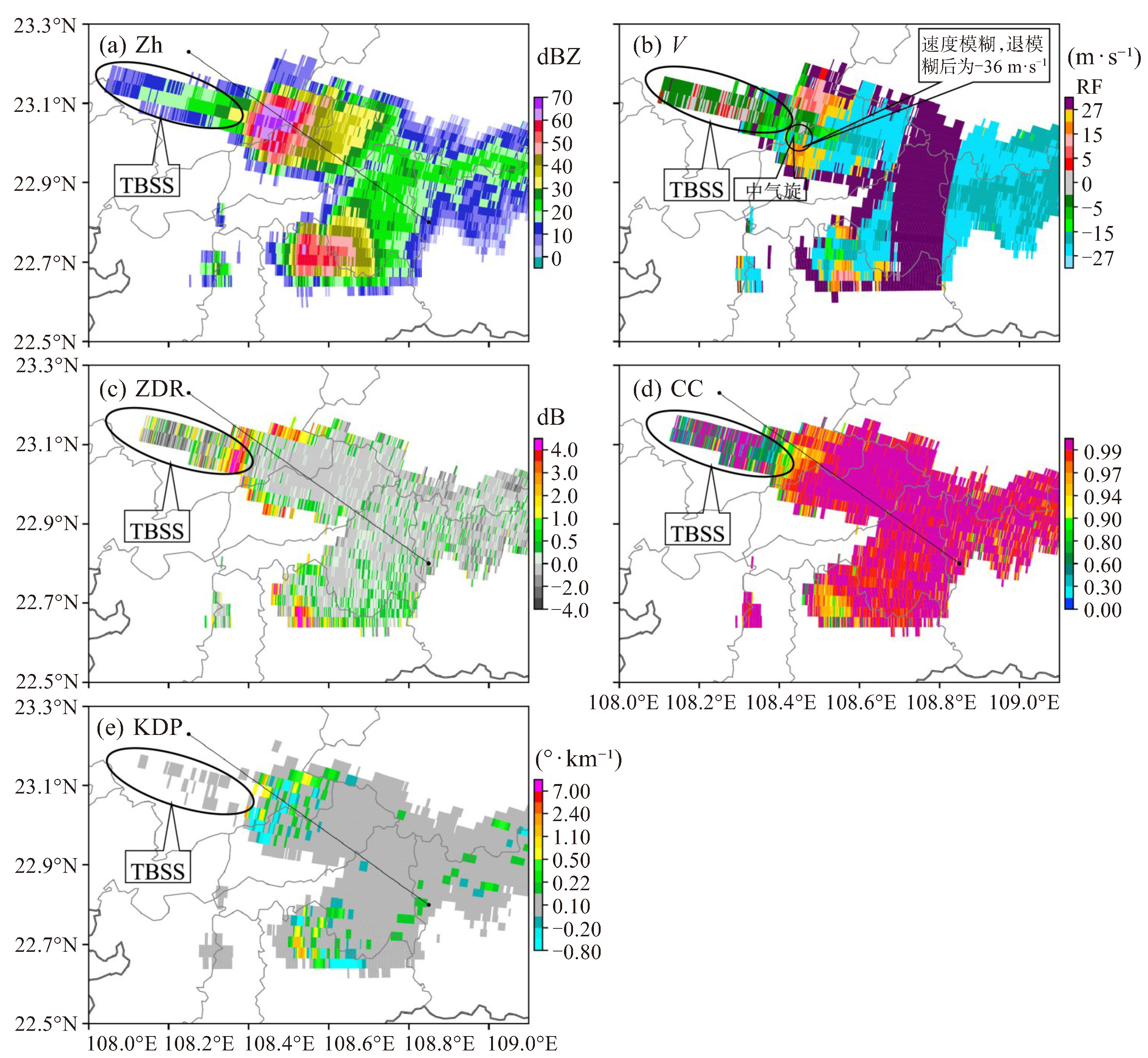
图 14 2023年3月23日16:55超级单体B成熟阶段1.5 °仰角的偏振参量Zh(a)、V(b)、ZDR(c)、CC(d)、KDP(e)
椭圆圈为三体散射,圆圈为中气旋,线段为剖面线。

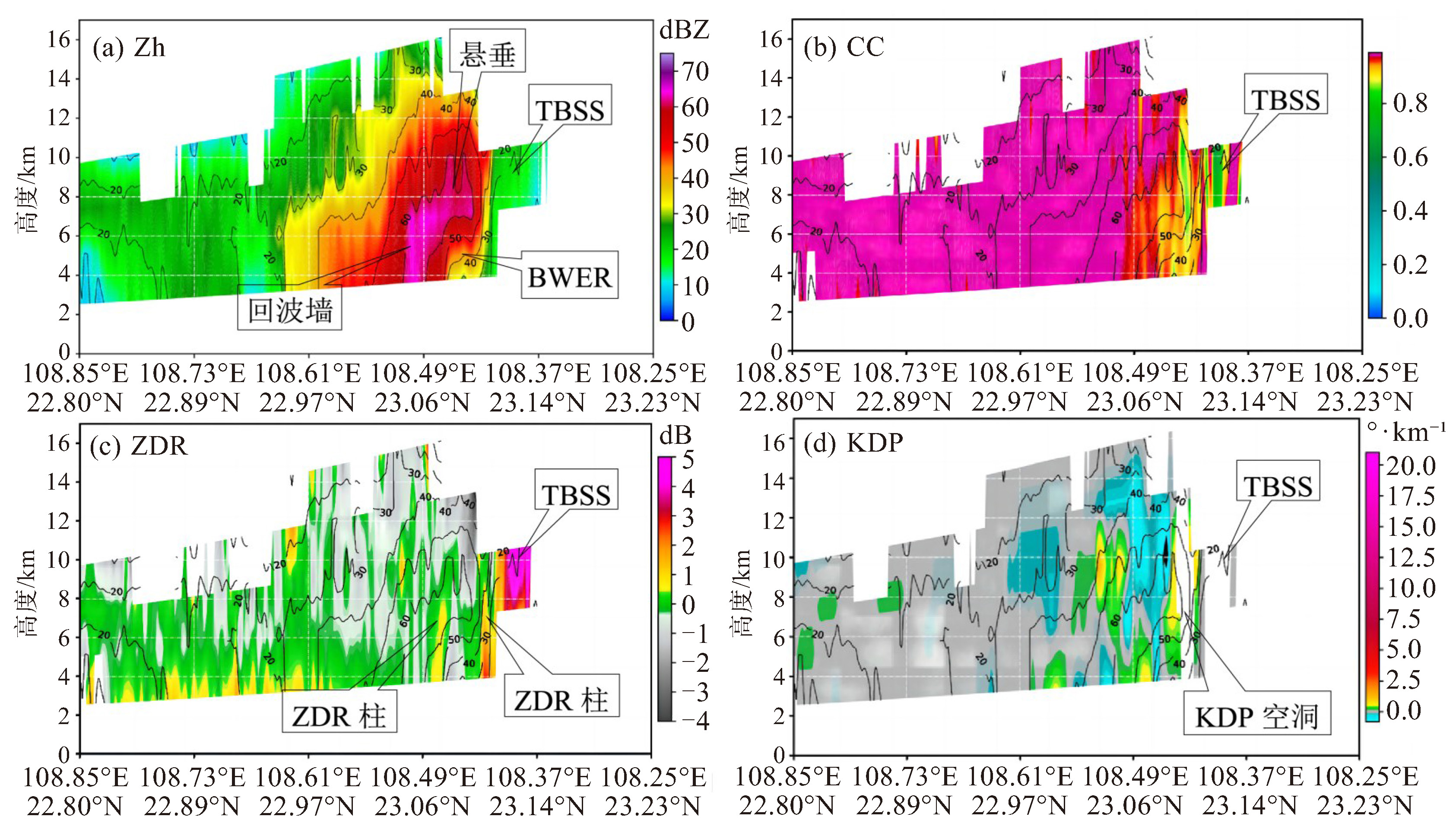
图 15 2023年3月23日16:55超级单体B成熟阶段偏振参量沿图 14所示线段的垂直剖面Zh(a)、CC(b)、ZDR(c)、KDP(d)
等值线为Zh(单位: dBZ,间隔: 10 dBZ)。
-
[1] 许爱华, 张瑛, 刘献耀. 江西"暖区"强对流天气的热力和动力条件诊断分析[J]. 气象, 2001, 27(5): 30-34. [2] 庞古乾, 王刚, 李怀宇, 等. "暖区"强对流和"冷区"强对流天气热力和动力条件分析[C]//第27届中国气象学会年会灾害天气研究与预报分会场论文集, 2010: 635-642. [3] 黄士松. 华南前汛期暴雨[M]. 广州: 广东科技出版社, 1986: 94-95. [4] 陈涛, 陈博宇, 于超, 等. 华南前汛期锋面对流系统和暖区对流系统的多尺度特征和集合预报敏感性对比分析[J]. 气象, 2020, 46(9): 1129-1142. [5] 夏丽花, 冯晋勤, 黄美金, 等. 一次强对流天气过程的成因分析[J]. 气象, 2006, 32(7): 110-114. [6] 俞小鼎, 王秀明, 李万莉, 等. 雷暴与强对流临近预报[M]. 北京: 气象出版社, 2020: 68. [7] 翟国庆, 俞樟孝. 强对流天气发生前期地面风场特征[J]. 大气科学, 1992, 16(5): 522-529. [8] 张有洋, 谢文锋, 陈美玲. 2015年6月广东一次暖区强对流过程分析[J]. 广东气象, 2018, 40(3): 24-28. [9] 吴小芳, 伍志方, 叶爱芬. 广东一次强对流天气过程分析[J]. 广东气象, 2011, 33(1): 5-7. [10] 孙炜文, 王璇, 肖潇. 江西一次冰雹过程的S波段双偏振雷达回波特征分析[J]. 暴雨灾害, 2022, 41(6): 621-630. [11] 唐佳, 张昆, 唐明晖, 等. 低层暖平流强迫下两次大冰雹超级单体风暴结构特征分析[J]. 暴雨灾害, 2023, 42(1): 37-46. [12] 李芳, 刁秀广, 魏鸣. 一次强冰雹超级单体风暴双偏振参量特征分析[J]. 气象, 2024, 50(2): 195-209. [13] 王福侠, 薛学武, 杨吕玉慈, 等. 一次长生命史超级单体风暴双偏振参量结构及演变特征[J]. 气象, 2024, 50(10): 1216-1230. [14] 潘佳文, 魏鸣, 郭丽君, 等. 闽南地区大冰雹超级单体演变的双偏振特征分析[J]. 气象, 2020, 46(12): 1608-1620. [15] 周聪, 张涛, 夏昕, 等. 基于S波段双偏振雷达的成都初春冰雹特征分析[J]. 干旱气象, 2024, 42(1): 95-106. [16] 吴举秀, 潘佳文, 魏鸣, 等. 不同尺寸冰雹S波段双偏振雷达偏振量特征统计[J]. 热带气象学报, 2022, 38(2): 193-202. [17] 杜牧云, 刘黎平, 胡志群, 等. 双线偏振多普勒雷达资料质量分析[J]. 气象学报, 2013, 71(1): 146-158. [18] 张羽, 姚聃, 杨金红, 等. 基于S波段双偏振雷达和X波段相控阵雷达的超级单体观测分析[J]. 气象科技, 2023, 51(3): 419-430. [19] 廖玉芳, 俞小鼎, 吴林林, 等. 强雹暴的雷达三体散射统计与个例分析[J]. 高原气象, 2007, 26(4): 812-820. [20] 孙伟, 曹舒娅, 沈建. 基于多源探测资料的"4.12"非典型冰雹特征分析[J]. 热带气象学报, 2021, 37(2): 218-232. [21] Lemon L R. The radar"three-body scatter spike": an operational large-hail signature[J]. Weather and Forecasting, 1998, 13(2): 327-340. [22] Alberoni P P, Levizzani V, Watson R J, et al. The 18 June 1997 Companion supercells: multiparametric Doppler radar analysis[J]. Meteorology and Atmospheric Physics, 2000, 75(1): 101-120. [23] 张铭, 张立凤, 颜兆辉, 等. 海陆风环流的计算方法[J]. 大气科学, 1999, 23(6): 693-702. [24] 卢伟萍, 李江南, 梁维亮, 等. 一次引发北部湾大暴雨过程的海风锋模拟研究[J]. 热带气象学报, 2012, 28(6): 945-952. [25] 卢伟萍, 梁维亮, 李菁. 北部湾海风锋暴雨气候特征分析[J]. 气象研究与应用, 2010, 31(3): 1-4. [26] 邱晓暖, 范绍佳. 海陆风研究进展与我国沿海三地海陆风主要特征[J]. 气象, 2013, 39(2): 186-193. [27] 俞小鼎, 周小刚, 王秀明. 雷暴与强对流临近天气预报技术进展[J]. 气象学报, 2012, 70(3): 311-337. [28] 王秀明, 俞小鼎, 周小刚. 雷暴潜势预报中几个基本问题的讨论[J]. 气象, 2014, 40(4): 389-399. [29] Johns R H, Doswell C A Ⅲ. Severe local storms forecasting[J]. Weather and Forecasting, 1992, 7(4): 588-612. [30] 沈晓玲, 周弘媛, 黄颖杰, 等. 浙江一次连续下击暴流的多普勒雷达特征与成因分析[J]. 热带气象学报, 2024, 40(3): 362-372. [31] 吴剑坤, 俞小鼎. 强冰雹天气的多普勒天气雷达探测与预警技术综述[J]. 干旱气象, 2009, 27(3): 197-206. [32] 孙继松, 戴建华, 何立富, 等. 强对流天气预报的基本原理与技术方法中国强对流天气预报手册[M]. 北京: 气象出版社, 2014: 95-139. -

 下载:
下载:






 点击查看大图
计量
- 文章访问数: 2
- HTML全文浏览量: 1
- PDF下载量: 0
- 被引次数: 0
 粤公网安备 4401069904700003号