



Numerical Simulation of the Impact of SSTA on Extreme Warm Winter in Guangdong
-
摘要: 基于广东省国家气象观测站数据、ERA5再分析资料和NOAA海温等数据,分析了广东省极端暖冬的气温分布特征和对应的大气环流状况,考察了与广东省极端暖冬相关的关键海区,并通过大气环流模式验证关键海区对广东省冬季温度的相对贡献。结果表明:广东省极端暖冬温度模态表现为全区一致偏暖分布型,温度正异常强度由南岭山脉向沿海一带递增,对应同期东亚冬季风强度明显偏弱。与广东冬季气温显著相关的海区主要分布在北太平洋、热带西太平洋、热带中东太平洋、热带印度洋和北大西洋。各海区海温单独强迫数值模拟结果表明,上述五个关键海区的海温均可造成广东的温度正异常,但各海区对暖冬的贡献大小存在差异。此外,单独去除各海区强迫的数值模拟结果表明,相比其他海区,热带西太平洋和北大西洋海温异常总体上对广东极端暖冬的贡献突出,两个关键海区的各自影响以及协同作用都对广东极端暖冬的产生发挥了重要影响。Abstract: Based on observation data from the Guangdong national meteorological stations, ERA5 reanalysis data, and NOAA sea surface temperature data, this study analyzes the temperature distribution characteristics and the corresponding atmospheric circulation conditions of extreme warm winters in Guangdong. The key regions of sea surface temperature anomalies (SSTA) related to extreme warm winters in Guangdong, and the relative contribution of key regions to winter temperatures in Guangdong via Atmospheric Circulation Climate Model (AGCM) experiments are also discussed. During the extreme warm winter in Guangdong, the surface temperature anomaly shows a uniform warming pattern throughout the whole region, with the intensity of positive temperature anomalies increasing gradually from the Nanling Mountains to the coastal areas, which corresponds to the weak intensity of the East Asian winter monsoon simultaneously. The SSTA correlated with winter temperatures in Guangdong are mainly distributed in the North Pacific, tropical western Pacific, tropical central-eastern Pacific, tropical Indian Ocean, and North Atlantic. By conducting AGCM experiments for each key region, it is found that the SSTAs in all five key regions cause positive temperature anomalies in Guangdong. But the contribution of each region to warm winters is different. Furthermore, sensitivity experiment removing the SSTA forcing of each key region separately demonstrate that, compared to other key regions, the overall contribution of SSTAs in the tropical western Pacific and North Atlantic to the extreme warm winter in Guangdong are prominent, highlighting that the independent and synergistic effects of the two key regions played an important role in the occurrence of the extreme warm winter in Guangdong.
-

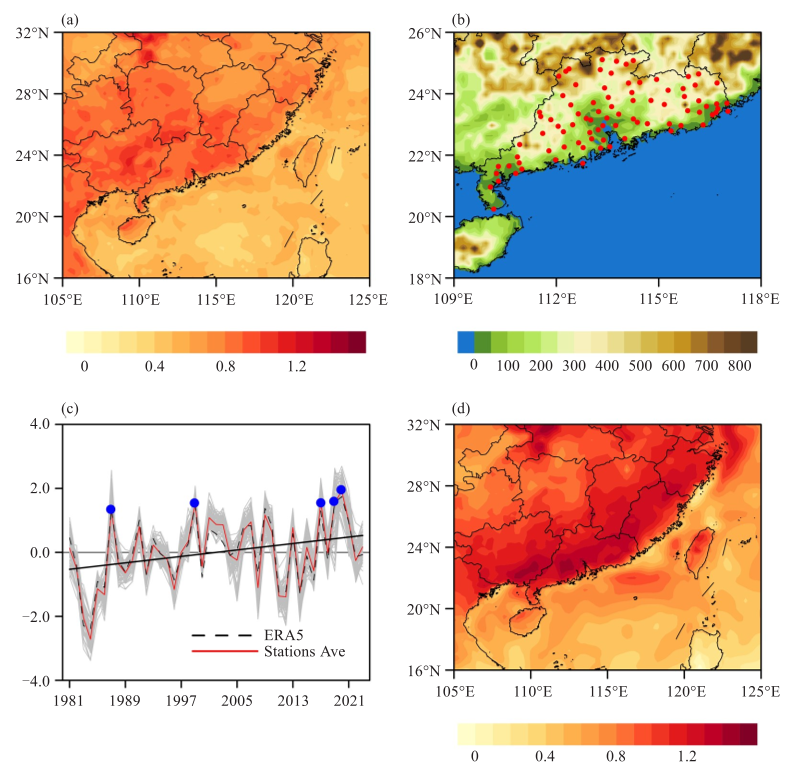
图 1 暖冬年近地表气温距平(单位:℃)合成分布(a);广东省国家气象观测站点(红色点)及海拔高度(填色,单位:m)分布图(b);1980—2023广东测站平均的冬季气温距平(单位:℃)序列(c);极端暖冬年份的近地表气温距平(单位:℃)合成分布(d)
b中黑色实线为线性趋势,红色实线为站点平均值,黑色虚线为ERA5再分析数据插值至站点的站点平均值,蓝色点为冬季温度距平超过90%百分位的极端暖冬年份。

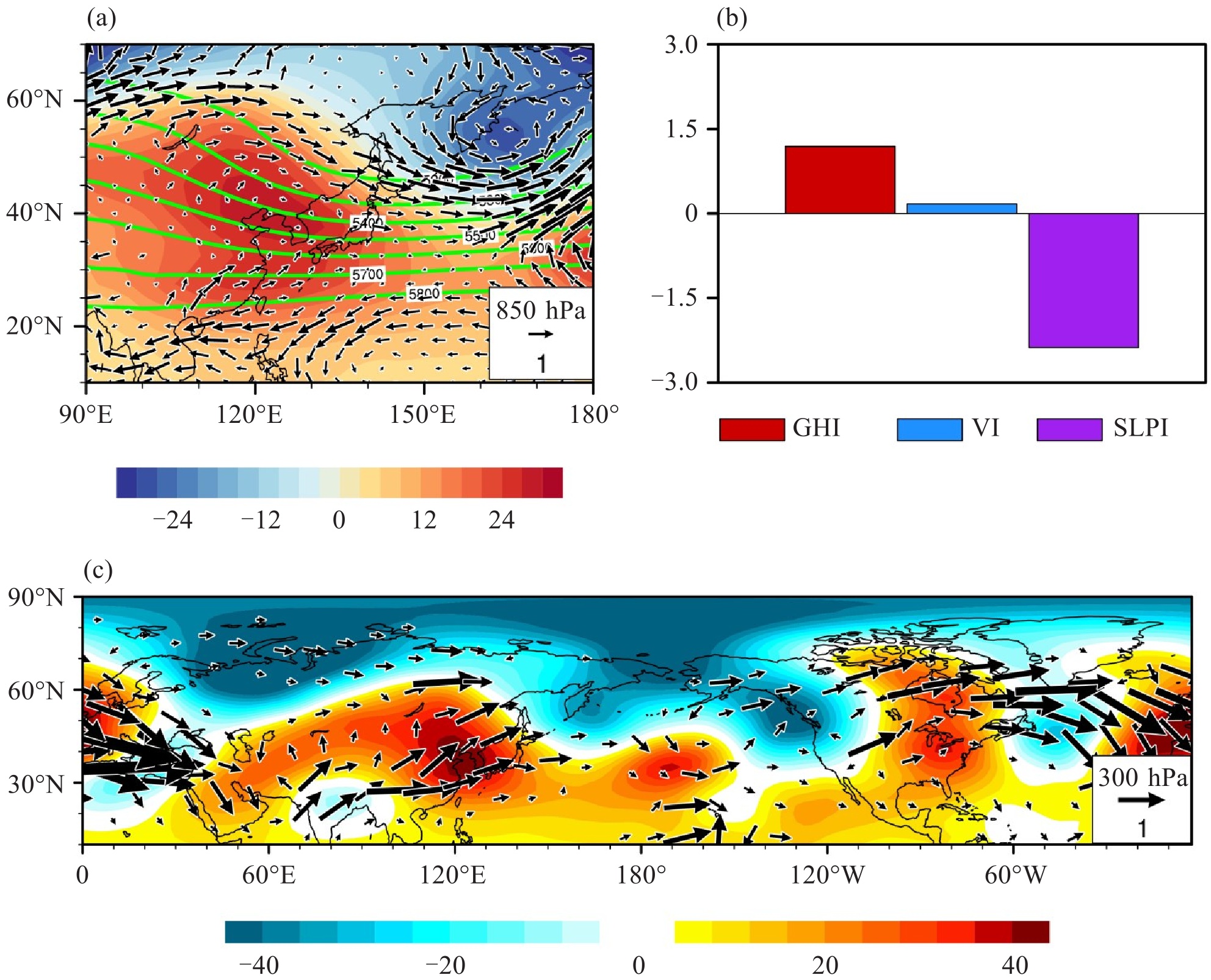
图 2 极端暖冬合成的850 hPa风场(箭头,单位:m·s-1)和500 hPa位势高度(填色,单位:gpm)距平,以及气候平均位势高度(等值线,单位:gpm)(a);合成的冬季风标准化位势高度指数(红色)、经向风指数(蓝色)和海平面气压指数(紫色)(b);合成的冬季300 hPa位势高度距平(填色,单位:gpm)以及300 hPa水平波活动通量(箭头,单位:m2 ·s-2)(c)
a和c中风场与波活动通量均只显示≥0.1的值。

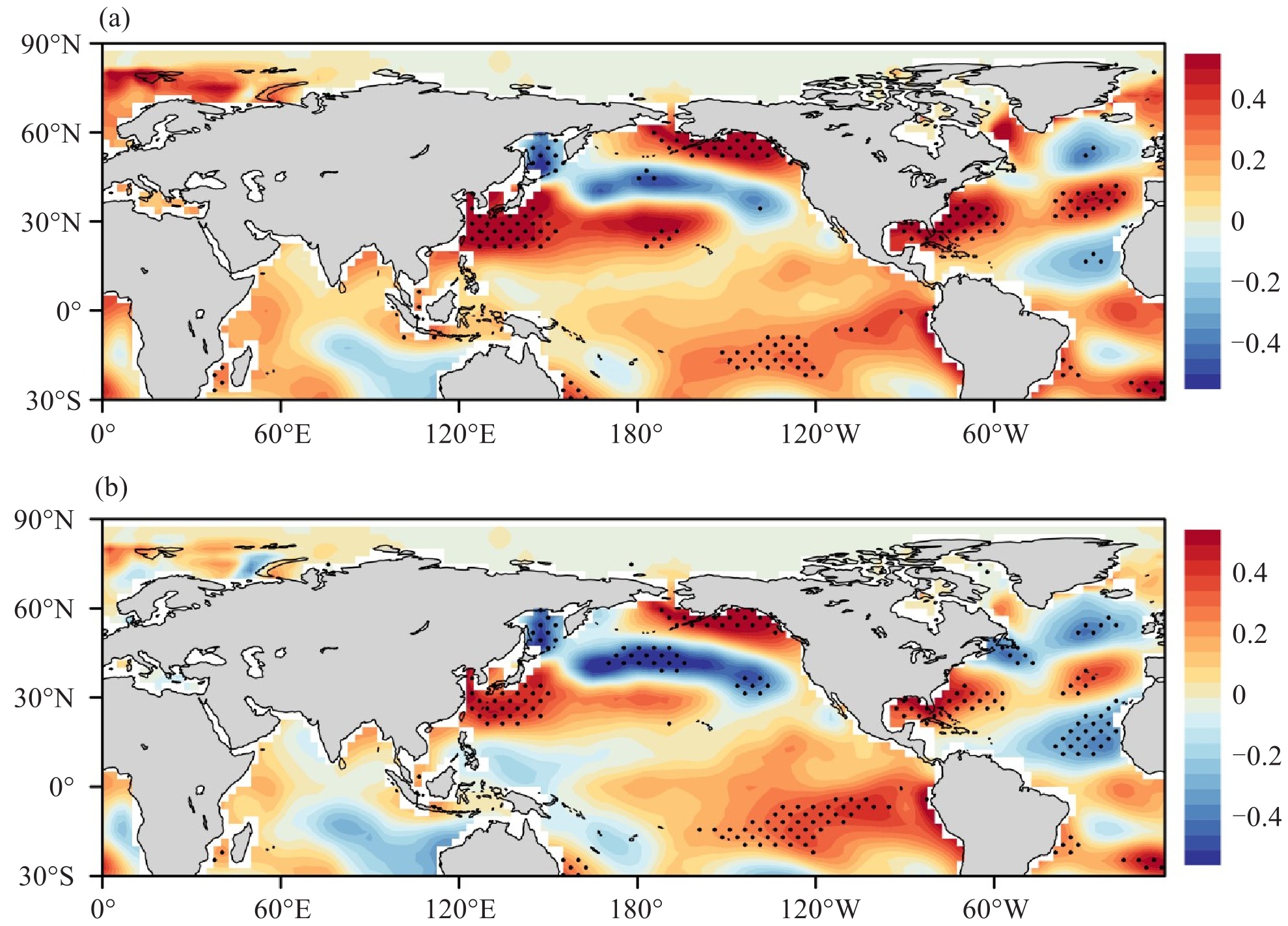
图 3 1980—2023广东省气象站平均冬季气温序列和同期海温相关系数的空间分布(a);极端暖冬年海温距平(单位:℃)合成的空间分布(b)
图中打点区域表示通过0.05显著性水平检验。

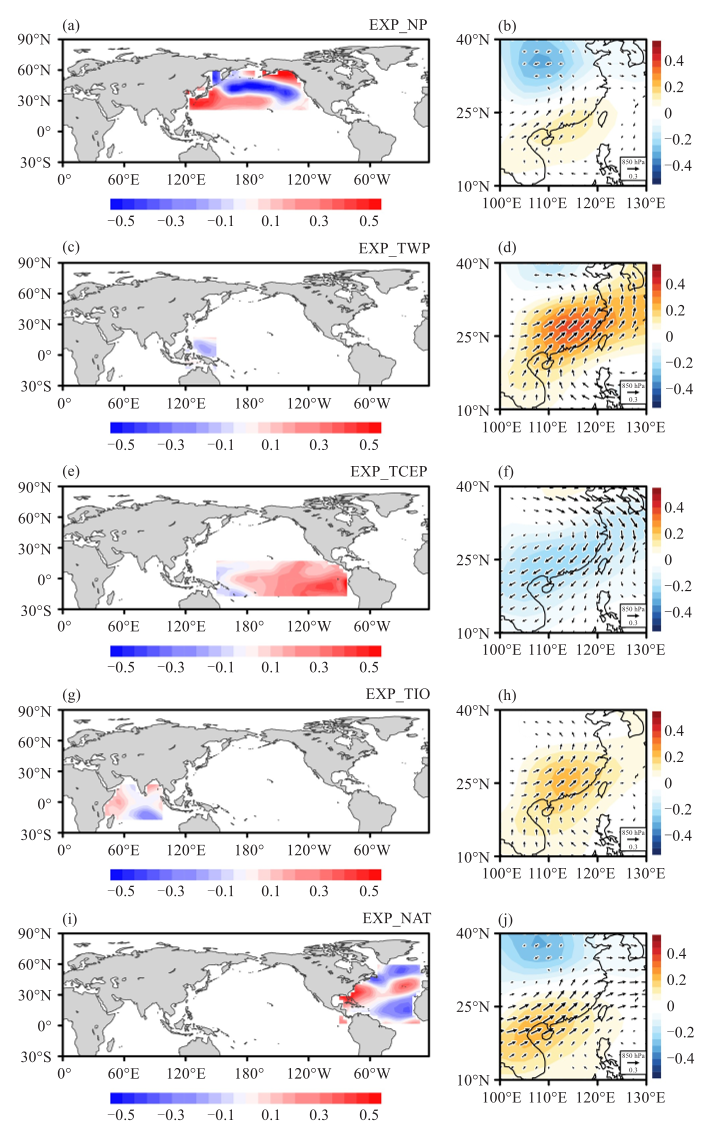
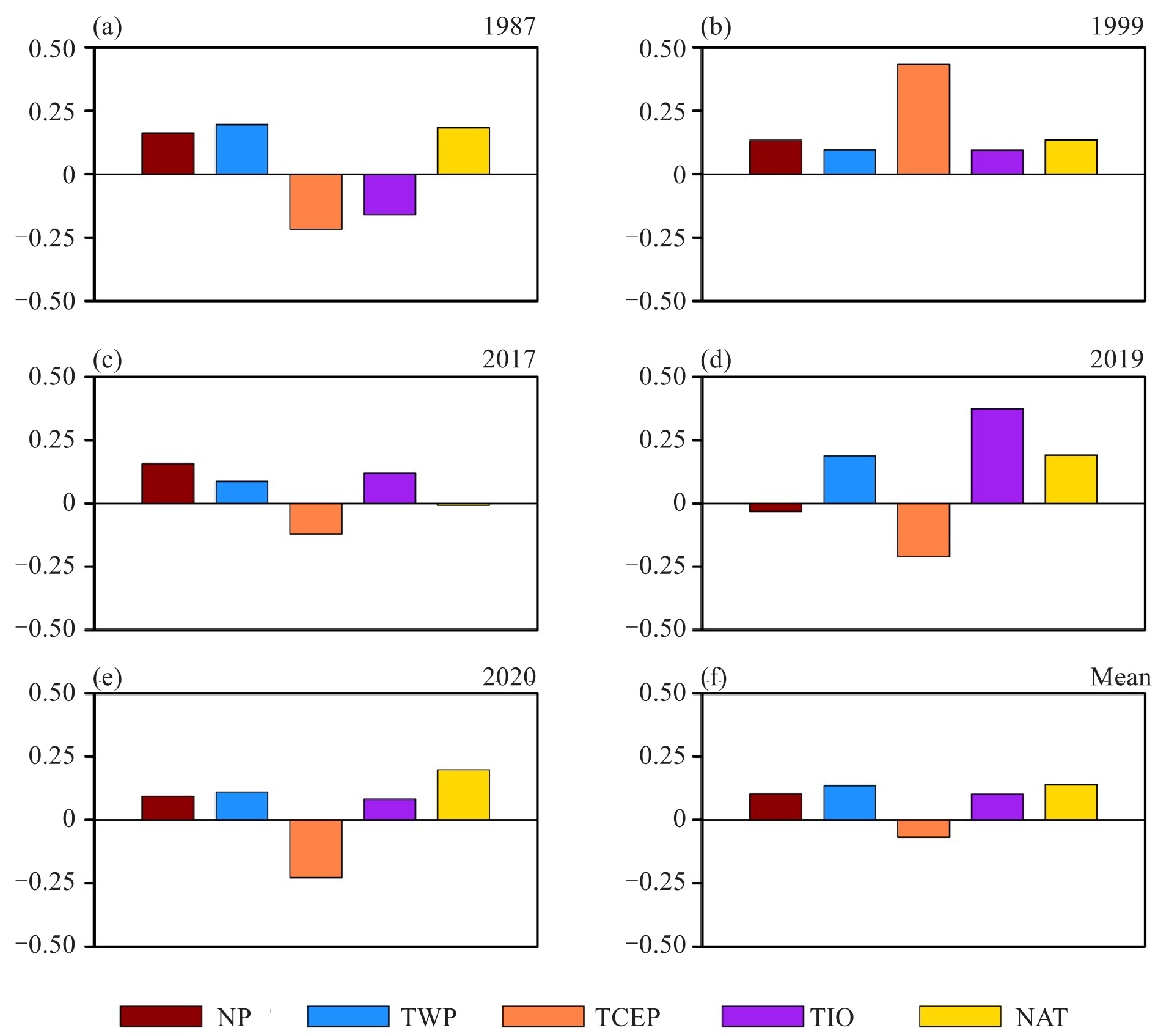
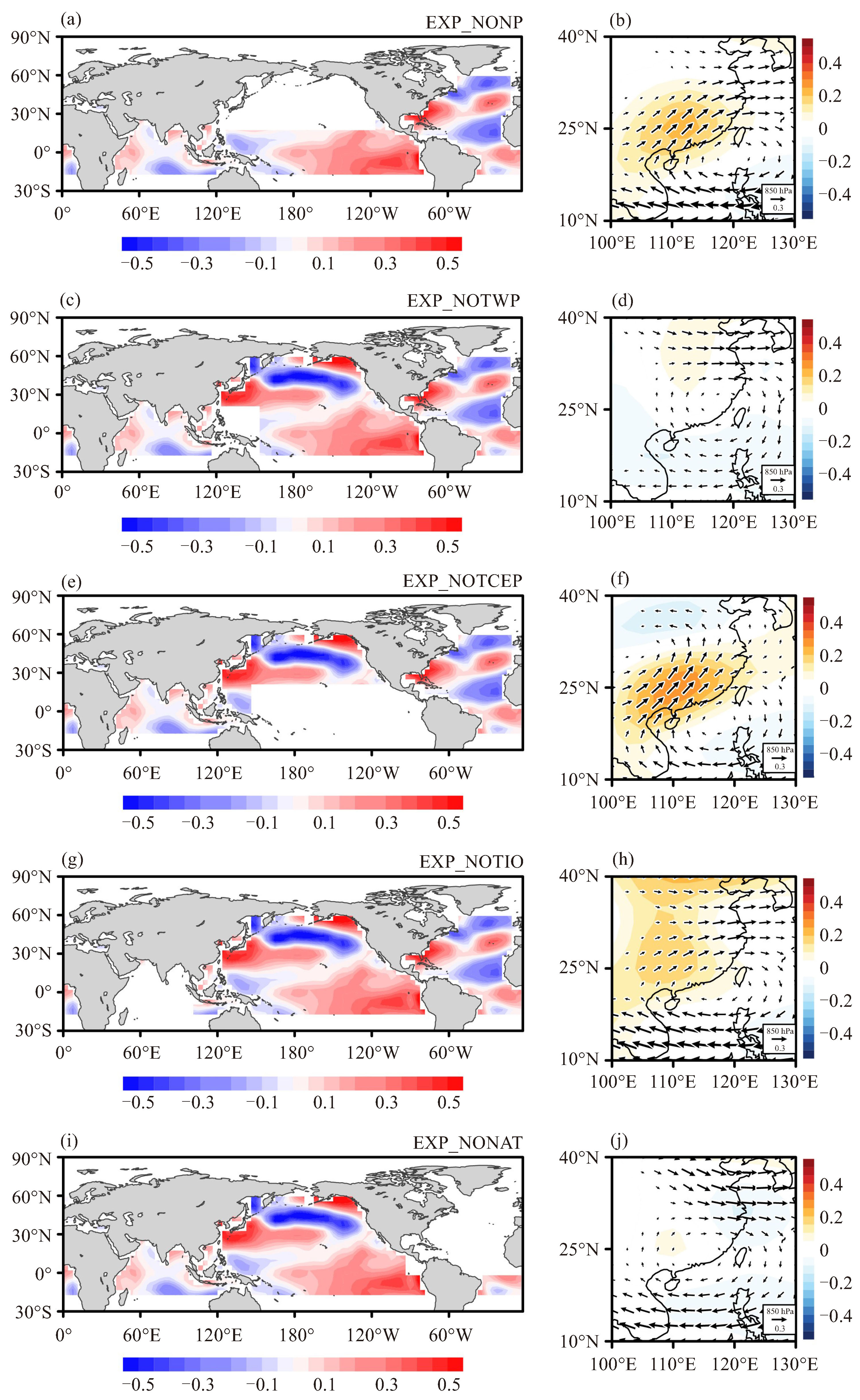
图 4 广东极端暖冬年份合成的各海区海温强迫场及数值模拟结果
a~b.北太平洋试验;c~d.热带西太平洋试验;e~f.热带中东太平洋试验;g~h.热带印度洋试验;i~j.北大西洋试验。左栏图为海温距平(填色,单位:℃)驱动场,右栏图为近地表温度(填色,单位:℃)以及850 hPa水平风场(箭头,单位:m·s-1,其中风场只显示≥0.05的值)。以上结果为敏感性试验和控制试验之间的差值场。
-
[1] 高辉, 陈丽娟, 贾小龙, 等. 2008年1月我国大范围低温雨雪冰冻灾害分析Ⅱ. 成因分析[J]. 气象, 2008, 34(4): 101-106. [2] 丁一汇, 王遵娅, 宋亚芳, 等. 中国南方2008年1月罕见低温雨雪冰冻灾害发生的原因及其与气候变暖的关系[J]. 气象学报, 2008, 66 (5): 808-825. [3] Wen M, Yang S, Kumar A, et al. An analysis of the large-scale climate anomalies associated with the snowstorms affecting China in January 2008[J]. Monthly Weather Review, 2009, 137(3): 1111-1131. [4] Zhou W, Chan J C L, Chen W, et al. Synoptic-scale controls of persistent low temperature and icy weather over Southern China in January 2008[J]. Monthly Weather Review, 2009, 137(11): 3978-3991. [5] 支蓉, 郑志海. 2021/2022年冬季中国气候异常特征及南方降水异常偏多成因分析[J]. 气象, 2022, 48(7): 925-935. [6] Zhang R N, Screen J A, Zhang R H. Arctic and Pacific Ocean conditions were favorable for cold extremes over Eurasia and North America during winter 2020/21[J]. Bulletin of the American Meteorological Society, 2022, 103(10): E2285-E2301. [7] 周晓平. 气象环境对温病发病影响的研究[D]. 南京: 南京中医药大学, 2007. [8] 秦娟, 张金良. 中国极端天气气候事件对传染性疾病的影响[J]. 卫生研究, 2009, 38(6): 762-764. [9] 曹锋. 暖冬骤增对江汉平原越冬作物的不利影响初探[J]. 湖北农业科学, 2018, 57(17): 34-36. [10] 黄冲, 姜玉英, 李佩玲, 等. 2017年我国小麦条锈病流行特点及重发原因分析[J]. 植物保护, 2018, 44(2): 162-166, 183. [11] 陈莉, 方修睦, 方修琦, 等. 过去20年气候变暖对我国冬季采暖气候条件与能源需求的影响[J]. 自然资源学报, 2006, 21(4): 590-597. [12] 雷媛, 吴尧祥. 气温异常偏高, 大雾天气频繁——2007年冬季(12-2月)浙江省天气与气候[J]. 浙江气象, 2007, 28(2): 47-48. [13] 丁雨莲, 陆林. 旅游气候研究进展与启示[J]. 人文地理, 2008, 23(5): 7-11. [14] Scott D, Gössling S, Hall C M. International tourism and climate change[J]. WIREs Climate Change, 2012, 3(3): 213-232. [15] 梅梅, 姜允迪, 王遵娅, 等. 2016年中国气候主要特征及主要天气气候事件[J]. 气象, 2017, 43(4): 468-476. [16] 冯爱青, 曾红玲, 尹宜舟, 等. 2017年中国气候主要特征及主要天气气候事件[J]. 气象, 2018, 44(4): 548-555. [17] 李莹, 曾红玲, 王国复, 等. 2019年中国气候主要特征及主要天气气候事件[J]. 气象, 2020, 46(4): 547-555. [18] 代潭龙, 王秋玲, 王国复, 等. 2020年中国气候主要特征及主要天气气候事件[J]. 气象, 2021, 47(4): 478-487. [19] 陈峪, 王凌, 赵俊虎, 等. 2021年中国气候主要特征及主要天气气候事件[J]. 气象, 2022, 48(4): 470-478. [20] 竺夏英, 孙林海, 钟海玲, 等. 2023年中国气候异常特征及主要天气气候事件[J]. 气象, 2024, 50(2): 246-256. [21] Chan J C L, Li C Y. The east Asia winter monsoon[M]//East Asian monsoon. Singapore: World Scientific Publishing, 2004: 54-106. [22] Wu M C, Chan J C L. Surface features of winter monsoon surges over South China[J]. Monthly Weather Review, 1995, 123(3): 662-680. [23] 伍红雨, 杨崧. 华南冬季气温异常与大气环流和海温的关系[J]. 热带气象学报, 2014, 30(6): 1061-1068. [24] You Q L, Ren G Y, Fraedrich K, et al. Winter temperature extremes in China and their possible causes[J]. International Journal of Climatology, 2013, 33(6): 1444-1455. [25] Gong D Y, Wang S W, Zhu J H. East Asian winter monsoon and Arctic oscillation[J]. Geophysical Research Letters, 2001, 28(10): 2073-2076. [26] Wu B Y, Wang J. Winter Arctic oscillation, Siberian high and East Asian winter monsoon[J]. Geophysical Research Letters, 2002, 29(19): 3-1-3-4. [27] Webster P J, Yang S. Monsoon and enso: selectively interactive systems[J]. Quarterly Journal of the Royal Meteorological Society, 1992, 118 (507): 877-926. [28] 陈文. El Niño和La Niña事件对东亚冬、夏季风循环的影响[J]. 大气科学, 2002, 26(5): 595-610. [29] Huang R H, Chen W, Yang B L, et al. Recent advances in studies of the interaction between the East Asian winter and summer monsoons and ENSO cycle[J]. Advances in Atmospheric Sciences, 2004, 21(3): 407-424. [30] Yu S, Sun J Q. Revisiting the relationship between El Niño-Southern Oscillation and the East Asian winter monsoon[J]. International Journal of Climatology, 2018, 38(13): 4846-4859. [31] 武炳义, 黄荣辉, 高登义. 冬季北极喀拉海、巴伦支海海冰面积变化对东亚冬季风的影响[J]. 大气科学, 1999, 23(3): 267-275. [32] 黄菲, 高聪晖. 东亚冬季气温的年际变化特征及其与海温和海冰异常的关系[J]. 中国海洋大学学报(自然科学版), 2012, 42(9): 7-14. [33] Sun C H, Yang S, Li W J, et al. Interannual variations of the dominant modes of East Asian winter monsoon and possible links to Arctic sea ice[J]. Climate Dynamics, 2016, 47(1): 481-496. [34] Zhang P, Wu Z W, Li J P, et al. Seasonal prediction of the northern and southern temperature modes of the East Asian winter monsoon: the importance of the Arctic sea ice[J]. Climate Dynamics, 2020, 54(7): 3583-3597. [35] Li S L, Bates G T. Influence of the Atlantic multidecadal oscillation on the winter climate of East China[J]. Advances in Atmospheric Sciences, 2007, 24(1): 126-135. [36] Jiang Z H, Yang H, Liu Z Y, et al. Assessing the influence of regional SST modes on the winter temperature in China: The effect of tropical Pacific and Atlantic[J]. Journal of Climate, 2014, 27(2): 868-879. [37] Zuo Z Y, Li M Q, An N, et al. Variations of widespread extreme cold and warm days in winter over China and their possible causes[J]. Science China Earth Sciences, 2022, 65(2): 337-350. [38] 梁巧倩, 简茂球, 罗会邦. 东亚冬季风与海温在年际尺度上的耦合关系分析[J]. 热带海洋学报, 2004, 23(2): 19-27. [39] 刘舸, 纪立人, 孙淑清, 等. 关于东亚冬季风指数的一个讨论——东亚中、低纬冬季风的差异[J]. 大气科学, 2013, 37(3): 755-764. [40] 丁一汇. 季节气候预测的进展和前景[J]. 气象科技进展, 2011, 1(3): 14-27. [41] Matsuno T. Quasi-geostrophic motions in the equatorial area[J]. Journal of the Meteorological Society of Japan Ser Ⅱ, 1966, 44(1): 25-43. [42] Gill A E. Some simple solutions for heat-induced tropical circulation[J]. Quarterly Journal of the Royal Meteorological Society, 1980, 106 (449): 447-462. [43] Wang B, Wu R G, Fu X. Pacific-East Asian teleconnection: How does ENSO affect East Asian climate?[J]. Journal of Climate, 2000, 13(9): 1517-1536. [44] Jian Y T, Lin X X, Zhou W, et al. Analysis of record-high temperature over southeast coastal China in winter 2018/19: the combined effect of mid-to high-latitude circulation systems and SST forcing over the north Atlantic and tropical western Pacific[J]. Journal of Climate, 2020, 33(20): 8813-8831. [45] Pan X, Wang W, Li T, et al. Cause of an extreme warm and rainy winter in Shanghai in 2019[J]. International Journal of Climatology, 2021, 41(9): 4684-4697. [46] Zhang P, Wu Z W, Li J P. Reexamining the relationship of La Niña and the East Asian winter monsoon[J]. Climate Dynamics, 2019, 53(1): 779-791. [47] Zhang P, Wang B, Wu Z W. Weak El Niño and winter climate in the mid-to high latitudes of Eurasia[J]. Journal of Climate, 2019, 32(2): 405-421. [48] Hersbach H, Bell B, Berrisford P, et al. The ERA5 global reanalysis[J]. Quarterly Journal of the Royal Meteorological Society, 2020, 146 (730): 1999-2049. [49] Huang B Y, Thorne P W, Banzon V F, et al. Extended reconstructed sea surface temperature, version 5 (ERSSTv5): upgrades, validations, and intercomparisons[J]. Journal of Climate, 2017, 30(20): 8179-8205. [50] Molteni F. Atmospheric simulations using a GCM with simplified physical parametrizations. Ⅰ: model climatology and variability in multi-decadal experiments[J]. Climate Dynamics, 2003, 20(2): 175-191. [51] Kucharski F, Molteni F, Bracco A. Decadal interactions between the western tropical Pacific and the North Atlantic Oscillation[J]. Climate Dynamics, 2006, 26(1): 79-91. [52] Kucharski F, Molteni F, King M P, et al. On the need of intermediate complexity general circulation models: a "SPEEDY" example[J]. Bulletin of the American Meteorological Society, 2013, 94(1): 25-30. [53] Plumb R A. On the three-dimensional propagation of stationary waves[J]. Journal of the Atmospheric Sciences, 1985, 42(3): 217-229. [54] Wang Y F, Yasunari T. A diagnostic analysis of the wave train propagating from high-latitudes to low-latitudes in early summer[J]. Journal of the Meteorological Society of Japan Ser Ⅱ, 1994, 72(2): 269-279. [55] 施春华, 蔡雯昳, 金鑫. 强厄尔尼诺事件下2016年1月中国南方超级寒潮的动力学机制: 瞬变波对大气长波异常的调制[J]. 大气科学学报, 2016, 39(6): 827-834. [56] Ding Y H. Build-up, air mass transformation and propagation of Siberian high and its relations to cold surge in East Asia[J]. Meteorology and Atmospheric Physics, 1990, 44(1): 281-292. [57] Ding Y H, Krishnamurti T N. Heat budget of the Siberian high and the winter monsoon[J]. Monthly Weather Review, 1987, 115(10): 2428-2449. [58] Wang H J, He S P. Weakening relationship between East Asian winter monsoon and ENSO after mid-1970s[J]. Chinese Science Bulletin, 2012, 57(27): 3535-3540. [59] Yang S, Lau K M, Kim K M. Variations of the East Asian jet stream and Asian-Pacific-American winter climate anomalies[J]. Journal of Climate, 2002, 15(3): 306-325. [60] Sun J Q, Wu S, Ao J. Role of the North Pacific sea surface temperature in the East Asian winter monsoon decadal variability[J]. Climate Dynamics, 2016, 46(11): 3793-3805. [61] Zhu Z W, Feng Y N, Jiang W, et al. The compound impacts of sea surface temperature modes in the Indian and North Atlantic Oceans on the extreme precipitation days in the Yangtze River Basin[J]. Climate Dynamics, 2023, 61(7): 3327-3341. [62] 伍红雨, 潘蔚娟, 王婷. 华南冬季气温异常与ENSO的关系[J]. 气象, 2014, 40(10): 1230-1239. -

 下载:
下载:
 点击查看大图
计量
- 文章访问数: 8
- HTML全文浏览量: 4
- PDF下载量: 1
- 被引次数: 0
 粤公网安备 4401069904700003号